Design World

  • Home
  • Technologies
    • ELECTRONICS • ELECTRICAL
    • Fastening • joining
    • FLUID POWER
    • LINEAR MOTION
    • MOTION CONTROL
    • SENSORS
    • TEST & MEASUREMENT
    • Factory automation
    • Warehouse automation
    • DIGITAL TRANSFORMATION
  • Learn
    • Tech Toolboxes
    • Learning center
    • eBooks • Tech Tips
    • Podcasts
    • Videos
    • Webinars • general engineering
    • Webinars • Automated warehousing
    • Voices
  • LEAP Awards
  • 2025 Leadership
    • 2024 Winners
    • 2023 Winners
    • 2022 Winners
    • 2021 Winners
  • Design Guides
  • Resources
    • 3D Cad Models
      • PARTsolutions
      • TraceParts
    • Digital Issues
      • Design World
      • EE World
    • Educational Assets
    • Engineering diversity
    • Reports
    • Trends
  • Supplier Listings
  • Advertise
  • SUBSCRIBE
    • MAGAZINE
    • NEWSLETTER

Brittle Starfish Shows How to Make Tough Ceramics

By European Synchrotron Radiation Facility | December 7, 2017

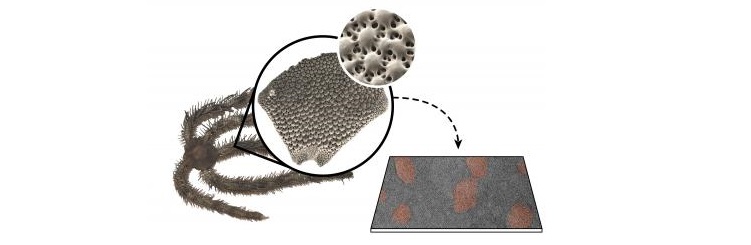
Schematic illustration showing the various scales, from the brittle star organism, the arm plate, the lenses and the TEM image showing the coherently aligned nano precipitates within the lattice. Image credit: Iryna Polishchuk

Nature inspires innovation. An international team lead by researchers at Technion-Israel Institute of Technology, together with ESRF — the European Synchrotron in Grenoble, France — has discovered how a brittle star can create material like tempered glass underwater. The findings are published in Science and may open new bio-inspired routes for toughening brittle ceramics in various applications that span from optical lenses to automotive turbochargers and even biomaterial implants.

A beautiful, brainless brittle star that lives in coral reefs has the clue to super tough glass. Hundreds of focal lenses are located on the arms of this creature, which is an echinoderm called Ophiocoma wendtii. These lenses, made of chalk, are powerful and accurate, and the deciphering of their crystalline and nanoscale structure has occupied Boaz Pokroy and his team, from the Technion-Israel Institute of Technology, for the past three years. Thanks to research done on three ESRF beamlines, ID22, ID13 and ID16B, among other laboratories, they have figured out the unique protective mechanism of highly resistant lenses.

As an example, take tempered glass, which is produced by exerting compressive pressure on the glass. Glass tempering is performed by rapidly heating and then rapidly cooling the material. In this process, the outside of the material cools more quickly than the inside and thereby compresses the inside. Ophiocoma wendtii lenses are created in the open sea, at room temperature, unlike tempered glass.

“We have discovered a strategy for making brittle material much more durable under natural conditions. It is ‘crystal engineering’ and tempering without heating and quenching – a process that could be very useful in materials engineering,” said Pokroy.

The formation of calcite lenses was discovered thanks to a long series of experiments at the ESRF and the Titan transmission electron microscope at the Technion. “When we first came to the ESRF we didn´t expect our research to reach these results,” said Pokroy. The team came first to ID22, where they used powder X-ray diffraction to look into the material in a powder form while heating it. “We understood that we had nanodomains after this experiment, so we did some transmission electron microscopy at home, then came to ID13 to map the nanodomains and finally to ID16 to do tomography on how the different particles arrange themselves in different layers,” he added.

The team, which includes scientists from the University of Wisconsin (US), the Natural History Museum of Los Angeles County (US), the University of Trento (Italy) and the Charité Hospital in Berlin (Germany), discovered that the crucial stage in the process of lens formation is the transition from the amorphous phase – the phase between liquid and solid – to the crystalline phase. At this stage, calcite nanoparticles, which are rich in magnesium and characterized by a relatively low density, separate from the rest of the material. The difference in concentration of magnesium in the calcite particles causes various degrees of hardness, density, and pressure in different regions of the material. Magnesium-rich particles press on the inner part of the lens as it crystallizes and “temper” it into a clear and tough crystalline material.

“Nature exhibits tremendous creativity in improving the organism’s abilities in various contexts such as strength, sensing, and self-defense. Here, too, in the process of creating hardy and precise transparent lenses, we see tremendous efficiency in the use of existing raw materials under conditions in the natural environment.”

Engineers now can use this newly discovered biostrategy in toughening and strengthening synthetic ceramic materials in various applications that span from optical lenses to automotive turbochargers and even biomaterial implants.

You might also like


Filed Under: Materials • advanced


LEARNING CENTER

Design World Learning Center
“dw
EXPAND YOUR KNOWLEDGE AND STAY CONNECTED
Get the latest info on technologies, tools and strategies for Design Engineering Professionals.
Motor University

Design World Digital Edition

cover

Browse the most current issue of Design World and back issues in an easy to use high quality format. Clip, share and download with the leading design engineering magazine today.

EDABoard the Forum for Electronics

Top global problem solving EE forum covering Microcontrollers, DSP, Networking, Analog and Digital Design, RF, Power Electronics, PCB Routing and much more

EDABoard: Forum for electronics

Sponsored Content

  • Digitalization made easy: Bridging IT/OT with scalable network infrastructure
  • Apple Rubber custom o-rings for harsh underwater conditions
  • ASMPT chooses Renishaw for high-quality motion control
  • Innovating Together: How Italian Machine Builders Drive Industry Forward Through Collaboration
  • Efficiency Is the New Luxury — and Italy Is Delivering
  • Beyond the Build: How Italy’s Machine Makers Are Powering Smart Manufacturing
View More >>
Engineering Exchange

The Engineering Exchange is a global educational networking community for engineers.

Connect, share, and learn today »

Design World
  • About us
  • Contact
  • Manage your Design World Subscription
  • Subscribe
  • Design World Digital Network
  • Control Engineering
  • Consulting-Specifying Engineer
  • Plant Engineering
  • Engineering White Papers
  • Leap Awards

Copyright © 2025 WTWH Media LLC. All Rights Reserved. The material on this site may not be reproduced, distributed, transmitted, cached or otherwise used, except with the prior written permission of WTWH Media
Privacy Policy | Advertising | About Us

Search Design World

  • Home
  • Technologies
    • ELECTRONICS • ELECTRICAL
    • Fastening • joining
    • FLUID POWER
    • LINEAR MOTION
    • MOTION CONTROL
    • SENSORS
    • TEST & MEASUREMENT
    • Factory automation
    • Warehouse automation
    • DIGITAL TRANSFORMATION
  • Learn
    • Tech Toolboxes
    • Learning center
    • eBooks • Tech Tips
    • Podcasts
    • Videos
    • Webinars • general engineering
    • Webinars • Automated warehousing
    • Voices
  • LEAP Awards
  • 2025 Leadership
    • 2024 Winners
    • 2023 Winners
    • 2022 Winners
    • 2021 Winners
  • Design Guides
  • Resources
    • 3D Cad Models
      • PARTsolutions
      • TraceParts
    • Digital Issues
      • Design World
      • EE World
    • Educational Assets
    • Engineering diversity
    • Reports
    • Trends
  • Supplier Listings
  • Advertise
  • SUBSCRIBE
    • MAGAZINE
    • NEWSLETTER
We use cookies to personalize content and ads, to provide social media features, and to analyze our traffic. We share information about your use of our site with our social media, advertising, and analytics partners who may combine it with other information you’ve provided to them or that they’ve collected from your use of their services. You consent to our cookies if you continue to use this website.