Design World

  • Home
  • Technologies
    • ELECTRONICS • ELECTRICAL
    • Fastening • joining
    • FLUID POWER
    • LINEAR MOTION
    • MOTION CONTROL
    • SENSORS
    • TEST & MEASUREMENT
    • Factory automation
    • Warehouse automation
    • DIGITAL TRANSFORMATION
  • Learn
    • Tech Toolboxes
    • Learning center
    • eBooks • Tech Tips
    • Podcasts
    • Videos
    • Webinars • general engineering
    • Webinars • Automated warehousing
    • Voices
  • LEAP Awards
  • 2025 Leadership
    • 2024 Winners
    • 2023 Winners
    • 2022 Winners
    • 2021 Winners
  • Design Guides
  • Resources
    • 3D Cad Models
      • PARTsolutions
      • TraceParts
    • Digital Issues
      • Design World
      • EE World
    • Educational Assets
    • Engineering diversity
    • Reports
    • Trends
  • Supplier Listings
  • Advertise
  • SUBSCRIBE
    • MAGAZINE
    • NEWSLETTER

Chip-Based Sensors with Incredible Sensitivity

By Penn State | November 3, 2017

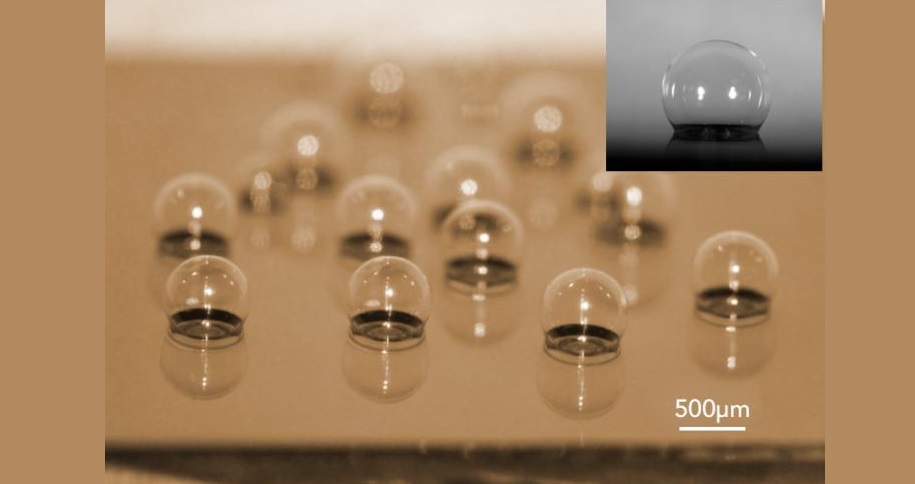
This is a chip-scale glass microspherical shell sensor array blown on a silicon substrate. Insert is a near-perfect spherical shell. Image credit: Tadigadapa Lab/Penn State

In London’s St. Paul’s Cathedral, a whisper can be heard far across the circular whispering gallery as the sound curves around the walls. Now, an optical whispering gallery mode resonator developed by Penn State electrical engineers can spin light around the circumference of a tiny sphere millions of times, creating an ultrasensitive microchip-based sensor for multiple applications.

“Whispering gallery mode resonators, which are basically optical resonators, have been intensely studied for at least 20 years,” said Srinivas Tadigadapa, professor of electrical engineering. “What people have done is to take an optical fiber and touch the end with a blow torch. When the melted fiber re-condenses, it forms a sphere at the tip. This can be coupled to a light source to make a sensor.”

That type of sensor consists of solid spheres and is not compatible with microfabrication methods, but recently Tadigadapa and his team developed an innovative way to grow on-chip glass microspherical shells with incredible sensitivities that potentially can be used for motion, temperature, pressure or biochemical sensing.

The hollow borosilicate glass spheres are blown from sealed and pressurized cylindrical cavities etched into a silicon substrate. Using a glassblowing technique, the thin glass wafer, under high heat and external vacuum pressure, forms an almost perfect bubble. The researchers grew arrays of spheres from 230 microns to 1.2 millimeters in diameter with wall thicknesses between 300 nanometers and 10 micrometers.

“The bottom of the sphere is thinned until it is basically a hole,” Tadigadapa said. “You can put the light on the outside of the sphere but do all the chemistry on the inner face of the shell. You can bring in any analyte that you want to identify, but it goes on the inner surface. That brings in a lot of possibilities. You can do chemical sensing, vapor sensing, biophysical sensing, pressure sensing and really outstanding temperature sensing.”

After many failed attempts, the team discovered that the key to making a high-quality sensor lays in making sure that the equatorial plane of the sphere, its center, is above the surface of the chip.

To get an understanding of the quality of their spheres, Tadigadapa’s doctoral student Chenchen Zhang and recent doctoral graduate Eugene Freeman worked with Alexander Cocking, a doctoral student in the lab of Penn State laser expert Zhiwen Liu, professor of electrical engineering.

“We make the bubbles and then take them to Dr. Liu’s lab to get the resonance levels and make the measurements,” said Zhang, lead author on a paper describing their work, which appears today (Nov. 2) in Scientific Reports, an online, open access journal. This result will have particular significance for lab-on-a-chip biophysical sensing for disease sensing, Zhang said. “Or by adding a polymer coating on the inside of the bubble, you could make a really sensitive humidity sensor.”

Tadigadapa added, “There are some really exciting possibilities. I think it will spawn a large follow-up work.”

You Might Also Like


Filed Under: Materials • advanced


LEARNING CENTER

Design World Learning Center
“dw
EXPAND YOUR KNOWLEDGE AND STAY CONNECTED
Get the latest info on technologies, tools and strategies for Design Engineering Professionals.
Motor University

Design World Digital Edition

cover

Browse the most current issue of Design World and back issues in an easy to use high quality format. Clip, share and download with the leading design engineering magazine today.

EDABoard the Forum for Electronics

Top global problem solving EE forum covering Microcontrollers, DSP, Networking, Analog and Digital Design, RF, Power Electronics, PCB Routing and much more

EDABoard: Forum for electronics

Sponsored Content

  • Digitalization made easy: Bridging IT/OT with scalable network infrastructure
  • Apple Rubber custom o-rings for harsh underwater conditions
  • ASMPT chooses Renishaw for high-quality motion control
  • Innovating Together: How Italian Machine Builders Drive Industry Forward Through Collaboration
  • Efficiency Is the New Luxury — and Italy Is Delivering
  • Beyond the Build: How Italy’s Machine Makers Are Powering Smart Manufacturing
View More >>
Engineering Exchange

The Engineering Exchange is a global educational networking community for engineers.

Connect, share, and learn today »

Design World
  • About us
  • Contact
  • Manage your Design World Subscription
  • Subscribe
  • Design World Digital Network
  • Control Engineering
  • Consulting-Specifying Engineer
  • Plant Engineering
  • Engineering White Papers
  • Leap Awards

Copyright © 2025 WTWH Media LLC. All Rights Reserved. The material on this site may not be reproduced, distributed, transmitted, cached or otherwise used, except with the prior written permission of WTWH Media
Privacy Policy | Advertising | About Us

Search Design World

  • Home
  • Technologies
    • ELECTRONICS • ELECTRICAL
    • Fastening • joining
    • FLUID POWER
    • LINEAR MOTION
    • MOTION CONTROL
    • SENSORS
    • TEST & MEASUREMENT
    • Factory automation
    • Warehouse automation
    • DIGITAL TRANSFORMATION
  • Learn
    • Tech Toolboxes
    • Learning center
    • eBooks • Tech Tips
    • Podcasts
    • Videos
    • Webinars • general engineering
    • Webinars • Automated warehousing
    • Voices
  • LEAP Awards
  • 2025 Leadership
    • 2024 Winners
    • 2023 Winners
    • 2022 Winners
    • 2021 Winners
  • Design Guides
  • Resources
    • 3D Cad Models
      • PARTsolutions
      • TraceParts
    • Digital Issues
      • Design World
      • EE World
    • Educational Assets
    • Engineering diversity
    • Reports
    • Trends
  • Supplier Listings
  • Advertise
  • SUBSCRIBE
    • MAGAZINE
    • NEWSLETTER
We use cookies to personalize content and ads, to provide social media features, and to analyze our traffic. We share information about your use of our site with our social media, advertising, and analytics partners who may combine it with other information you’ve provided to them or that they’ve collected from your use of their services. You consent to our cookies if you continue to use this website.