
Dirk Steiner, Business Development Manager for CT, YXLON
Time to market is always a design challenge. The design team at Tooling & Equipment International (TEI) had just three weeks to cast, clean, heat treat, machine and inspect a motorcycle swing arm with an architecture so intricate it almost defied gravity. Created by 3D software design company, Autodesk, the swing arm was developed for the Lightning LS-218, an all-electric motorcycle produced by Lightning Motorcycle. TEI, a state of the art prototype/ low volume foundry and machine shop, was commissioned by Autodesk to produce the prototype.
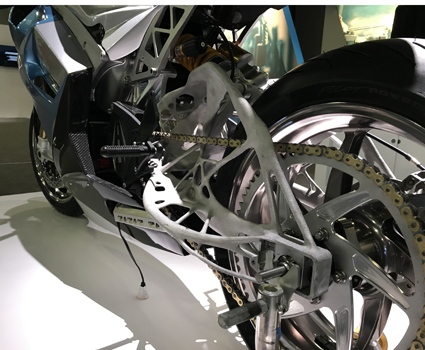
Said Oliver Johnson, TEI, “As a prototype casting supplier, we understand time to market is critical for our customers. There have been some job requests we were given three days to complete, and in some cases only twenty-four hours, but the geometry of this particular design created a significant challenge to complete in the time frame given.”

Designed to reduce the mass of the swing arm by 10% while increasing torsional and bending stiffness, the new part will replace a three-part billet machined into a box section. The organic shape is a great indicator of what is possible in metal casting and the tremendous opportunities that additive manufacturing techniques can bring to metal casters. To ensure the part meets the mechanical torsion and bending needs, CT (computed tomography) was critical for the casting engineers to understand how CT can improve production quality.
The power of CT imaging
A leading technology in the medical field since the 1970s, CT scanning is finding application as an observational tool in the industrial realm. A CT scan is a three-dimensional density map of any object that can be penetrated by the scan beam. The CT scan is generated from 2D projection images of the part onto a digital detector array (DDA), or from single rows of CT slices from a linear diode array (LDA). Once these images have been reconstructed, CT analysis software allows users to virtually slice the object in any direction allowing them to measure internal structure and flaws. Adoption of this technology enables users to visualize internal structures in ways that previously could only be done by destructive methods.
CT scanning has become an important tool for many research, industrial, and safety critical applications where the manufacturer needs to “see” inside an object or measure hidden or hard to reach features without destroying the object in the process.
“With designs as intricate as this one, we couldn’t detect and measure the quality of internal structures correctly with x-ray alone,” said Johnson. “That’s why we relied on the accuracy of YXLON CT to ensure that the integrity of the design was not compromised during the prototyping process.”
Speed matters
CT scanning is an option for applications that require visualizing an object’s internal features or inspecting it for defects or inclusions with high resolution. It is gaining in popularity for metrology applications, such as CAD comparison, nondestructive internal measurements (such as wall thickness measurement and geometric dimensioning), and reverse engineering.
Due to the intricacy of the motorcycle swing arm, TEI needed to ensure structural integrity was in place after prototype production. White light scanning to do the casting dimensional measurements and touch probes for inspection of the machined areas was used. And, since safety is critical when you’re making a part for a motorcycle that can reach up to 218 mph, perfect casting without defects is an absolute must. So TEI turned to CT for internal inspection.
“CT provides us with very good quality tomographs, that we can put together and export into Volume Graphics software which enables us to do all kinds of analysis,” said Johnson. “The CT images confirmed the quality of the casting was good with no porosity, inclusions or shrinkage.”
Image is everything
“Our digital x-ray is ok to check some parts, but for premium engineered aluminum castings with complex geometry like the swing arm, CT is superior,” said Johnson. “The crystal-clear images that CT provides allow us to evaluate the quality of the casting integrity without destroying the part. We can measure things, overlay machine parts from the data we export from the CT scanner, and see exactly what we are going to get.”
After TEI’s CT dimensional checks with white light scanning conducted before and after heat treating, engineers were able to confirm that the two molds both produced good parts and machining operations were completed without a hitch. The swing arm was ready for the customer within the three-week deadline.
A growing application in NDT in additive manufacturing
CT scanning can help build confidence in testing results to solve challenging NDT problems facing Additive Manufacturers. For example, some of the typical flaws that come from the powder bed fusion process are porosity, lack of fusion, balling, which comes from surface tension of the liquid metal, surface roughness and micro-structural issues. CT scan data makes it fast and easy to identify these issues sooner, reducing time and increasing productivity. For industrial CT scanning, the ability to see inside an object is beneficial since internal structures can be seen in their functioning position.
Parts can be analyzed without disassembly. Some software programs for industrial CT inspection allow for measurements to be taken from the CT dataset. These measurements are useful for determining the clearances between assembled parts or simply a dimension of an individual feature. CT can also be used to verify geometric dimensions and tolerances (GD&T) in accordance to ISO 1101 and Y14.5 or a comparison against nominal CAD models.
Density variation, embedded features, organic part design, and dissimilar metals or materials are all easily detected by CT better than other NDT techniques. With CT you can scan it and resolve all these issues quickly.
TEI relies heavily on the technology of CT imaging in their prototyping and machining process. Engineers tested their CT inspection system before purchasing and benchmarked it with a complex cylinder head with intricate passageways and subtle known defects. The CT scan performed by the YXLON CT Compact detected a collapsed gas bubble that showed up as a small “eyelash” inside the part.
The compact system is equipped with a high-power X-ray tube and a line detector array developed by YXLON. CT Compact generates high energy to effectively penetrate iron components up to 65 mm (ca.2.6 in.) thick and aluminum parts up to 250 mm (ca.9.9 in.). In 30 seconds you can start analyzing the first CT slices. The mechanical capacity and performance is complemented by a variety of process-enhancing software tools integrated into every CT Compact set-up. Automated center determination and beam hardening corrections eliminate the need for time-consuming manual interaction.
Designs like the swing arm are great showpieces, but Johnson believes the impact can go far past prototyping for manufacturers like his company. “You might not see parts like the swing arm on a high- or even medium-volume mass-produced vehicle, but you could apply the same approach of advanced CT and non-destructive testing applied to routine manufacturing quality and inspection,” he said.
YXLON International
www.yxlon.com
Filed Under: 3D printing • additive • stereolithography


Tell Us What You Think!