Design World

  • Home
  • Technologies
    • ELECTRONICS • ELECTRICAL
    • Fastening • joining
    • FLUID POWER
    • LINEAR MOTION
    • MOTION CONTROL
    • SENSORS
    • TEST & MEASUREMENT
    • Factory automation
    • Warehouse automation
    • DIGITAL TRANSFORMATION
  • Learn
    • Tech Toolboxes
    • Learning center
    • eBooks • Tech Tips
    • Podcasts
    • Videos
    • Webinars • general engineering
    • Webinars • Automated warehousing
    • Voices
  • LEAP Awards
  • 2025 Leadership
    • 2024 Winners
    • 2023 Winners
    • 2022 Winners
    • 2021 Winners
  • Design Guides
  • Resources
    • 3D Cad Models
      • PARTsolutions
      • TraceParts
    • Digital Issues
      • Design World
      • EE World
    • Educational Assets
    • Engineering diversity
    • Reports
    • Trends
  • Supplier Listings
  • Advertise
  • SUBSCRIBE
    • MAGAZINE
    • NEWSLETTER

Configuration And Manipulation Of Soft Robotics For On-Orbit Servicing

By Science China Press | June 6, 2017

Traditional rigid-bodied robots have few degrees of freedom and large stiffness, which may bring limitations in some applications. Recently, more and more scholars pay attention to the soft and flexibility properties of living beings. The concept of bionic soft robotics is proposed and becomes a hot research topic. The main characteristics of the soft robots are flexibility, deformability and energy-absorbing property. With respect to on-orbit servicing (OOS), soft robots have great value of application, which can be reflected as follows. (1) Flexibility (large degrees of freedom): soft robots can adapt to the unstructured space environment. (2) Deformability: soft robots can satisfy different tasks demands. This can lighten the payload of spacecraft. (3) Energy-absorbing characteristics: soft robots can improve safety and reliability when robots interact with targets or even humans. Although soft robots have these impressive advantages, there still exist many issues in the practice. Recently, a paper published in SCIENCE CHINA Information Sciences reviews the status and development of soft robotics and a conceptual design of configuration and manipulation of space soft robot is proposed.

Currently, the development of soft robotics technologies is fast but the studies are still in the stage of validating the experimental prototypes. Compared with conventional robots, soft robots are special in configuration and manipulation. Thus, these two aspects are reviewed in this work. This paper mainly introduces soft robotic arms, soft grippers, earthworm-like robots, caterpillar-like robots, and multi-limb robots. For example, most soft robotic arms are inspired by elephant trunk or octopus arm. The robots can roll up or operate the targets flexibly. Manipulation of soft robots is difficult. The actuation and control of soft robots cannot be addressed by traditional methods effectively. Novel actuation should be used to realize the complex motion. Some types of actuation applied in soft robots are described. They are electroactive polymers (EAPs) actuation, cable actuation, shape memory alloy (SMA) actuation and fluidic actuation. The existed control problems for the soft robots are much more challenging. The main reasons are that the model of a soft robot is hard to be established and the number of control variables is huge. Currently, most studies just use a sequence of motion commands to control robots. To increase the automation level of soft robots, novel control schemes need to be developed.

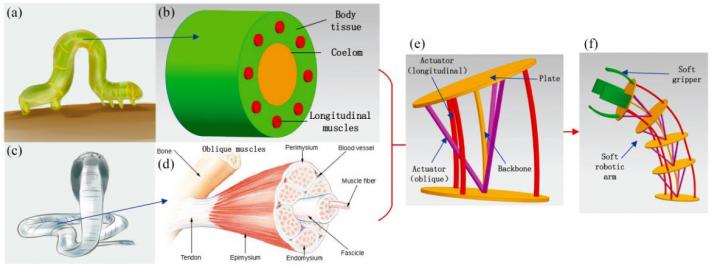
This paper proposes a conceptual design of configuration and manipulation of space soft robot according to the application requirements of OOS. The robot is composed of a space soft robotic arm and a space soft gripper. Inspired by the biologic body of inchworm and snake, soft robotic arm reflects the combination of flexibility and stiffness. Space soft gripper mimics the prolegs of an inchworm to catch the targets. With respect to the space soft manipulation, distributed perception and brain-inspired control is presented to build a high performance control system for the space soft robot. Similar with the living beings, massive sensors are embedded in the robot to obtain the inner states of the robot and the information of outer environment. Neural networks are used to connect the sensing signals and the control signals to enable the robot to complete various missions automatically. The hybrid structure of the space soft robot is shown in Fig. 1 and the block diagram of the potential manipulation system of space soft robot is shown in Fig. 2.
(Image Credit: Science China Press)

You might also like


Filed Under: M2M (machine to machine)
 

LEARNING CENTER

Design World Learning Center
“dw
EXPAND YOUR KNOWLEDGE AND STAY CONNECTED
Get the latest info on technologies, tools and strategies for Design Engineering Professionals.
Motor University

Design World Digital Edition

cover

Browse the most current issue of Design World and back issues in an easy to use high quality format. Clip, share and download with the leading design engineering magazine today.

EDABoard the Forum for Electronics

Top global problem solving EE forum covering Microcontrollers, DSP, Networking, Analog and Digital Design, RF, Power Electronics, PCB Routing and much more

EDABoard: Forum for electronics

Sponsored Content

  • Robot Integration with Rotary Index Tables and Auxiliary Axes
  • How to Choose the Right Rotary Index Table for Your Application
  • Designing a Robust Rotary Index Table: Engineering Best Practices for Long-Term Performance
  • Custom Integration Options for your New and Existing Rotary Table Applications
  • Tech Tips: Crossed Roller Bearing Update
  • Five Uses for the Parvalux Modular Range
View More >>
Engineering Exchange

The Engineering Exchange is a global educational networking community for engineers.

Connect, share, and learn today »

Design World
  • About us
  • Contact
  • Manage your Design World Subscription
  • Subscribe
  • Design World Digital Network
  • Control Engineering
  • Consulting-Specifying Engineer
  • Plant Engineering
  • Engineering White Papers
  • Leap Awards

Copyright © 2026 WTWH Media LLC. All Rights Reserved. The material on this site may not be reproduced, distributed, transmitted, cached or otherwise used, except with the prior written permission of WTWH Media
Privacy Policy | Advertising | About Us

Search Design World

  • Home
  • Technologies
    • ELECTRONICS • ELECTRICAL
    • Fastening • joining
    • FLUID POWER
    • LINEAR MOTION
    • MOTION CONTROL
    • SENSORS
    • TEST & MEASUREMENT
    • Factory automation
    • Warehouse automation
    • DIGITAL TRANSFORMATION
  • Learn
    • Tech Toolboxes
    • Learning center
    • eBooks • Tech Tips
    • Podcasts
    • Videos
    • Webinars • general engineering
    • Webinars • Automated warehousing
    • Voices
  • LEAP Awards
  • 2025 Leadership
    • 2024 Winners
    • 2023 Winners
    • 2022 Winners
    • 2021 Winners
  • Design Guides
  • Resources
    • 3D Cad Models
      • PARTsolutions
      • TraceParts
    • Digital Issues
      • Design World
      • EE World
    • Educational Assets
    • Engineering diversity
    • Reports
    • Trends
  • Supplier Listings
  • Advertise
  • SUBSCRIBE
    • MAGAZINE
    • NEWSLETTER
We use cookies to personalize content and ads, to provide social media features, and to analyze our traffic. We share information about your use of our site with our social media, advertising, and analytics partners who may combine it with other information you’ve provided to them or that they’ve collected from your use of their services. You consent to our cookies if you continue to use this website.