Shot peening has been in use for decades; most often to increase the fatigue life of parts, making them last longer without adding extra material. This is important when weight is a critical issue, such as in the aerospace or automotive industries. Peening creates a compressive stress layer on the surface of the part. This compressive layer makes it more difficult for the part to develop a fatigue crack, and if a crack is created, makes it harder for that crack to grow.
Traditional peening takes a “shotgun” or blanket blast approach to peening parts. It blasts spherical media (glass bead, ceramic bead, stainless steel, cast steel, or cut wire) at surfaces using nozzles that range in internal diameter (ID) from 0.250″ to 0.625″. This nozzle is fixed and the part is held up to 18″ away from it.
Peening machines are very large and require huge volumes of air to operate. They are typically armored with half inch metal plates because the media that isn’t hitting the part is constantly bombarding the interior machine walls, wearing them away.
Most traditional shot peening machines process one part at a time. Many semi-automated machines have an indexing turntable that indexes the parts sequentially, but still peen each part individually, with an operator loading and unloading as needed. Masking, or special fixturing, is often required, to protect regions of the part that must not be hit by the peening media stream.
Birth of Precision Shot Peening
Precision shot peening brings an entirely new concept to this field, and is complementary to its larger cousin, traditional shot peening. Comco entered the shot peening market because it uses more accurate nozzles that move and focus on the part.
Like most innovative machines, the precision shot peener originated with a customer request. Our approach to shot peening was guided by their requirements, and our existing automation platform gave us a basis from which to start.
Using glass bead media, Comco has been shot peening for years with automated micro abrasive blasting technology. A major difference with the micro blasting approach is that, with very fine media (150 micron or finer), it can only be used once. Shot peening media is larger and is reclaimed for reuse. However, the theory behind both micro blasting and shot peening is basically the same: accurately mixing air and media, and shooting it at a target part.
In shot peening, everything is bigger — media is measured in inches or mm. For example, S-230 is cast steel shot 0.023″ diameter (590 µm); S-550 is 0.055″ diameter (a whopping 1,400 µm). Therefore, when we started this project, addressing the issue of larger media was the initial task. Also, shot peening media is expensive, so it needs to be reclaimed for reuse. This required a whole new element to be added to the system.
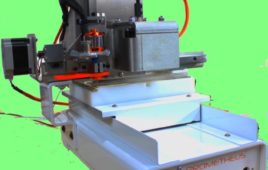
Our precision shot peening system looked and operated differently than traditional shot peeners, taking a “machine gun approach.” The smaller nozzle size (0.060″ to 0.155″ ID typical) created a collimated media stream and ensured that 100 percent of the media hit the part. Coupled with automation, the system needed no protective steel plating, required very little or no masking of parts, and used a less costly air compressor unit.
The smaller nozzle size and tighter control allowed multiple parts to be peened at the same time, as the precision shot peening machine could process four tubular components simultaneously, both ID and OD.
Firing media from smaller nozzles required a level of media control that was not found in traditional shot peening equipment. It required metering exact quantities of media and air, ensuring the tightest process control. This was accomplished by positively introducing media into the air stream, as opposed to gravity, syphon, or magnetic feed systems that had control limits. A side benefit of a more accurate abrasive delivery was the ability to hold tighter intensity tolerances.
Approach to the Project
The first step was to figure out the overall system. What was it supposed to do from the customer’s perspective? How would they want to interact with it? A project never has a total vision at the very beginning, but we had to start somewhere.
We broke the project into four major sections: blaster, lathe, conveyor, and classifier. The blaster and lathe were components that Comco had been building for years; the new system would be an adaptation. The conveying system and classifier were items we thought that we could purchase.
After segmenting a project, our engineering design team always started with the part that had the greatest number of unknowns to determine which project assumptions carried the highest risk.There were several with this project. For example, commercially available conveying equipment, such as bucket elevators and screw conveyors, are large, expensive, and complex. How were we going to deal with that? Vacuum conveying is also used but isn’t as reliable as other methods.
Specific Challenges
Our initial review identified the classifying and conveying systems as primary targets. Traditional shot peening machines moved the media from the blast chamber to the top of the classifier with vacuum, bucket elevators, or screw conveyors. From there, gravity took it through the classifier and into the blasters, with spiral separation typically done off-line. This approach was very large, expensive, and costly to operate. Given the infrastructure required, it could take several hours to several days to change media sizes. We wanted to avoid this complexity and achieve greater flexibility in media relocation.
The challenge was in how to not only reclaim, but properly sort and size the shot-peening media for reuse. This media is typically robust enough that it does not destroy itself after one use, but it does get smaller, and periodically spheres can chip or break. The reclamation system needed to move the media, sort for proper sizing, and eliminate any particles that were not spherical.
This became two processes. The first step was to design and build a screen classifier system with media storage. A classifier is a big, vibrating bed that has a vertical stack of screens that sort the used media to a size specification.
Our goal was to sort multiple abrasive sizes with a single classifier, ideally yielding up to three different size media. For example, a shot peen service provider will run a selection of media sizes, S-70, S-110, and S-230. With our design, any of these could be dumped into the top of our screen classifier. The screens would be set up in such a manner that the top screen throws away the oversize media; the bottom screen throws away the undersize media, and the three gaps in between sort out the three different sizes. Therefore, any size media could be put in, but only S-70 would make it into the S-70 storage hopper, etc. When the media became smaller through use, but retained its shape, it would simply drop into a different hopper and be classified as a new size. Then the cycle repeats.
We designed three custom storage hoppers around the classifier. The base and lids were made of spun metal, and the body was designed using transparent PVC, making media levels visible. Each hopper was equipped with a capacitive proximity sensor to prevent overfill. The tank feed fittings were tangent so the media would spiral and slow before dropping into the tank, instead of impacting a wall.
The second area we addressed was eliminating “out of round” media. If any shot breaks in half or chips instead of reducing circumference in a balanced manner, it will scratch instead of peen. The system needed to automatically remove broken spheres when recycling the media. Commercial spiral separators are well-designed and far more practical to buy rather than redesign. We decided on a separator from Profile Industries. Comprised of a large spiral flute, the media is introduced at the top. As particles flow down the flutes, spherical particles pick up speed and are flung off the side. They are then collected at the bottom for reuse. If flat on any side, media slides all the way down the spiral for disposal.
With the combination of multiple media sizes and classification operations, media conveying became a significant task. Our challenge was to design a system that could move the media around from the numerous pick-up locations to drop-off locations: the classifier had one input and four outputs, the spiral separator had one input and one output, the blaster needed to be filled with media, and once blasted, the media needed to be removed from the blast chamber and conveyed back to the classifying system.
Most conveying designs were difficult to clean and expensive. To solve the problem, we developed a way to push the media with air pressure, similar to how a pressure-pot blaster works, but without a nozzle. Next, we applied a small pressure vessel-weldment to each pick up location and Carlo Gavazzi capacitive proximity sensors to sense when the tank was full. Finally, we applied a pneumatic pinch valve, which closed the tank and allowed it to pressurize. The bottom of the tank was conic and lead into a hose routed through a media distribution valve (MDV). This was repeated for each pick-up location. Each drop-off location was similarly connected to the MDV. The valves were opened and closed according to conveying source and destination. The precise nature of our system allowed us to handle media efficiently, unburdened by large volumes of wasted shot.
The geometry of the MDV is important because media must not become trapped within it. Large shot like S-230 must not be left behind to invade the peening process, so an air purge was added to assist in removing remaining media.
The MDV contained a series of pneumatic pinch valves that were custom designed and molded to be stronger, more efficient, and cost effective. By making a prototype MDV in a transparent material, it allowed us watch the valves operate during cycle and pressure testing and thus improve their construction.
This approach solved numerous conveying problems, including the ability to easily change media sizes and types by simply conveying the media to an external drum for storage. It also allowed the system to run “occasional use” media without cross contamination by dumping the media into the lathe hoppers and then conveying it directly to the blaster.
Our advancements in precision shot peening are not meant to replace the traditional process. In many cases, traditional peening is still the preferred approach. Our goal was to address a need in the industry for a process that has been optimized for selective peening of high value, intricate parts, or to peen areas that are hard to reach, that would normally require substantial masking.
Filed Under: Rapid prototyping