Design World

  • Home
  • Technologies
    • ELECTRONICS • ELECTRICAL
    • Fastening • joining
    • FLUID POWER
    • LINEAR MOTION
    • MOTION CONTROL
    • SENSORS
    • TEST & MEASUREMENT
    • Factory automation
    • Warehouse automation
    • DIGITAL TRANSFORMATION
  • Learn
    • Tech Toolboxes
    • Learning center
    • eBooks • Tech Tips
    • Podcasts
    • Videos
    • Webinars • general engineering
    • Webinars • Automated warehousing
    • Voices
  • LEAP Awards
  • 2025 Leadership
    • 2024 Winners
    • 2023 Winners
    • 2022 Winners
    • 2021 Winners
  • Design Guides
  • Resources
    • 3D Cad Models
      • PARTsolutions
      • TraceParts
    • Digital Issues
      • Design World
      • EE World
    • Educational Assets
    • Engineering diversity
    • Reports
    • Trends
  • Supplier Listings
  • Advertise
  • SUBSCRIBE
    • MAGAZINE
    • NEWSLETTER

Fanning the Flame a Little Faster in Space

By NASA | June 5, 2017

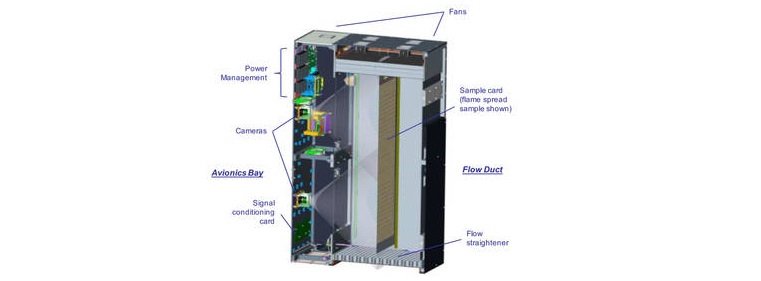
NASA will start another large fire in space on June 4, when ground controllers ignite the third in a three-part series of spacecraft fire experiments (Saffire-III). Set inside a cargo spacecraft that is filled with trash and disposal items from the International Space Station and is orbiting Earth, the flame will spread across a 3.28-foot-long (1 meter) sample of cotton-fiberglass fabric.

Saffire-I, conducted in June 2016, burned an identical cotton-fiberglass sample inside an identical flow duct with fans controlling a low flow rate. Saffire-III will be ignited under the same conditions, except this time, the fans will run faster to produce a higher flow rate on the flame. Saffire-II burned nine different, smaller samples.

Gary A. Ruff leads Saffire at NASA’s Glenn Research Center in Cleveland. He explains that increasing the flow rates for Saffire-III will improve the accuracy of computational models that NASA uses to predict flame spread in microgravity. “For Saffire-I, we measured flame spread rates for burns both in the same direction as the air flow and in the opposite direction of the air flow,” Ruff said. “We need to get additional data at another air flow speed using the same material to compare with the predictions of the computational model.”

Before Saffire, the largest fire experiments in space were conducted with much smaller (3.9 inches or 10 cm) samples, and showed that flames in space burn at a lower temperature, lower rate, and with less oxygen than in normal gravity. Even with this existing data, researchers encountered new surprises with Saffire.
“The biggest surprise is how slowly the flame are spreading across the samples,” said Ruff. Based on smaller samples in controlled burns on the space station, we expected flames on these larger samples to be up to three times faster than we’ve observed.”

A slow-moving flame might seem more favorable than a fast flame, but it also means that smoke production could be slower, resulting in a time delay for a smoke detector to detect a fire. Slow-moving fires also produce larger amounts of carbon monoxide, the leading contributor to suffocation in house fires.

Understanding fire detection and the build-up of toxic gases is an important part of fire protection. Saffire IV-VI, in development now, are being designed to continue to address large scale flammability, but also to investigate fire detection and post-fire monitoring and cleanup.

Saffire is managed at Glenn, and is funded by NASA’s Advanced Exploration Systems Division as part of its ongoing work to develop habitation systems for astronauts on future missions beyond Earth orbit.

You might also like


Filed Under: Aerospace + defense


LEARNING CENTER

Design World Learning Center
“dw
EXPAND YOUR KNOWLEDGE AND STAY CONNECTED
Get the latest info on technologies, tools and strategies for Design Engineering Professionals.
Motor University

Design World Digital Edition

cover

Browse the most current issue of Design World and back issues in an easy to use high quality format. Clip, share and download with the leading design engineering magazine today.

EDABoard the Forum for Electronics

Top global problem solving EE forum covering Microcontrollers, DSP, Networking, Analog and Digital Design, RF, Power Electronics, PCB Routing and much more

EDABoard: Forum for electronics

Sponsored Content

  • Robot Integration with Rotary Index Tables and Auxiliary Axes
  • How to Choose the Right Rotary Index Table for Your Application
  • Designing a Robust Rotary Index Table: Engineering Best Practices for Long-Term Performance
  • Custom Integration Options for your New and Existing Rotary Table Applications
  • Tech Tips: Crossed Roller Bearing Update
  • Five Uses for the Parvalux Modular Range
View More >>
Engineering Exchange

The Engineering Exchange is a global educational networking community for engineers.

Connect, share, and learn today »

Design World
  • About us
  • Contact
  • Manage your Design World Subscription
  • Subscribe
  • Design World Digital Network
  • Control Engineering
  • Consulting-Specifying Engineer
  • Plant Engineering
  • Engineering White Papers
  • Leap Awards

Copyright © 2026 WTWH Media LLC. All Rights Reserved. The material on this site may not be reproduced, distributed, transmitted, cached or otherwise used, except with the prior written permission of WTWH Media
Privacy Policy | Advertising | About Us

Search Design World

  • Home
  • Technologies
    • ELECTRONICS • ELECTRICAL
    • Fastening • joining
    • FLUID POWER
    • LINEAR MOTION
    • MOTION CONTROL
    • SENSORS
    • TEST & MEASUREMENT
    • Factory automation
    • Warehouse automation
    • DIGITAL TRANSFORMATION
  • Learn
    • Tech Toolboxes
    • Learning center
    • eBooks • Tech Tips
    • Podcasts
    • Videos
    • Webinars • general engineering
    • Webinars • Automated warehousing
    • Voices
  • LEAP Awards
  • 2025 Leadership
    • 2024 Winners
    • 2023 Winners
    • 2022 Winners
    • 2021 Winners
  • Design Guides
  • Resources
    • 3D Cad Models
      • PARTsolutions
      • TraceParts
    • Digital Issues
      • Design World
      • EE World
    • Educational Assets
    • Engineering diversity
    • Reports
    • Trends
  • Supplier Listings
  • Advertise
  • SUBSCRIBE
    • MAGAZINE
    • NEWSLETTER
We use cookies to personalize content and ads, to provide social media features, and to analyze our traffic. We share information about your use of our site with our social media, advertising, and analytics partners who may combine it with other information you’ve provided to them or that they’ve collected from your use of their services. You consent to our cookies if you continue to use this website.