Design World

  • Home
  • Technologies
    • ELECTRONICS • ELECTRICAL
    • Fastening • joining
    • FLUID POWER
    • LINEAR MOTION
    • MOTION CONTROL
    • SENSORS
    • TEST & MEASUREMENT
    • Factory automation
    • Warehouse automation
    • DIGITAL TRANSFORMATION
  • Learn
    • Tech Toolboxes
    • Learning center
    • eBooks • Tech Tips
    • Podcasts
    • Videos
    • Webinars • general engineering
    • Webinars • Automated warehousing
    • Voices
  • LEAP Awards
  • 2025 Leadership
    • 2024 Winners
    • 2023 Winners
    • 2022 Winners
    • 2021 Winners
  • Design Guides
  • Resources
    • 3D Cad Models
      • PARTsolutions
      • TraceParts
    • Digital Issues
      • Design World
      • EE World
    • Educational Assets
    • Engineering diversity
    • Reports
    • Trends
  • Supplier Listings
  • Advertise
  • SUBSCRIBE
    • MAGAZINE
    • NEWSLETTER

Float Like a Butterfly, Sting Like a Hornet: US Air Force Picks Battle-Hardened Engines

By Fred Guterl, GE Reports | October 5, 2018

Boeing’s F/A-18 Hornet and Super Hornet fighter jets have something for everybody. Built to take off from and land on aircraft carriers, the planes come in handy for escorting ships through hostile waters or defending a fleet against air attacks. They can also provide close air support for troops on the ground. Depending on the type of mission, they can be equipped with a wide variety of weapons.

With its twin F404 engines, the Hornet became the backbone of the U.S. Navy’s fleet of fighter planes through the 1980s and 1990s. “If you looked out on the flight deck of an aircraft carrier during those years, you’d see mainly Hornets,” says Tom Lodge, head of marketing for GE Aviation’s military engines business. “I would say the Hornet is more of a Corvette than a pickup truck,” he adds. “It’s high-end, but not expensive. It’s not a Lamborghini. It’s a common airplane.”

Versatility and low cost were key words here. The F404 is a medium-size engine —11,000 pounds of thrust, 17,000 with afterburner. But it’s also relatively light, which makes it suitable for agile fighters, and designed to be easily maintained. Its six modules — fan, compressor, combustor, high-pressure turbine, low-pressure turbine and afterburner — were made to fit together like Legos. This design is convenient especially on an aircraft carrier, allowing engineers to quickly swap out a module for a spare. “You could pull the engine apart, mix and match, and get flying right away,” says Lodge.

This modular approach has won plaudits. The journalist and author Orr Kelly wrote in his book “Hornet: The Inside Story of the F/A-18” that GE “was, on its own, one of the first to recognize the value of worrying, early in the design phase, about the cost of building and maintaining an engine. Although this seems a commonsense approach, it runs contrary to the natural inclinations of most engineers.”

This engineering style may have something to do with the F404’s long life. Last week the U.S. Air Force announced an agreement with Boeing to purchase more than 350 T-X trainer jets, all of them powered by the F404 engine. “We’re very excited about supporting Boeing and the U.S. Air Force with our F404 engines and helping train fighter pilots for generations to come,” says Al DiLibero, vice president and general manager GE Aviation’s turbofan and turbojets projects based in Lynn, Massachusetts.
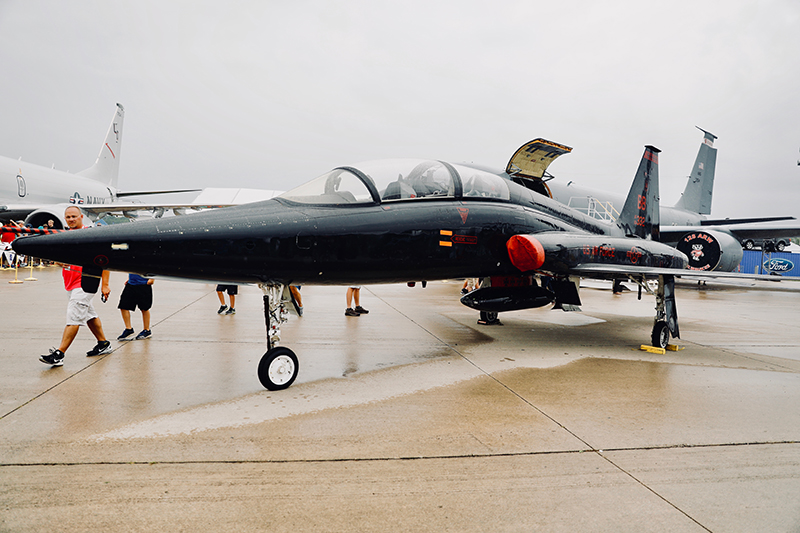
The new Boeing T-X trainer will replace trainers like the T-38 Talon, powered by a pair of GE’s J85 engines. Image credit: Tomas Kellner for GE Reports. Top image: An F/A-18C Hornet assigned to the “Golden Warriors” of Strike Fighter Squadron Eight Seven (VFA-87) launches from the flight deck of USS Theodore Roosevelt. Image credit: Getty Images.

The deal represents something of a generational change for GE. The F404s will replace another GE engine, the J85, which was used on the previous generation of T-X trainers. Designed in the late 1950s, the J85 was the first small turbojet to operate with an afterburner, and was also the first GE engine with a variable-exhaust nozzle. In the early 1960s, a commercial variant of the engine powered the first Learjets, a family of pioneering private jets for business executives.

Production of J85s ended in 1988, but the Boeing contract now passes the torch to the F404: The deal could extend the life of the F404 for another decade.

The F404 engine and its cousin, the F414, power a wide variety of jets in the U.S. and around the world, including the F-117 Nighthawk, Sweden’s Saab Gripen, India’s Tejas, and of course, the Super Hornet.

“This is all about joint warfighting excellence,” said Air Force Chief of Staff Gen. David L. Goldfein. “We need the T-X to optimize training for pilots heading into our growing fleet of fifth-generation aircraft.”

You might also like


Filed Under: Aerospace + defense


LEARNING CENTER

Design World Learning Center
“dw
EXPAND YOUR KNOWLEDGE AND STAY CONNECTED
Get the latest info on technologies, tools and strategies for Design Engineering Professionals.
Motor University

Design World Digital Edition

cover

Browse the most current issue of Design World and back issues in an easy to use high quality format. Clip, share and download with the leading design engineering magazine today.

EDABoard the Forum for Electronics

Top global problem solving EE forum covering Microcontrollers, DSP, Networking, Analog and Digital Design, RF, Power Electronics, PCB Routing and much more

EDABoard: Forum for electronics

Sponsored Content

  • Robot Integration with Rotary Index Tables and Auxiliary Axes
  • How to Choose the Right Rotary Index Table for Your Application
  • Designing a Robust Rotary Index Table: Engineering Best Practices for Long-Term Performance
  • Custom Integration Options for your New and Existing Rotary Table Applications
  • Tech Tips: Crossed Roller Bearing Update
  • Five Uses for the Parvalux Modular Range
View More >>
Engineering Exchange

The Engineering Exchange is a global educational networking community for engineers.

Connect, share, and learn today »

Design World
  • About us
  • Contact
  • Manage your Design World Subscription
  • Subscribe
  • Design World Digital Network
  • Control Engineering
  • Consulting-Specifying Engineer
  • Plant Engineering
  • Engineering White Papers
  • Leap Awards

Copyright © 2026 WTWH Media LLC. All Rights Reserved. The material on this site may not be reproduced, distributed, transmitted, cached or otherwise used, except with the prior written permission of WTWH Media
Privacy Policy | Advertising | About Us

Search Design World

  • Home
  • Technologies
    • ELECTRONICS • ELECTRICAL
    • Fastening • joining
    • FLUID POWER
    • LINEAR MOTION
    • MOTION CONTROL
    • SENSORS
    • TEST & MEASUREMENT
    • Factory automation
    • Warehouse automation
    • DIGITAL TRANSFORMATION
  • Learn
    • Tech Toolboxes
    • Learning center
    • eBooks • Tech Tips
    • Podcasts
    • Videos
    • Webinars • general engineering
    • Webinars • Automated warehousing
    • Voices
  • LEAP Awards
  • 2025 Leadership
    • 2024 Winners
    • 2023 Winners
    • 2022 Winners
    • 2021 Winners
  • Design Guides
  • Resources
    • 3D Cad Models
      • PARTsolutions
      • TraceParts
    • Digital Issues
      • Design World
      • EE World
    • Educational Assets
    • Engineering diversity
    • Reports
    • Trends
  • Supplier Listings
  • Advertise
  • SUBSCRIBE
    • MAGAZINE
    • NEWSLETTER
We use cookies to personalize content and ads, to provide social media features, and to analyze our traffic. We share information about your use of our site with our social media, advertising, and analytics partners who may combine it with other information you’ve provided to them or that they’ve collected from your use of their services. You consent to our cookies if you continue to use this website.