
Honeywell continues to expand its TruStability® Board Mount Pressure Sensor platform with a Ultra-Low Pressure Sensor that provides industry-leading long term stability, Total Error Band (TEB), accuracy, flexibility, and high burst and working pressures.
The TruStability® Ultra-Low Pressure Sensors HSC (High Accuracy Silicon Ceramic) Series and SSC (Standard Accuracy Silicon Ceramic) Series use new Honeywell proprietary technology that combines three performance factors difficult to achieve in the same product: high sensitivity with high overpressure and burst pressure. This technology protects the sensor without sacrificing the ability to sense very small changes in pressure, as well as provides high durability amid environmental factors such as temperature and humidity.
TruStability® Ultra-Low Pressure Sensors perform substantially better relative to stability than any other pressure sensor available in the industry today, even after long-term use and thermal extremes. This quality minimizes system calibration needs, maximizes system performance, and helps support system uptime by eliminating the need to service or replace the sensor during its application life.
“It is more difficult for a pressure sensor to maintain high levels of stability in applications that require ultra-low pressure ranges,” said AJ Smith, Global Product Marketing Manager for Honeywell Sensing and Control. “Typically, pressure sensors used for ultra-low pressure applications are more susceptible to damage due to the high pressure conditions. TruStability® Ultra-Low Pressure Sensors’ use of Honeywell proprietary technology provides industry-leading stability and performance while tolerating high working pressure and over-pressure conditions.”
These devices provide an amplified compensated digital or analog output for reading pressure over the full scale pressure span in the ultra-low pressure range of ±2.5 mbar to ±40 mbar [±1 inH2O to ±30 inH2O], providing support for many unique industrial and medical applications including:
* Industrial HVAC (heating, ventilation, and air conditioning) applications, including VAV (variable air volume) control, static duct pressure, clogged HVAC filter detection, HVAC transmitters, and indoor air quality.
* Medical control applications including ventilators, anesthesia machines, spirometers, nebulizers, and hospital room air pressure.
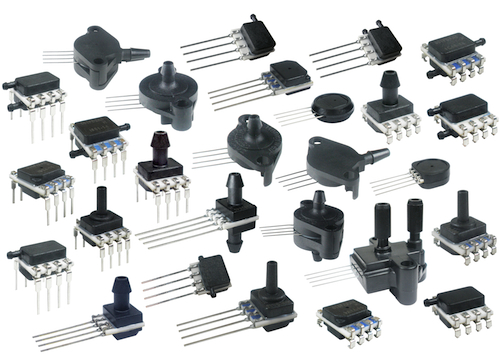
Honeywell provides industry-leading TEB, the most comprehensive and clear measurement that specifies the sensor’s true accuracy over the compensated temperature range, so that customers can implement the sensors quickly and easily without having to calculate the total effect of individual errors that might be encountered in their applications. The TEB for the HSC Series varies between ±1 %FSS and ±3 %FSS (depending on the pressure range), and the TEB for the SSC Series varies between ±2 %FSS and ±5 %FSS (depending on the pressure range). TEB eliminates individual sensor test and calibration (which can increase manufacturing time and process), supports system accuracy and warranty requirements, helps to optimize system uptime, and provides excellent sensor interchangeability (there is minimal part-to-part variation in accuracy).
Additional features of TruStability® Ultra-Low Pressure Sensors:
* Industry-leading accuracy of ±0.25 % FSS BFSL (Best Fit Straight Line) reduces software required to correct system inaccuracies, minimizing system design time, supporting system accuracy and warranty requirements, and helping to optimize system uptime.
* High burst pressures above 1034 mbar [415 inH2O] allow the sensor to endure a wide range of conditions while maintaining a high level of sensitivity, simplifying the customers’ design process.
* High working pressure ranges above 336 mbar [135 inH2O] allow the device to be used continuously well above the calibrated pressure range.
* Modular, flexible design with many package styles (all with the same industry-leading stability), pressure ports, and options simplifies integration into device manufacturers’ applications.
* Onboard signal conditioning typically allows for the removal of signal conditioning components from the PCB, reducing costs and simplifying the customers’ production processes.
* Insensitivity to mounting orientation allows customers to position the sensor in the most optimal point in the system, eliminating concern for positional effects and increasing flexibility of use within the application.
* Insensitivity to vibration reduces susceptibility to application-specific vibration that occurs with changes in pressure, minimizing inaccurate pressure readings.
* Integrated amplification, compensation, and calibration typically allow for the removal of additional components associated with signal conditioning from the PCB, reducing both the PCB size as well as costs often associated with those components (e.g., acquisition, inventory, assembly).
* Internal diagnostic functions increase system reliability.
* Extremely low power consumption (less than 10 mW, typ.) reduces power consumption, provides extended battery life, and promotes energy efficiency.
* I2C- or SPI-compatible 14-bit digital output (min. 12-bit sensor resolution) versions have accelerated performance through reduced conversion requirements and the convenience of direct interface to microprocessors/microcontrollers.
* Miniature 10 mm x 10 mm [0.39 in x 0.39 in] package is very small when compared to most board mount pressure sensors, occupying less area on the PCB and typically allowing for easy placement on crowded PCBs or in small devices.
These products join the TruStability® low-to mid-pressure product line (60 mbar to 10 bar [1 psi to 150 psi]) originally launched in 2009, and the TruStability® Uncompensated/Unamplified Pressure Sensors (60 mbar to 10 bar [1 psi to 150 psi]) launched in July of this year.
Honeywell
www.honeywell.com
::Design World::
Filed Under: Sensors (pressure), SENSORS, TEST & MEASUREMENT
Tell Us What You Think!