Design World

  • Home
  • Technologies
    • ELECTRONICS • ELECTRICAL
    • Fastening • joining
    • FLUID POWER
    • LINEAR MOTION
    • MOTION CONTROL
    • SENSORS
    • TEST & MEASUREMENT
    • Factory automation
    • Warehouse automation
    • DIGITAL TRANSFORMATION
  • Learn
    • Tech Toolboxes
    • Learning center
    • eBooks • Tech Tips
    • Podcasts
    • Videos
    • Webinars • general engineering
    • Webinars • Automated warehousing
    • Voices
  • LEAP Awards
  • 2026 Leadership
    • 2025 Winners
    • 2024 Winners
    • 2023 Winners
    • 2022 Winners
    • 2021 Winners
  • Design Guides
  • Resources
    • 3D Cad Models
      • PARTsolutions
      • TraceParts
    • Digital Issues
      • Design World
      • EE World
    • Educational Assets
    • Engineering diversity
    • On the Floor
    • Reports
    • Trends
  • Supplier Listings
  • Advertise
  • SUBSCRIBE
    • MAGAZINE
    • NEWSLETTER

How to specify a ball screw

By Leslie Langnau | July 18, 2013

Ball screws are available in a range of types, styles, and sizes. A few tips, though, will help you match the right ball screw with the right application.

1. You will have the best success with specifying a ball screw if you know the following information about your application:

Duty Cycle—the cycle rate, dwell times, and lifetime expectation.

Environment—harsh or rugged, wash down, heat extremes, or other requirements.

Load—the mass being moved.

Orientation—how the ball screw be mounted (vertically or horizontally).

Precision—what is the positional accuracy and repeatability need to be.

Speed—velocity and acceleration requirements.

Travel—stroke length.

2. Consider a preloaded ball screw

Preloading Ball Screw 300x292

Ball screw manufacturers can increase the rigidity of the ball screw through preloading—a step that reduces axial clearance between the ball nut and the screw shaft. In addition, preloading enhances positioning precision and repeatability. One of the more common preload options is the use of oversized balls. But other methods include the use of a double-nut. Manufacturers may also offset the raceway spiral, which can force the balls into a preload condition.

3. Know your need for speed

Manufacturers offer information on the operational speed limits that their ball screw system can handle. Variables that go into this determination include temperature, operating limits of the bearing and inertia of the bearing’s moving components.

The critical speed of a ball screw is the lowest speed at which the ball screw shaft is in resonance, i.e. where screw whip occurs. It depends on screw length and the end bearing mounting support. To prevent critical speed, select a larger screw diameter, choose the right bearings, and use proper screw supports.
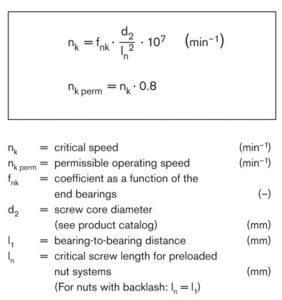
Ball Screws Speed Calcs 282x300

Formulas to help determine critical speed

4. And of course, the next tip is to always use a good lubricant. Oil and grease are the common choices. Avoid ones with solid additives as they can clog the recirculating system.

Leslie Langnau
[email protected]


Linear Motion Tips

You might also like


Filed Under: Ballscrews • leadscrews, Linear Motion Tips


LEARNING CENTER

Design World Learning Center
“dw
EXPAND YOUR KNOWLEDGE AND STAY CONNECTED
Get the latest info on technologies, tools and strategies for Design Engineering Professionals.
Motor University

Design World Digital Edition

cover

Browse the most current issue of Design World and back issues in an easy to use high quality format. Clip, share and download with the leading design engineering magazine today.

EDABoard the Forum for Electronics

Top global problem solving EE forum covering Microcontrollers, DSP, Networking, Analog and Digital Design, RF, Power Electronics, PCB Routing and much more

EDABoard: Forum for electronics

Sponsored Content

  • Industrial automation accelerates with increased capital spending
  • How do position encoders improve gimbal performance?
  • Majors launch new products and platforms at Automate 2026
  • Venture capital pumps industrial automation and Honeywell spins off major units
  • From film to tape: Engineering for low outgassing in space
  • For the machines that don’t take days off. How Electrification Is Reshaping On- and Off-Road Machinery.
View More >>
Engineering Exchange

The Engineering Exchange is a global educational networking community for engineers.

Connect, share, and learn today »

Design World
  • About us
  • Contact
  • Manage your Design World Subscription
  • Subscribe
  • Design World Digital Network
  • Control Engineering
  • Consulting-Specifying Engineer
  • Plant Engineering
  • Engineering White Papers
  • Leap Awards

Copyright © 2026 Arrowfly LLC. All Rights Reserved. The material on this site may not be reproduced, distributed, transmitted, cached or otherwise used, except with the prior written permission of Arrowfly
Privacy Policy | Advertising | About Us

Search Design World

  • Home
  • Technologies
    • ELECTRONICS • ELECTRICAL
    • Fastening • joining
    • FLUID POWER
    • LINEAR MOTION
    • MOTION CONTROL
    • SENSORS
    • TEST & MEASUREMENT
    • Factory automation
    • Warehouse automation
    • DIGITAL TRANSFORMATION
  • Learn
    • Tech Toolboxes
    • Learning center
    • eBooks • Tech Tips
    • Podcasts
    • Videos
    • Webinars • general engineering
    • Webinars • Automated warehousing
    • Voices
  • LEAP Awards
  • 2026 Leadership
    • 2025 Winners
    • 2024 Winners
    • 2023 Winners
    • 2022 Winners
    • 2021 Winners
  • Design Guides
  • Resources
    • 3D Cad Models
      • PARTsolutions
      • TraceParts
    • Digital Issues
      • Design World
      • EE World
    • Educational Assets
    • Engineering diversity
    • On the Floor
    • Reports
    • Trends
  • Supplier Listings
  • Advertise
  • SUBSCRIBE
    • MAGAZINE
    • NEWSLETTER