
By John Jones, Hydraulic Pump Div., Parker Hannifin Corp.
Every hydraulic system needs a pump. An earlier article in this series told how to pick the right one. Now, it’s time to make some noise about controlling sound levels.
Hydraulic systems are known for adjustable, controllable power transmission to a variety of actuators. But they require careful design attention to keep noise to acceptable levels. Fortunately, new pump technologies are making this task easier.
Variable-displacement axial-piston pumps are increasingly used for hydraulic systems because they provide better efficiency, higher power density and increased versatility. While these areas are important in pump selection, there is also added emphasis on reducing pump and system sound levels. In addition to sound generated from fluid velocities, the pump and system pressure ripple contribute to the overall system sound levels.
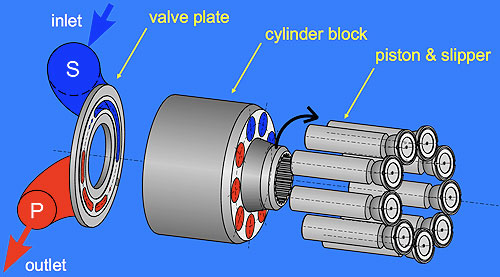
Rotating group of an axial piston pump.
There are two pump noise-generating mechanisms:
- Alternating forces inside the pump body, considered the primary mechanism, and…
- Noise emitted by all downstream components resulting from pulsating flow delivered by the pump.
Primary pump noise
In an axial piston pump with swashplate, pistons rotate together with the cylinder block according to the drive speed of the shaft. (Nine pistons are shown in the example below.) The valve plate ports fluid to and from the pistons: half a rotation with the pressure side and the other 180° with the suction side. Pistons connected to the pressure port may be either four or five as the figures below show. At an odd number of pistons (9 pistons, pitch angle 40°) this situation changes every 20° rotation angle. At an input speed of 1,500 rpm, the total resulting force of the pressurized piston changes with a frequency of 225 Hz. For a pump operating at 350 bar, with a displacement of 46 cm3/rev (piston diameter 17 mm) that means a change of the internal forces from 3.2 to 4 tons! For the largest pump in Parker’s PVplus family, the force steps from 10.5 to 13.2 tons and back. In such an axial piston pump, a force of several tons stresses the structure by pulsating with a high frequency. Such high alternating forces require careful design of the pump body. Under these high forces the pump case will be deformed. And, because of the rapid load changes – it takes less than 1 ms to change from the high to low force level or back – higher harmonic vibrations will be induced in the structure.
The deformations need to be minimized to reduce the effects on the surrounding air and the natural frequencies of the structure must be made as low as possible to make the noise level more tolerable.
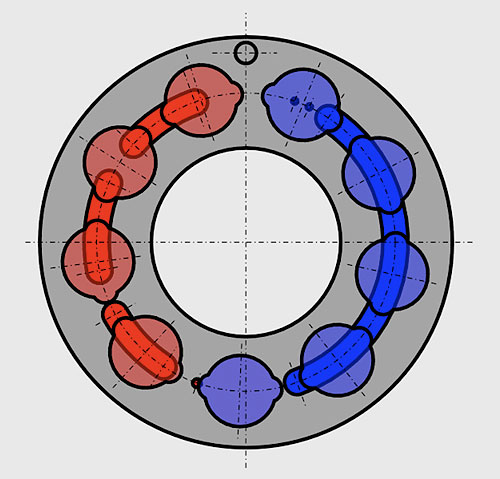
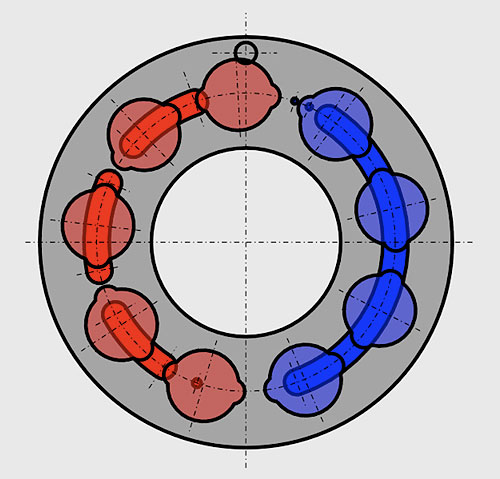
Cylinder block over valve plate at 0° and 20° rotation angles.
Pulsation reduction with a pre-compression chamber
One new pump design uses a pre-compression (ripple) chamber design in the pump to reduce the output flow pulsation. In the first part of the compression phase, an internal chamber – filled with fluid under pump output pressure – is connected to the piston coming from the low-pressure side. Fluid now starts to flow back into the chamber to refill it.
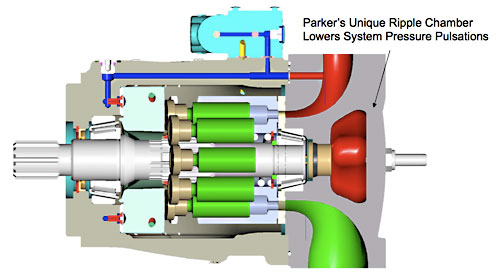
Pre-compression chamber design reduces output flow pulsation.
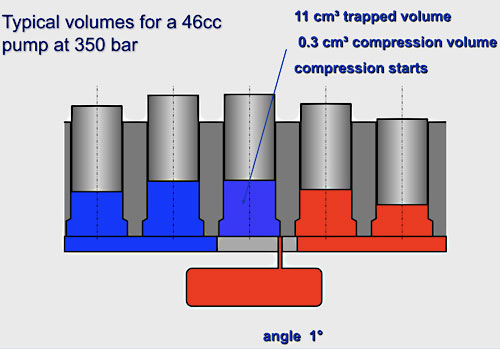
Pulsation reduction with a pre-compression (ripple) chamber at 1° of rotation where compression starts…
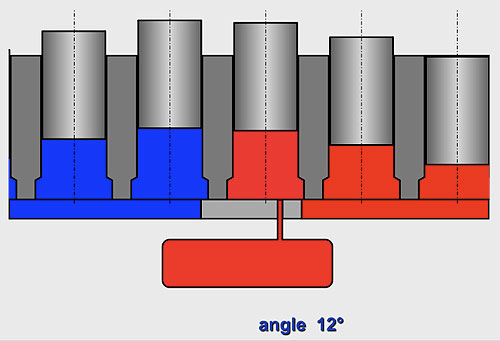
…then advances to 12° rotation where compression ends and chamber refill starts…
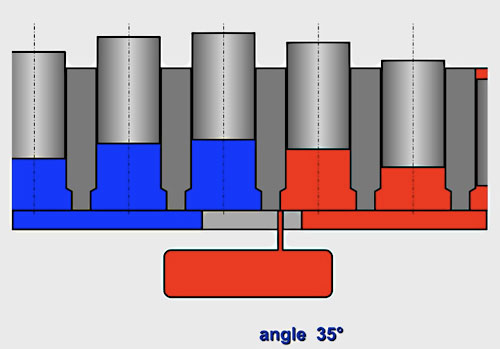
…and continues to 35° where chamber refill ends.
Chamber refill ends with refill time covering 25° of rotation. As the volume to bring the piston chamber to 350 bar is reduced by the ripple chamber input, now a lower average flow is required from the pressure chamber to have it refilled when the next piston gets connected. As a result, the peaks in the flow are reduced by more than 50%. The whole system is less excited by the reduced flow pulsation and is quieter. Built to a power unit and incorporated into a hydraulic system, the lower pulsation causes a total reduction in primary and secondary noise by 3 dB(A) typical, and in some cases even up to 5 dB(A).
Parker Hannifin Corp.
www.parker.com
Filed Under: Hydraulic equipment + components, Pumps, FLUID POWER

After rebuild the black hole axial hydraulic pump and fill to the machine and now is noise .
We have repaired 200 cc varible piston pump twice by replacing rotating group. Noice is increasing. I am sure it is beacause of the proportional throttle valve but unable know