
More and more industrial equipment is connected to industrial networks. In 2019, the number of new connected nodes is expected to grow by 10%. Industrial Ethernet and Wireless continue to grow fast, but 2019 also marks the first year of fieldbus decline. These are the main findings in the annual study of the industrial network market by HMS Networks. Industrial Ethernet now accounts for 59% of new installed nodes (52% last year), while fieldbuses are on 35% (42). EtherNet/IP is still the most widely installed network at 15%, but PROFINET is closing in at 14%. Wireless technologies continue to develop strongly and are steady at 6% of the market (6).
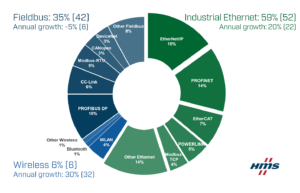
Market shares 2019 according to HMS Networks – fieldbus, industrial Ethernet and wireless.
HMS Networks presents its annual analysis of the industrial network market, which focuses on new installed nodes within factory automation globally. As an independent supplier of solutions for industrial communication and the Industrial Internet of Things, HMS has insight into the industrial network market. Here are some of the trends they see within industrial communication in 2019.
Continued growth for industrial Ethernet
Last year, HMS concluded that Industrial Ethernet had surpassed traditional fieldbuses for the first time, and this development continues in 2019. With a steady growth rate of 20% (22), industrial Ethernet now makes up for 59% of the global market (compared to 52% last year). EtherNet/IP is the largest industrial Ethernet network with 15% of the market, but PROFINET has almost closed the gap and is now at 14%. Ethernet runners-up globally are EtherCAT at 7%, Ethernet POWERLINK at 5%, and Modbus-TCP at 4% all of which are showing stable growth.
Fieldbuses are declining
For the first time ever, fieldbuses are declining by -5% (compared to a 6% growth last year), now accounting for 35% of new installed nodes. The dominant fieldbus is still PROFIBUS with 10% of the total world market, followed by CC-Link at 6% and Modbus-RTU at 5%.
Reflections on the industrial Ethernet growth and the fieldbus decline
“The transition to industrial Ethernet continues and is driven by the need for high performance and the need for integration between factory installations and IT-systems/IIoT applications,” says Anders Hansson, Chief Marketing Officer at HMS. “For the first time we see that traditional fieldbuses actually declined in terms of new installed nodes. When it comes to industrial Ethernet, we see good growth for many networks – for the established Ethernet/IP, PROFINET, EtherCAT, POWERLINK and Modbus-TCP, as well as for the networks grouped in the ‘other Ethernet’ category. This fragmented Ethernet picture is very interesting, and it goes to prove that industrial Ethernet never standardized on one network as many predicted when the Ethernet-based networks first evolved in the 1990s. Just like the fieldbuses, the various Ethernet networks serve different purposes depending on industrial application.”
Still a strong drive for wireless solutions
Wireless technologies are also growing steadily by 30% (32) and accounts for 6% (6) of the total market. Within Wireless, WLAN is the most popular technology, followed by Bluetooth. “Wireless is increasingly being used by machine builders and system integrators to realize new, innovative automation architectures. Users can reduce cabling and create new solutions for connectivity and control” says Anders Hansson. “We also see increased activities globally around cellular technologies (e.g. Private LTE/5G networks) as enablers for Smart and Flexible Manufacturing in factories.”
Regional network variations
In Europe and the Middle East, EtherNet/IP and PROFINET are leading and PROFIBUS is still widely used. Other popular networks are EtherCAT and Ethernet POWERLINK. The US market is dominated by the CIP networks, with a clear movement towards EtherNet/IP. EtherCAT is continuing to gain market share. In Asia, no network stands out as truly market-leading, but PROFINET, EtherNet/IP, PROFIBUS, EtherCAT, Modbus and CC-Link are widely used, with the Ethernet version CC-Link IE Field also gaining traction.
HMS Networks
www.hms-networks.com
Filed Under: IoT • IIoT • Internet of things • Industry 4.0, NEWS • PROFILES • EDITORIALS, CONNECTIVITY • fieldbuses • networks, Wireless • 5G and more