Vertically integrated, Premold delivers Class A results across the board.
Reaction Injection Molding (RIM) was invented in Germany in the 1970s, and made its way to America about 10 years later. Originally used for producing automotive components, RIM is a low-pressure, low-temperature process that uses urethane thermoset resins. The process has been refined over the years, but has remained primarily unchanged.
Founded in 1980, Premold focuses on producing covers and enclosures for the life sciences industry, particularly in medical equipment. With a 68,000 square foot facility, the company is one of nine RIM facilities in America, and is a primary testing facility, and large resin processor for Bayer Material Sciences.
Although there are varying forms of injection molding, the results from RIM lend themselves particularity well to the medical device industry, delivering high cosmetics, precise fit-ups, and tight tolerances.
“Premold provides comprehensive design and engineering support services from concept through production launch,” explains Doug Culbertson, vice president of Premold. “This approach to design for manufacturability results in finished parts with tight tolerances and first-in-class cosmetics. Customers get precise fit-ups and Class A finishes with every batch of parts.”
Custom Tool Design
Premold is vertically integrated, offering in-house tooling and “finishing” work (painting, silk screening, EMI coating, sub-assembly, etc.). A Solidworks master is also on staff to provide design services and engineering support. Regional manager Lucas Boettcher explains, “With the right design, our customers are able to nail down their fit-ups every single time.”
The design phase begins with a review of the project and application specifications. Engineers then work with the customers to fine-tune their part geometries in CAD. When the part design has been finalized, custom molds are machined that will produce the RIM part.
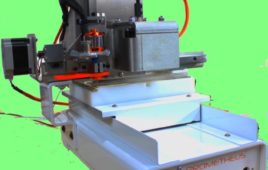
Robotic CNC systems are used to machine the molds and have the capacity to handle large, multi-mold projects. The company’s largest CNC machine has a build envelop of 100” x 60” x 28” and a 28 station robotic tool changer. “It can run for days on its own when everything is working properly – which is all the time,” adds one enthusiastic machine operator.
In contrast to high-pressure injecting molding, RIM is low-pressure, around 50 to 70 psi, and low-temperature, reaching anywhere from 150° to 170°F. These factors allow for aluminum molds, rather than steel, because the conditions lead to a lower mold degradation.
One advantage to aluminum molds, is cost. “If you have a huge part with a huge mold, it’s going to cost hundreds of thousands of dollars with steel. But with aluminum, it’s about a third of the price,” explains Boettcher.
Besides the cost savings, RIM parts don’t require secondary operations to machine vent-slots or to glue-in bosses. These features are molded into the part, and result in precise tolerances, and batch-to-batch consistency.
“You don’t have someone trying to drill holes after the fact,” says Boettcher. “It saves [our customers] time and money, and they aren’t buying multiple tools.”
The Injection Process
Once the custom molds are machined, “first article” parts are molded and sent to the customer for verification. After approval, they are ready for production. The mold is then placed in a press which is tilted at an angle specified for each part. Tilt orientation ranges from 25° to 80°, and helps to facilitate venting.
Two liquid components, a polyol (the resin) and an isocyanate (the reactant), wait in separate holding tanks until they are released by the dispensing unit and impinged in the mix-head attached to the mold.
The mixed components are now called the “resin system,” which is injected from the bottom of the mold (at the gate) to flow through the mold toward the vent area. “The resin flows in with the viscosity of skim milk. As a result, you can fill out really large and complex parts,” explains Boettcher.
The resin system fills the mold in a few seconds, and then the curing process begins. On average, RIM parts cure in three to eight minutes depending on the size and complexity of the geometry. Because these are urethane thermoset resins, the part is fully cured in the mold.
One drawback is that RIM is not suitable for high volumes. “Our set up times are low, but the actual cycle time can take a while,” says Boettcher. Typically, RIM parts are used when a customer needs between 100 and 2,000 parts-per-year. The parts are produced in small batches, usually 25 to 50 parts-per-batch.
Class A Results
After the molding process, the next step is to get rid of the mold release, which is essentially petroleum jelly that keeps the product from sticking. “We sand blast [the part] with calcium chloride. It is good for the environment, gets recycled after use, and takes off the mold release. It also prepares the part for optimal paint adhesion,” Boettcher explains.
When the base coat is established, the paint is cured in an oven. A second coat is applied which determines the texture and gloss of the product by controlling the spray of the droplets, specifically the frequency and thickness. The part then goes back through the paint curing oven to complete the process.
Drying the paint takes around 45 minutes, as the product makes its way through the paint-drying oven. Kept at around 140°F, Boettcher describes it as “a slow pizza oven.”
In addition, Premold maintains UL recognition to apply top quality electromagnetic shield coatings (EMI) to their custom molded plastic parts. The EMI coated parts provide a highly effective EMI shielding for enclosures, and can eliminate the need for EMI gaskets.
In line with the company’s quality standards, every part must have a Class A finish, meaning that it must be visually perfect from a distance of 18”. With this requirement, and an additional ISO 9001:2008 certification, attention to detail is pertinent. To ensure that everything is performed to specifications, a “job traveler” document accompanies each batch of products throughout its time in the facility.
The document details the customer information on the product, and provides product description, quantity, and history. All processes are barcoded so employees can scan them to receive visual work instructions. “If there is a problem, it’s easy to look back at the job traveler, so there is a lot of accountability,” explains Boettcher.
Securing a Market Niche
With a path towards commercialization in the industry, the Premold process offers customers a chance to differentiate themselves from their competitors. Custom covers and silk screens are easily achieved through the RIM process, and with vertical integration in the facility, the customers have many options.
“I think that if you aren’t evolving and staying hungry, there is always competition that is going to want to fill your market niche,” says Boettcher.
Filed Under: Rapid prototyping