By Antonin Deschamps, APEM
As more industrial and commercial applications are requiring greater functionality, there is a need for low-profile input devices that enable users to achieve fine control, even in the harshest field environments.
Many heavy-duty industrial and commercial applications, despite the large scope and scale of driven equipment, still need delicate operator-initiated control for various aspects of their operation. For instance, a massive gantry crane may require precise positioning of the pickup apparatus, or a construction equipment operator may need to set the position of a blade or other attachment. Incorporating these types of fine control, along with other types of operator input, can be challenging in an industrial setting (Figure 1).
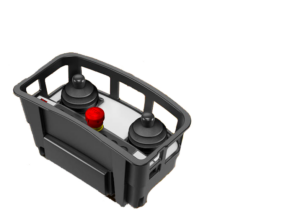
Figure 1: Precise user control for heavy-duty equipment via belly boxes, armrest consoles, and marine controls requires industrial-grade thumbsticks.
Furthermore, as digital automation methods have become the norm, along with the increasing availability of electronic sensors, machines are gaining much more functionality than traditional and basic systems. Whether the application is a fixed installation, a portable piece of equipment, or a vehicle, these additional technologies are prompting a greater need for industrial-rated operator control devices able to provide a responsive and accurate interface to digital controls while surviving the rigors of the environment.
User-friendly input
Putting precise control into the hands and fingers of operators takes many forms. For some modern systems, touchscreen displays are incorporated into the design. Touchscreens work fine for personal electronics, but their relative fragility and lack of tactile feedback make them less than ideal for heavy-duty equipment applications.
Proportional joysticks address these and other issues. True proportional joysticks — which are different than simple on/off control at each compass point — are a classic form of operator input for relatively delicate actions. These types of joysticks are commonly seen in certain aircraft controls or video games, providing an excellent way for operators to command two (X-Y) or more axes of motion in a smooth and positional manner.
However, using the whole hand and arm may not provide the finest control because an operator’s thumb and index finger are much more agile. Using a full-size joystick is less practical when there are many pairs of axes to be controlled. Another consideration is that the relatively large size of a traditional proportional joystick makes it more susceptible to damage or unintended operation.
In many cases, the best solution to address these issues and provide refined control in a robust form factor is to use a low-profile joystick, sometimes called a thumbstick, which can be used by the thumb or fingers.
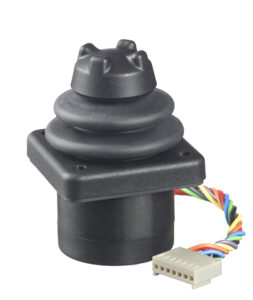
Figure 2: The APEM XS Series low-profile joystick/thumbstick combines robust metal mechanicals with refined Hall effect sensors — and a range of designer-selected options — to deliver precise user control for challenging industrial, construction, or marine applications.
Keeping a low profile
Many of the most challenging industrial, commercial, and marine applications require extensive operator interface. Sometimes an operator input device can be mounted in a relatively protected fixed location, like a control panel. But more commonly, operators need to be close to the work. This means that wired or wireless consoles, vehicle armrests, pendants, and belly boxes must be populated with several operator interface devices.
Each of these locations is space-constrained and subject to considerable abuse. Belly boxes can be dropped, where an extended joystick can absorb a significant impact. Controls on board a pitching ship or vehicle may serve as an ill-advised handhold. These actions can damage flimsy devices and create undesirable and potentially dangerous equipment operation.
For these reasons, thumbsticks should be compact and extend no more than about 2-in. above a panel face. This minimized height makes them less vulnerable to impact, and it also means that any guarding provisions can be low enough to avoid interfering with operator use. A low-profile thumbstick also makes it suitable for multiple devices to be installed on dense control arrays while providing easy operator access.
Tough and tested technology
A low profile is important but may not be enough to protect a generic thumbstick when exposed to damaging force. Therefore, thumbsticks made for industry should have a stainless-steel shaft, along with similarly tough metal gimble and base mechanicals and limiters. Because bare metal is not an ideal contact surface for operators, the stick and cap should be covered by a material such as nylon, which provides a durable yet easily gripped surface (Figure 2).
Thumbstick applications are often exposed to falling or directed water, so these devices must be rated at least IP66. This is best accomplished with a convoluted gaiter to protect the moving location where the stick enters the device, in combination with a robust panel mounting design that permits drop-in or rear-mount installation for the best design flexibility. Users should also look for devices rated for an ultra-wide temperature range to guarantee performance under harsh conditions.
Older joystick designs may have used relatively fragile and short-lived potentiometers, but today’s designers should instead insist on proven Hall effect sensor technology. Non-contact Hall effect sensors, operating at standard 3.3 or 5VDC and implemented in conjunction with robust mechanicals, result in a device that can endure an expected lifetime of 10 million cycles.
For compatibility with the widest range of applications with X or X-Y axes, the Hall effect sensors should be capable of operating as single- or dual-axis, with dual and dual-inverse outputs available in analog or PWM formats. The availability of center-detect functionality, and center-tap signaling (Z-axis pushbutton), provides even more options for designers to fine-tune the device selection to meet their needs.
In fact, designers should look for a device meeting not only the criteria described above, but also providing sufficient configuration flexibility in terms of:
• Signaling options
• Gain levels
• Movement limiters
• Handle shapes
• Spring force levels
• Colors
Industrial-grade thumbsticks should be able to survive a 1m free fall and be rated for vibration, EMC, and ESD resistance in accordance with applicable IEC standards. Designers should ensure the products they select come with a comprehensive validation plan, ensuring adherence to all standards and performance requirements.
 Thumbsticks in the field
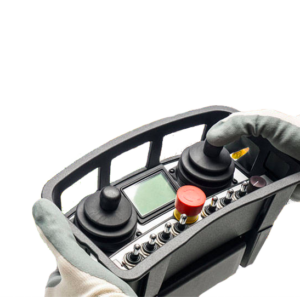
Providing practical operator controls for space-constrained belly boxes is a prime use case for thumbsticks. Some belly boxes are wired but are still relatively heavy and require a neck strap, while wireless versions can be even more weighty due to batteries. One drop as the box is picked up or removed can be catastrophic for the input devices unless they are built to withstand this type of rough treatment. Add to these considerations the fact that belly boxes are often used in high-EMI environments due to welding, and the need for rugged and properly rated operator input devices becomes clear (Figure 3).
The control console of a ship is another prime application for functions, such as thrusters, requiring precise operator control. Obviously, any shipboard device or instrument can be subject to water spray, but some users may think of a marine control panel as relatively protected from a mechanical standpoint. However, aboard a constantly moving ship, it can be quite common for users to grab anything handy to keep their balance. Thumbsticks are less susceptible to this problem than a larger joystick, and well-built thumbsticks will easily survive such abuse.
In addition to the above industrial and marine applications, there are also many commercial applications for thumbsticks. As electric vehicles and other transport equipment, such as wheelchairs, become more advanced, they need user input devices sized for convenient use but tough enough to handle mistreatment.
For industries as varied as construction, material handling, industrial robotics, marine controls, and more, the increasing use of automation and sensors is driving a need for refined control options that can survive in harsh environments. Low-profile Hall effect sensor joysticks/thumbsticks provide designers and users with a high-performance solution for fine control in the most challenging applications.
APEM
www.apem.com
Filed Under: Uncategorized