
When specifying surface treatment finishes, it is best to consider anodizing, electroplating, thermal spray and others early in the product development process. Each treatment offers unique properties and benefits as well as limitations.

Holes and other features in a design may not receive sufficient coating because of line-of-sight restrictions in the manufacturing process or they may require special equipment for proper coating.
According to vendors that apply surface treatment finishes to parts, there are steps you can take to ensure the coating process is as fast and cost-effective as possible. Attending to a few details early will reap the benefits of faster product cycle time, lower cost, and ensure better part performance in the field.
One reason to specify coatings is to extend the life of equipment. Protective coatings also provide lubrication and can increase structural integrity. In addition, the correct surface treatment can increase a part’s lifespan and reduce downtime and overhead.
Key factors that affect surface treatment include:
–Limitations in the manufacturing process
–Choice of base metal
–Part configuration and design
–Surface finish
Limitations in the manufacturing process
One of the more common process limitations experienced with electroplating, anodizing, spray coatings and physical vapor deposition (PVD) methods is ‘Line-of-sight.’ Essentially the rule with these processes is ‘what you see is what you can coat,’ so consider an immersion process for parts with hidden surfaces that require treatment.
For uniform penetration down a hole in a part, the depth of coating for line-of-sight applications is usually limited to 1 to 1½ times the diameter of the hole. The limitation is due to the limited ‘throw’ of a line-of-sight process. Therefore parts with deeper holes will not have a uniform coating thickness, which may be a significant issue for parts with tight tolerances.
Air pockets or ‘pocketing’ are commonly found with immersion processes such as anodizing and plating. If a critical surface must be coated, ensure that the part offers access to that surface so that the coating vendor can remove those pockets. Pocketing also reduces the efficiency of the coating process because the part often must be orientated (in the case of immersion processes) at different angles and then maneuvered to remove the air. Intricate parts are more susceptible to this issue, so consider using relief holes to allow the air to escape.
Base metal choices
The choice of base metal for the part can eliminate problems later. If the part has tight tolerances, for example, the processing temperatures can affect the final size and shape. Deformation can occur if application surface loads are high. During the coating procedure, process or post-process temperatures may exceed the substrate heat treatment recommended operating temperatures. As well as deformation, some metals suffer from structural stability issues where the part will move or actually change size.
With high strength alloys or materials such as titanium or tool steels, some manufacturing processes may trigger hydrogen embrittlement, which can make the part crack and fail under loads. In the cleaning process, which often involves acidic materials, certain alloys will impart hydrogen to the surface of the metal, initiating embrittlement. If the coating vendor is aware of this, he can take steps to reduce embrittlement after coating or use alternative cleaning processes to expel the hydrogen from the surface.
Often, a component or part will consist of more than one material. In this case the cleaning processes may differ for each material, complicating the plating surface treatment. One cleaning process may activate the surface of a specific metal for coating, while rendering the surface of the second material passive or inactive. If both surfaces cannot be coated at the same time, special masking will be required, driving labor costs up. Adhesion issues on the boundary areas between the two metals may also occur and when they are exposed to electrolytes, there may be a galvanic reaction between the two materials creating corrosion of one of the base materials.
Additionally, if the base metal of the part is extremely hard it can cause surface tensions that prevent a strong adhesion between the base material and coating. A bad bond between the part and coating will lead to chipping of the coating.
Part configuration
In many plating processes, sharp corners are subject to chipping; therefore it is always advisable to radius the parts. A greater radius provides more support for the coating and reduces the chance of chipping, but if a sharp corner is absolutely necessary then the coating thickness should be minimal.
Some processes that require electrical current to generate the coating produce an unwanted effect on sharp edges and corners of parts – greater coating thickness in those areas and less in others. If the part has tight tolerances, subsequent machining operations will be required, which increase both costs and time. Including sufficient corner and edge breaks helps avoids this issue.
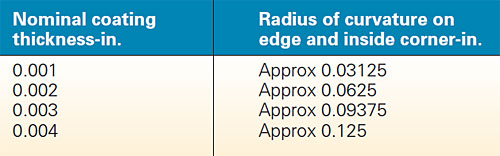
Curves should have these radii to achieve a nominal coating thickness.
If a part has thin areas of metal, then these spots can be prone to burning. When high voltages are required during some coating processes, thin sections of metal generate high amperages, which can cause those areas to burn. The metal finishing expert will have to adjust processes accordingly.
Size also matters with coatings. Immersion coating processes are limited by the tank size, so communicate with the vendor to see what size parts they can physically accommodate. In the case of very heavy parts, material-handling capabilities should also be discussed.

Parts with deep blind holes are subject to air pocketing and may require special fixtures or position to insure continuous coating.
Coating considerations
Parts are often racked for the coating process, so discuss the implications of this process with the coating vendor early in the product development stage. Racking means that areas of the part may be left uncoated where they come in contact with the rack, or the part may end up marked by the racking process.
If the part is large then it cannot be suspended by a small hole, so consider where to accommodate rack suspension within or on the part. In certain processes, particularly anodizing and electroplating, the racks act as a current carrying device so correct positioning of the racks is critical, as is the number of rack points required to achieve a uniform coating.
Some applications require areas of the part to be free from coating, requiring masking. Do not underestimate how much this process adds to the cost. If cost is an issue, then it is best to design a part that can be coated all over.
Tight part tolerances
Each coating process applies the coating to specific thickness and tolerances. Whenever possible, pre-size parts to accommodate coating thickness and tolerances.
Certain processes, such as plating, are described in terms of surface growth. For example, 0.001 mm of a coating will be equal to 0.001 mm of surface growth. Other methods, such as anodic processes, are described in terms of a combination of penetration and surface growth, where 0.001 mm of a coating may only be equal to 0.0005 mm of surface growth because the coating penetrates the metal’s surface.
Threads often have tight tolerances, especially on the pitch diameter where the two parts engage each other. On a 60° thread form, every unit of coating thickness applied to the surface will affect the pitch diameter by four times that amount. If threads must be coated, they should be pre-sized to accommodate the coating thickness requirement to ensure proper engagement.

Coating thickness affects pitch diameter. Here’s a look at common effects.
Surface finish
Some coating processes will replicate the surface finish, but only to a certain degree – measured in units of Ra. For instance, plating a surface can replicate as low as 16 to 32 Ra finish. For lower Ra values, or for a better finish, post grinding or polishing may be required.
General Magnaplate
www.magnaplate.com
::Design World::
Filed Under: Materials • advanced



Tell Us What You Think!