
Selecting the best material for your application can be tricky. Sometimes switching to a new or different material can affect product outcome and quality. Here is a look at some interesting material applications in the consumer goods, thermoforming, and aerospace arenas that you may consider.
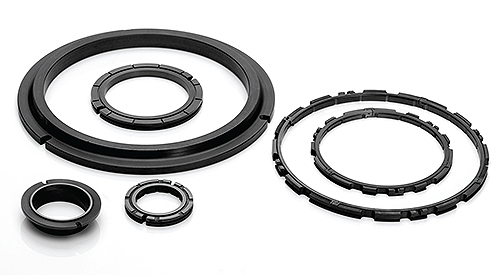
Mechanical carbon materials stand up to high sliding speed in shaft seals for aircraft gear boxes.
Recently, Polenghi LAS, an Italian food and juice bottler, developed Europe’s first extrusion-blow-molded Ingeo bottle for its new “bio” line of organic lemon juice. The company along with NatureWorks LLC, manufacturer of Ingeo bioplastic, reported that the bioplastic is made from renewable plant material, not oil.

Using a new Ingeo blend formulation, Polenghi LAS developed Europe’s first extrusionblow-molded bio-based
bottle. The material is made from renewable plant material, not oil. By switching from polyolefin resin to Ingeo
bio-plastic for packaging 10 million bottles of its new Bio organic lemon juice, Polenghi will conserve 1,000 barrels
of oil and reduce CO2 emissions by 126 tons.
By switching from polyolefin resin to the new material for packaging 10 million bottles of its new bio organic lemon juice, Polenghi will conserve 1,000 barrels of oil and reduce CO2 emissions by 126 tons compared to an equivalent oil-based plastic squeeze bottle. Polenghi’s achievement demonstrates the first European commercial introduction of a proven, low-environmental impact and renewably sourced bioplastic substitute for polyolefin resins in extrusion-blow-molding applications. This material also offers stable pricing compared to the volatility experienced in the petroleum market.
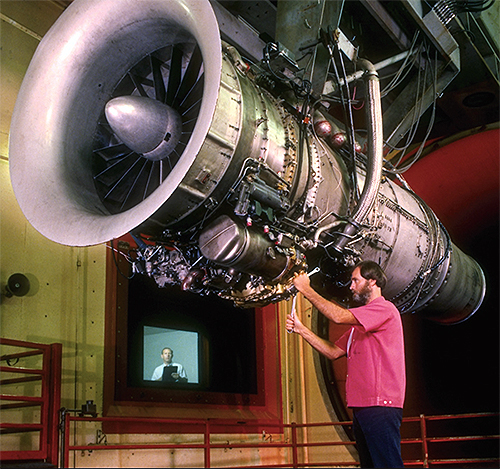
Main shaft seals for aircraft turbine engines and auxiliary power units must handle speed and high temperatures.
Polyethylene and polypropylene are the polyolefins typically used in the extrusion-blow-molding process to produce the soft plastic packaging often used for food and personal care squeeze bottles. The resin manufacturing process to produce Ingeo bioplastic emits 38% less CO2 and consumes 45% less energy than the resin manufacturing process for an equivalent weight low-density polyethylene. The resin manufacturing process to produce Ingeo bioplastic emits 31.6% less CO2 and consumes 42% less energy than the resin manufacturing process for polypropylene. Polenghi Bio, the organic lemon juice packed in the eco-friendly bottle, is available in Italy and will soon be stocked in stores throughout Europe.
In other thermal forming news, Ticona Engineering Polymers added Vectra T. rex to its family of flame resistant liquid crystal polymers (LCP). It was developed for thermal forming and extrusion processes and the company reports that the material offers high dimensional stability, high-temperature performance, and chemical resistance.
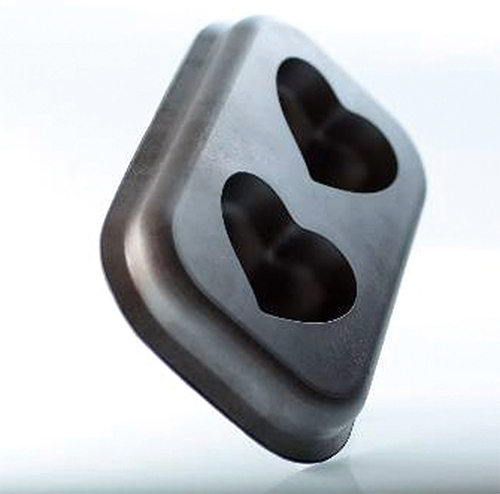
Here is a vacuum formed “double heart” mold made from extruded Vectra T. rex liquid crystal polymer. Photo credit: Klaus Kunststofftechnik
Other characteristics of this material include the following:
•High heat deflection temperature (HDT) of 245°C (473°F)
•20% improvement in impact performance versus standard 40% mineral filled LCP
•High melt viscosity – up to three times greater than standard 40% mineral filled LCP
Ticona developed the new material for customers that extrude sheets and films that can be thermoformed to finished components. Such applications include medical, aerospace, semiconductor, and kitchenware.
Carbon materials for aircraft applications
Oil-free, self-lubricating mechanical carbon materials possess a combination of characteristics that make them ideal for commercial and military aircraft seal applications. These materials are self-polishing and dimensionally stable which helps ensure a good seal mate. In addition, they are heat resistant and have a high thermal conductivity which helps conduct frictional heat away from the sliding surface. These materials are readily machinable to exacting aerospace dimensional tolerances and can be supplied lapped and polished to a flatness specification of one helium light band.
Modern mechanical carbon materials have a variety of uses including aircraft gear boxes, air turbine motor starters, and main shaft seals for aircraft turbine engines and aircraft auxiliary power units (APUs). These materials are made of fine-grained, electrographite substances that are impregnated with proprietary inorganic chemicals to improve lubricating properties and oxidation resistance.
To seal the oil lubricant within the gearbox and protect it from leaking out where the shaft enters and exits the gearbox, most aircraft gear boxes use face seals. These usually contain a carbon-graphite stationary ring and a silicon carbide or tungsten carbide rotating ring. The rings that make the dynamic face seal are both lapped flat and are held together with springs or magnets so that liquids cannot flow between the ring faces even though they are spinning against each other at high rpm.
The two rings in relative motion that make the dynamic seal are adhered to the shaft or the gear box housing with static seal rings such as polymeric O-rings. Seal designers use spiral grooves, straight grooves, and wedges to channel or pump a thin film of air or oil between the two sliding sealing faces. This creates aerodynamic or hydrodynamic lift which reduces the friction and wear of the seal faces.
MetCar Grade M-45 from Metalized Carbon Corporation can be used as the stationary ring. This material is well suited for these shaft seals because it is impermeable and can support aerodynamic film. It also has the ability to run at high speed with low friction and low wear.
Face seal rings with carbon-graphite primary rings and carbon-graphite circumferential seal rings are used in aircraft engine main shaft seals to control the air flow and combustion gas flow inside the engine. They also seal the oil lubricant in the main engine bearings that allow the compressor shaft and the combustion gas turbine shaft to rotate freely. Both circumferential and face type seal rings are used.
For circumferential main shaft seal rings, carbon-graphite segments that fit with close end clearance in slots in the stationary housing are used. The carbon-graphite segments are tensioned against a ceramic or hard metal coating on the rotating shaft using a “garter” spring.
Lifting wedges and machined configurations are used to create lift so that these seals run on an aerodynamic or hydrodynamic film. Rotating speeds can be as high as 26,000 rpm and temperatures in the seal rings can reach as high as 800°F.
MetCar Grade M-595 type materials are used for aircraft main shaft seals because the chemical additive in these grades prevents oxidation at high temperature and provides improved lubricating qualities at the required operating conditions.
APUs are small gas turbine engines that create electric power, air conditioning, or cabin heat when the main engines are turned off at the gate to save fuel. APUs contain carbon-graphite seals that are similar to but smaller than main engine seals.
Commercial foams
As the demand for thinner, larger, and more expensive LCD displays continues to grow, designers and manufacturers face new challenges with these increasingly complex technologies. Rogers Corp.’s newest offering – PORON ShockSeal foams – are specifically engineered to meet the cushioning, sealing, and protection requirements that larger displays demand. The product is available as thin as 0.5 mm, and conforms to some of the smallest and most intricate manufacturing designs.
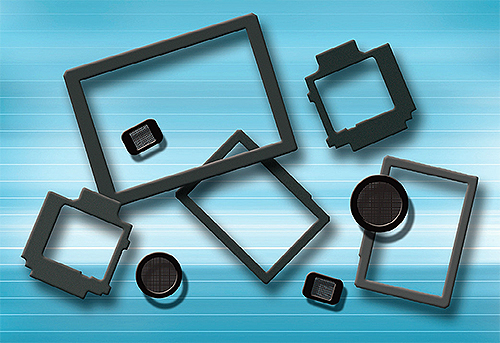
PORON ShockSeal foams for gaskets of all sizes.
Dropped cell phones, falling netbooks, and PDA’s knocked off of desks are some of the issues associated with using handheld devices. PORON materials have helped safeguard these devices, and now the PORON ShockSeal series offers more impact protection for sensitive applications. The company reports that the material reduces impact force by more than four times that of competitive materials.
These foams have the same compression set resistance as other PORON offerings and the same compressibility as the PORON 92 formulation. This helps them maintain spring forces over time and effectively seal out dust and other harmful particles.

Polenghi LAS
www.polenghigroup.it
NatureWorks LLC
www.natureworksllc.com
Ticona Engineering Polymers
www.ticona.com
Metalized Carbon Corporation
www.metcar.com
Rogers Corp.
www.rogerscorp.com
::Design World::
Filed Under: Aerospace + defense, Seals • O rings, Materials • advanced, Seals


Tell Us What You Think!