Design World

  • Home
  • Technologies
    • ELECTRONICS • ELECTRICAL
    • Fastening • joining
    • FLUID POWER
    • LINEAR MOTION
    • MOTION CONTROL
    • SENSORS
    • TEST & MEASUREMENT
    • Factory automation
    • Warehouse automation
    • DIGITAL TRANSFORMATION
  • Learn
    • Tech Toolboxes
    • Learning center
    • eBooks • Tech Tips
    • Podcasts
    • Videos
    • Webinars • general engineering
    • Webinars • Automated warehousing
    • Voices
  • LEAP Awards
  • 2025 Leadership
    • 2024 Winners
    • 2023 Winners
    • 2022 Winners
    • 2021 Winners
  • Design Guides
  • Resources
    • 3D Cad Models
      • PARTsolutions
      • TraceParts
    • Digital Issues
      • Design World
      • EE World
    • Educational Assets
    • Engineering diversity
    • Reports
    • Trends
  • Supplier Listings
  • Advertise
  • SUBSCRIBE
    • MAGAZINE
    • NEWSLETTER

New Method Improves Stability of Perovskite Quantum Dots

By Ecole Polytechnique Federale de Lausanne | May 30, 2017

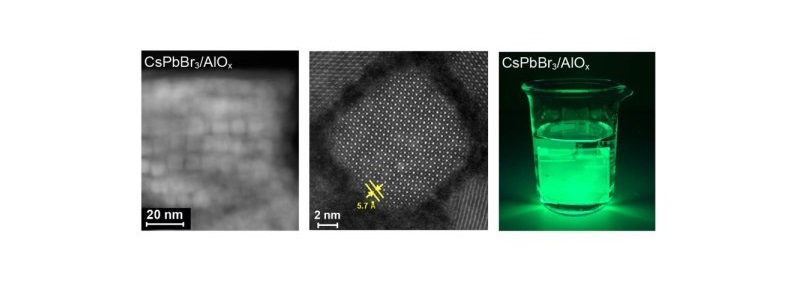
Electron microscopy images of perovskite quantum dots embedded in the protective alumina matrix, and a photograph of the same film stable in water. Image credit: R. Buonsanti/EPFL

Quantum dots are nanometer-size, semiconducting materials whose tiny size gives them unique optical properties. Much effort has been put in building quantum dots from perovskites, which already show much promise for solar panels, LEDs and laser technologies. Their fundamental optoelectronic properties are also very unique and of great interest among the scientific community. However, perovskite quantum dots have huge issues with stability against air, heat, light, and water. EPFL scientists have now succeeded in building perovskite quantum dot films with a technique that helps them overcome these weaknesses. The work is published in Angewandte Chemie.

The new approach to stabilize the perovskite quantum dots was developed in the lab of Raffaella Buonsanti at EPFL Valais Wallis. The innovation of this study, developed by Anna Loiudice and PhD student Seryio Saris, lies in a technique called “atomic layer deposition” (ALD), which is commonly used to fabricate ultra-thin films with high uniformity in their structure. The idea was to use ALD to encapsulate the perovskite quantum dots with an amorphous alumina matrix, which acts as a gas and ion diffusion barrier thus making the quantum dots more robust against air, light, heat, and moisture.

The team used an array of characterization techniques to monitor the nucleation and growth process of the alumina matrix on the quantum dot surface. The process showed that the interaction between the ALD precursor and the dot surface is crucial in order to uniformly coat the dots while preserving their optoelectronic properties.

“By addressing the stability challenge of perovskite quantum dots, this work is expected to greatly impact the field by enabling fundamental optoelectronic studies, which require the samples to be stable during the measurements, in addition to increase the durability of devices based on this new class of quantum dots,” said the authors.

This work received contributions from EPFL’s Interdisciplinary Centre for Electron Microscopy. It was funded by a Horizon 2020-Marie Curie Individual Fellowship and the Swiss National Science Foundation.

You might also like


Filed Under: Materials • advanced


LEARNING CENTER

Design World Learning Center
“dw
EXPAND YOUR KNOWLEDGE AND STAY CONNECTED
Get the latest info on technologies, tools and strategies for Design Engineering Professionals.
Motor University

Design World Digital Edition

cover

Browse the most current issue of Design World and back issues in an easy to use high quality format. Clip, share and download with the leading design engineering magazine today.

EDABoard the Forum for Electronics

Top global problem solving EE forum covering Microcontrollers, DSP, Networking, Analog and Digital Design, RF, Power Electronics, PCB Routing and much more

EDABoard: Forum for electronics

Sponsored Content

  • Robot Integration with Rotary Index Tables and Auxiliary Axes
  • How to Choose the Right Rotary Index Table for Your Application
  • Designing a Robust Rotary Index Table: Engineering Best Practices for Long-Term Performance
  • Custom Integration Options for your New and Existing Rotary Table Applications
  • Tech Tips: Crossed Roller Bearing Update
  • Five Uses for the Parvalux Modular Range
View More >>
Engineering Exchange

The Engineering Exchange is a global educational networking community for engineers.

Connect, share, and learn today »

Design World
  • About us
  • Contact
  • Manage your Design World Subscription
  • Subscribe
  • Design World Digital Network
  • Control Engineering
  • Consulting-Specifying Engineer
  • Plant Engineering
  • Engineering White Papers
  • Leap Awards

Copyright © 2026 WTWH Media LLC. All Rights Reserved. The material on this site may not be reproduced, distributed, transmitted, cached or otherwise used, except with the prior written permission of WTWH Media
Privacy Policy | Advertising | About Us

Search Design World

  • Home
  • Technologies
    • ELECTRONICS • ELECTRICAL
    • Fastening • joining
    • FLUID POWER
    • LINEAR MOTION
    • MOTION CONTROL
    • SENSORS
    • TEST & MEASUREMENT
    • Factory automation
    • Warehouse automation
    • DIGITAL TRANSFORMATION
  • Learn
    • Tech Toolboxes
    • Learning center
    • eBooks • Tech Tips
    • Podcasts
    • Videos
    • Webinars • general engineering
    • Webinars • Automated warehousing
    • Voices
  • LEAP Awards
  • 2025 Leadership
    • 2024 Winners
    • 2023 Winners
    • 2022 Winners
    • 2021 Winners
  • Design Guides
  • Resources
    • 3D Cad Models
      • PARTsolutions
      • TraceParts
    • Digital Issues
      • Design World
      • EE World
    • Educational Assets
    • Engineering diversity
    • Reports
    • Trends
  • Supplier Listings
  • Advertise
  • SUBSCRIBE
    • MAGAZINE
    • NEWSLETTER
We use cookies to personalize content and ads, to provide social media features, and to analyze our traffic. We share information about your use of our site with our social media, advertising, and analytics partners who may combine it with other information you’ve provided to them or that they’ve collected from your use of their services. You consent to our cookies if you continue to use this website.