Design World

  • Home
  • Technologies
    • ELECTRONICS • ELECTRICAL
    • Fastening • joining
    • FLUID POWER
    • LINEAR MOTION
    • MOTION CONTROL
    • SENSORS
    • TEST & MEASUREMENT
    • Factory automation
    • Warehouse automation
    • DIGITAL TRANSFORMATION
  • Learn
    • Tech Toolboxes
    • Learning center
    • eBooks • Tech Tips
    • Podcasts
    • Videos
    • Webinars • general engineering
    • Webinars • Automated warehousing
    • Voices
  • LEAP Awards
  • 2025 Leadership
    • 2024 Winners
    • 2023 Winners
    • 2022 Winners
    • 2021 Winners
  • Design Guides
  • Resources
    • 3D Cad Models
      • PARTsolutions
      • TraceParts
    • Digital Issues
      • Design World
      • EE World
    • Educational Assets
    • Engineering diversity
    • Reports
    • Trends
  • Supplier Listings
  • Advertise
  • SUBSCRIBE
    • MAGAZINE
    • NEWSLETTER

No Assembly Required: Researchers Automate Microrobotic Designs

By University of Toronto | April 26, 2019

Assembling a microrobot used to require a pair of needle-nosed tweezers, a microscope, steady hands and at least eight hours. But now University of Toronto Engineering researchers have developed a method that requires only a 3D printer and 20 minutes.

In the lab of Professor Eric Diller, researchers create magnetized microrobots—the size of the head of a pin—that can travel through fluid-filled vessels and organs within the human body. Diller and his team control the motion of these microrobots wirelessly using magnetic fields.

Each microrobot is built by precisely arranging microscopic sections of magnetic needles atop a flat, flexible material. Once deployed, the researchers apply magnetic fields to induce microrobots to travel with worm-like motion through fluid channels, or close its tiny mechanical ‘jaws’ to take a tissue sample.

“These robots are quite difficult and labour-intensive to fabricate because the process requires precision,” says graduate student, Tianqi Xu. “Also because of the need for manual assembly, it’s more difficult to make these robots smaller, which is a major goal of our research.”

That is why Xu and his labmates developed an automated approach that significantly cuts down on design and development time, and expands the types of microrobots they can manufacture. Their findings were published today in Science Robotics.

Smaller and more complex microrobots are needed for future medical applications, such as targeted drug delivery, assisted fertilization, or biopsies.

“If we were taking samples in the urinary tract or within fluid cavities of the brain—we envision that an optimized technique would be instrumental in scaling down surgical robotic tools,” Diller says.

To demonstrate the capabilities of their new technique, the researchers devised more than 20 different robotic shapes, which were then programmed into a 3D printer. The printer then builds and solidifies the design, orienting the magnetically patterned particles as part of the process.
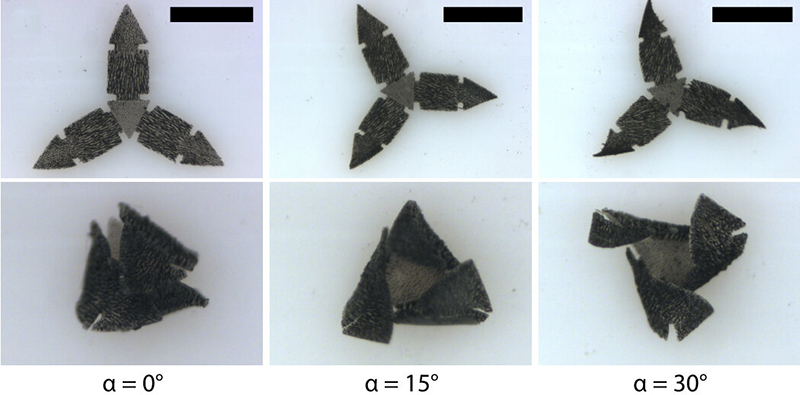
Top view images of the tri-arm soft magnetic structures that bear different magnetization profiles. Credit: Xu et al., Sci. Robot. 4, eaav4494 (2019)

“Previously, we would prepare one shape and manually design it, spend weeks planning it, before we could fabricate it. And that’s just one shape,” says Diller. “Then when we build it, we would inevitably discover specific quirks—for example, we might have to tweak it to be a little bigger or thinner to make it work.”

“Now we can program the shapes and click print,” adds Xu. “We can iterate, design and refine it easily. We have the power to really explore new designs now.”

The researchers’ optimized approach opens the doors for developing even smaller and more complex microrobots than the current millimetre-size. “We think it’s promising that we could one day go 10 times smaller,” says Diller.

Diller’s lab plans to use the automated process to explore more sophisticated and complicated shapes of microrobots. “As a robotics research community, there’s a need to explore this space of tiny medical robots,” adds Diller. “Being able to optimize designs is a really critical aspect of what the field needs.”

You might also like


Filed Under: 3D printing • additive • stereolithography, Rapid prototyping, Robotics • robotic grippers • end effectors
 

LEARNING CENTER

Design World Learning Center
“dw
EXPAND YOUR KNOWLEDGE AND STAY CONNECTED
Get the latest info on technologies, tools and strategies for Design Engineering Professionals.
Motor University

Design World Digital Edition

cover

Browse the most current issue of Design World and back issues in an easy to use high quality format. Clip, share and download with the leading design engineering magazine today.

EDABoard the Forum for Electronics

Top global problem solving EE forum covering Microcontrollers, DSP, Networking, Analog and Digital Design, RF, Power Electronics, PCB Routing and much more

EDABoard: Forum for electronics

Sponsored Content

  • Digitalization made easy: Bridging IT/OT with scalable network infrastructure
  • Apple Rubber custom o-rings for harsh underwater conditions
  • ASMPT chooses Renishaw for high-quality motion control
  • Innovating Together: How Italian Machine Builders Drive Industry Forward Through Collaboration
  • Efficiency Is the New Luxury — and Italy Is Delivering
  • Beyond the Build: How Italy’s Machine Makers Are Powering Smart Manufacturing
View More >>
Engineering Exchange

The Engineering Exchange is a global educational networking community for engineers.

Connect, share, and learn today »

Design World
  • About us
  • Contact
  • Manage your Design World Subscription
  • Subscribe
  • Design World Digital Network
  • Control Engineering
  • Consulting-Specifying Engineer
  • Plant Engineering
  • Engineering White Papers
  • Leap Awards

Copyright © 2025 WTWH Media LLC. All Rights Reserved. The material on this site may not be reproduced, distributed, transmitted, cached or otherwise used, except with the prior written permission of WTWH Media
Privacy Policy | Advertising | About Us

Search Design World

  • Home
  • Technologies
    • ELECTRONICS • ELECTRICAL
    • Fastening • joining
    • FLUID POWER
    • LINEAR MOTION
    • MOTION CONTROL
    • SENSORS
    • TEST & MEASUREMENT
    • Factory automation
    • Warehouse automation
    • DIGITAL TRANSFORMATION
  • Learn
    • Tech Toolboxes
    • Learning center
    • eBooks • Tech Tips
    • Podcasts
    • Videos
    • Webinars • general engineering
    • Webinars • Automated warehousing
    • Voices
  • LEAP Awards
  • 2025 Leadership
    • 2024 Winners
    • 2023 Winners
    • 2022 Winners
    • 2021 Winners
  • Design Guides
  • Resources
    • 3D Cad Models
      • PARTsolutions
      • TraceParts
    • Digital Issues
      • Design World
      • EE World
    • Educational Assets
    • Engineering diversity
    • Reports
    • Trends
  • Supplier Listings
  • Advertise
  • SUBSCRIBE
    • MAGAZINE
    • NEWSLETTER
We use cookies to personalize content and ads, to provide social media features, and to analyze our traffic. We share information about your use of our site with our social media, advertising, and analytics partners who may combine it with other information you’ve provided to them or that they’ve collected from your use of their services. You consent to our cookies if you continue to use this website.