Photo Credit: University of Massachusetts at Amherst
A lightweight, comfortable jacket that can generate the power to light up a jogger at night may sound futuristic, but materials scientist Trisha Andrew at the University of Massachusetts Amherst could make one today. In a new paper this month, she and colleagues outline how they have invented a way to apply breathable, pliable, metal-free electrodes to fabric and off-the-shelf clothing so it feels good to the touch and also transports enough electricity to power small electronics.
“Our lab works on textile electronics,” she says. “We aim to build up the materials science so you can give us any garment you want, any fabric, any weave type, and turn it into a conductor. Such conducting textiles can then be built up into sophisticated electronics. One such application is to harvest body motion energy and convert it into electricity in such a way that every time you move, it generates power.”
Powering advanced fabrics that can monitor health data remotely are important to the military and increasingly valued by the health care industry, she notes.
Generating small electric currents through relative movement of layers is called triboelectric charging, explains Andrew, who trained as a polymer chemist and electrical engineer. Materials can become electrically charged as they create friction by moving against a different material, like rubbing a comb on a sweater.
“By sandwiching layers of differently materials between two conducting electrodes, a few microwatts of power can be generated when we move,” she adds.
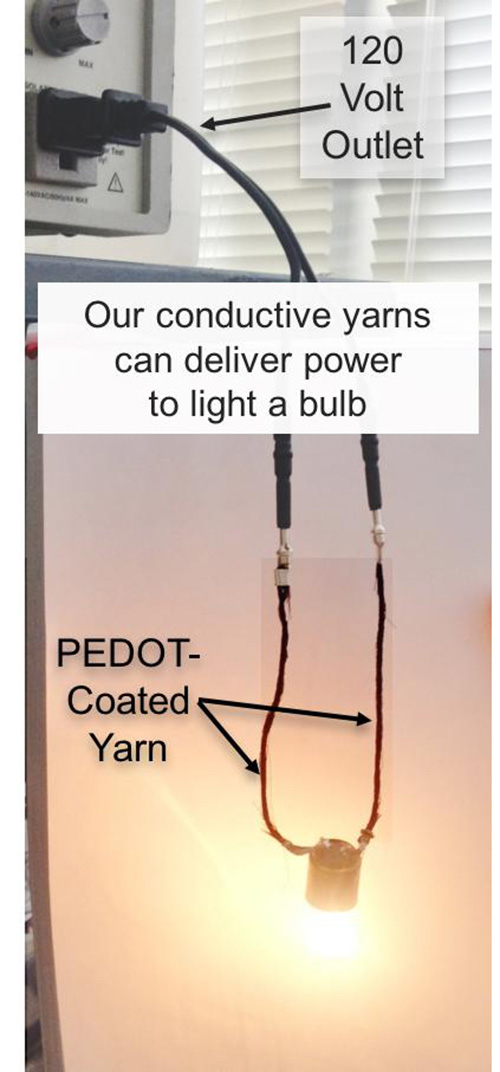
In the current early online edition of Advanced Functional Materials, she and postdoctoral researcher Lu Shuai Zhang in her lab describe the vapor deposition method they use to coat fabrics with a conducting polymer, poly(3,4-ethylenedioxytiophene) also known as PEDOT, to make plain-woven, conducting fabrics that are resistant to stretching and wear and remain stable after washing and ironing. The thickest coating they put down is about 500 nanometers, or about 1/10 the diameter of a human hair, which retains a fabric’s hand feel.
The authors report results of testing electrical conductivity, fabric stability, chemical and mechanical stability of PEDOT films and textile parameter effects on conductivity for 14 fabrics, including five cottons with different weaves, linen and silk from a craft store.
“Our article describes the materials science needed to make these robust conductors,” Andrew says. “We show them to be stable to washing, rubbing, human sweat and a lot of wear and tear.”
PEDOT coating did not change the feel of any fabric as determined by touch with bare hands before and after coating. Coating did not increase fabric weight by more than 2 percent. The work was supported by the Air Force Office of Scientific Research.
Until recently, she and Zhang point out, textile scientists have tended not to use vapor deposition because of technical difficulties and high cost of scaling up from the laboratory. But over the last 10 years, industries such as carpet manufacturers and mechanical component makers have shown that the technology can be scaled up and remain cost-effective. The researchers say their invention also overcomes the obstacle of power-generating electronics mounted on plastic or cladded, veneer-like fibers that make garments heavier and/or less flexible than off-the-shelf clothing “no matter how thin or flexible these device arrays are.”
“There is strong motivation to use something that is already familiar, such as cotton/silk thread, fabrics and clothes, and imperceptibly adapting it to a new technological application.” Andrew adds, “This is a huge leap for consumer products, if you don’t have to convince people to wear something different than what they are already wearing.”
Test results were sometimes a surprise, Andrew notes.
“You’d be amazed how much stress your clothes go through until you try to make a coating that will survive a shirt being pulled over the head. The stress can be huge, up to a thousand newtons of force. For comparison, one footstep is equal to about 10 newtons, so it’s yanking hard. If your coating is not stable, a single pull like that will flake it all off. That’s why we had to show that we could bend it, rub it and torture it. That is a very powerful requirement to move forward.”
Andrew is director of wearable electronics at the Center for Personalized Health Monitoring in UMass Amherst’s Institute of Applied Life Sciences (IALS). Since the basic work reported this month was completed, her lab has also made a wearable heart rate monitor with an off-the-shelf fitness bra to which they added eight monitoring electrodes. They will soon test it with volunteers on a treadmill at the IALS human movement facility.
She explains that a hospital heart rate monitor has 12 electrodes, while the wrist-worn fitness devices popular today have one, which makes them prone to false positives. They will be testing a bra with eight electrodes, alone and worn with leggings that add four more, against a control to see if sensors can match the accuracy and sensitivity of what a hospital can do. As the authors note in their paper, flexible, body-worn electronics represent a frontier of human interface devices that make advanced physiological and performance monitoring possible.
For the future, Andrew says, “We’re working on taking any garment you give us and turning it into a solar cell so that as you are walking around the sunlight that hits your clothes can be stored in a battery or be plugged in to power a small electronic device.”
Zhang and Andrew believe their vapor coating is able to stick to fabrics by a process called surface grafting, which takes advantage of free bonds dangling on the surface chemically bonding to one end of the polymer coating, but they have yet to investigate this fully.
Filed Under: Materials • advanced