Design World

  • Home
  • Technologies
    • ELECTRONICS • ELECTRICAL
    • Fastening • joining
    • FLUID POWER
    • LINEAR MOTION
    • MOTION CONTROL
    • SENSORS
    • TEST & MEASUREMENT
    • Factory automation
    • Warehouse automation
    • DIGITAL TRANSFORMATION
  • Learn
    • Tech Toolboxes
    • Learning center
    • eBooks • Tech Tips
    • Podcasts
    • Videos
    • Webinars • general engineering
    • Webinars • Automated warehousing
    • Voices
  • LEAP Awards
  • 2025 Leadership
    • 2024 Winners
    • 2023 Winners
    • 2022 Winners
    • 2021 Winners
  • Design Guides
  • Resources
    • 3D Cad Models
      • PARTsolutions
      • TraceParts
    • Digital Issues
      • Design World
      • EE World
    • Educational Assets
    • Engineering diversity
    • Reports
    • Trends
  • Supplier Listings
  • Advertise
  • SUBSCRIBE
    • MAGAZINE
    • NEWSLETTER

Photo Of The Day: 3D-Printed ‘Bionic Skin’ Could Give Robots The Sense Of Touch

By University of Minnesota College of Science and Engineering | May 11, 2017

Engineering researchers at the University of Minnesota have developed a revolutionary process for 3D printing stretchable electronic sensory devices that could give robots the ability to feel their environment. The discovery is also a major step forward in printing electronics on real human skin.

The research will be published in the next issue of Advanced Materials and is currently online.

“This stretchable electronic fabric we developed has many practical uses,” said Michael McAlpine, a University of Minnesota mechanical engineering associate professor and lead researcher on the study. “Putting this type of ‘bionic skin’ on surgical robots would give surgeons the ability to actually feel during minimally invasive surgeries, which would make surgery easier instead of just using cameras like they do now. These sensors could also make it easier for other robots to walk and interact with their environment.”

McAlpine, who gained international acclaim in 2013 for integrating electronics and novel 3D-printed nanomaterials to create a “bionic ear,” says this new discovery could also be used to print electronics on real human skin. This ultimate wearable technology could eventually be used for health monitoring or by soldiers in the field to detect dangerous chemicals or explosives.

“While we haven’t printed on human skin yet, we were able to print on the curved surface of a model hand using our technique,” McAlpine said. “We also interfaced a printed device with the skin and were surprised that the device was so sensitive that it could detect your pulse in real time.”

McAlpine and his team made the unique sensing fabric with a one-of-a kind 3D printer they built in the lab. The multifunctional printer has four nozzles to print the various specialized “inks” that make up the layers of the device — a base layer of silicone, top and bottom electrodes made of a conducting ink, a coil-shaped pressure sensor, and a sacrificial layer that holds the top layer in place while it sets. The supporting sacrificial layer is later washed away in the final manufacturing process.

Surprisingly, all of the layers of “inks” used in the flexible sensors can set at room temperature. Conventional 3D printing using liquid plastic is too hot and too rigid to use on the skin. These flexible 3D printed sensors can stretch up to three times their original size.

“This is a completely new way to approach 3D printing of electronics,” McAlpine said. “We have a multifunctional printer that can print several layers to make these flexible sensory devices. This could take us into so many directions from health monitoring to energy harvesting to chemical sensing.”

Researchers say the best part of the discovery is that the manufacturing is built into the process.

“With most research, you discover something and then it needs to be scaled up. Sometimes it could be years before it ready for use,” McAlpine said. “This time, the manufacturing is built right into the process so it is ready to go now.”

The researchers say the next step is to move toward semiconductor inks and printing on a real body.

“The possibilities for the future are endless,” McAlpine said.

In addition to McAlpine, the research team includes University of Minnesota Department of Mechanical Engineering graduate students Shuang-Zhuang Guo, Kaiyan Qiu, Fanben Meng, and Sung Hyun Park.

The research was funded by the National Institute of Biomedical Imaging and Bioengineering of the National Institutes of Health (Award No. 1DP2EB020537). The researchers used facilities at the University of Minnesota Characterization Facility and Polymer Characterization Facility for testing.
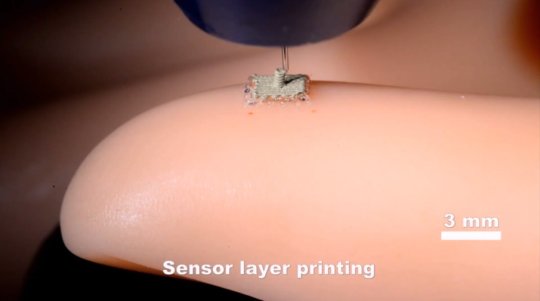
(Image Credit: Shuang-Zhuang Guo and Michael McAlpine, University Of Minnesota)

You might also like


Filed Under: Sensors (pressure), 3D printing • additive • stereolithography, M2M (machine to machine), Energy management + harvesting

 

LEARNING CENTER

Design World Learning Center
“dw
EXPAND YOUR KNOWLEDGE AND STAY CONNECTED
Get the latest info on technologies, tools and strategies for Design Engineering Professionals.
Motor University

Design World Digital Edition

cover

Browse the most current issue of Design World and back issues in an easy to use high quality format. Clip, share and download with the leading design engineering magazine today.

EDABoard the Forum for Electronics

Top global problem solving EE forum covering Microcontrollers, DSP, Networking, Analog and Digital Design, RF, Power Electronics, PCB Routing and much more

EDABoard: Forum for electronics

Sponsored Content

  • Five Uses for the Parvalux Modular Range
  • Robot Integration with Rotary Index Tables and Auxiliary Axes
  • How to Choose the Right Rotary Index Table for Your Application
  • Designing a Robust Rotary Index Table: Engineering Best Practices for Long-Term Performance
  • Custom Integration Options for your New and Existing Rotary Table Applications
  • How Apple Rubber’s Rapid Prototyping Kept Whale Research Afloat
View More >>
Engineering Exchange

The Engineering Exchange is a global educational networking community for engineers.

Connect, share, and learn today »

Design World
  • About us
  • Contact
  • Manage your Design World Subscription
  • Subscribe
  • Design World Digital Network
  • Control Engineering
  • Consulting-Specifying Engineer
  • Plant Engineering
  • Engineering White Papers
  • Leap Awards

Copyright © 2026 WTWH Media LLC. All Rights Reserved. The material on this site may not be reproduced, distributed, transmitted, cached or otherwise used, except with the prior written permission of WTWH Media
Privacy Policy | Advertising | About Us

Search Design World

  • Home
  • Technologies
    • ELECTRONICS • ELECTRICAL
    • Fastening • joining
    • FLUID POWER
    • LINEAR MOTION
    • MOTION CONTROL
    • SENSORS
    • TEST & MEASUREMENT
    • Factory automation
    • Warehouse automation
    • DIGITAL TRANSFORMATION
  • Learn
    • Tech Toolboxes
    • Learning center
    • eBooks • Tech Tips
    • Podcasts
    • Videos
    • Webinars • general engineering
    • Webinars • Automated warehousing
    • Voices
  • LEAP Awards
  • 2025 Leadership
    • 2024 Winners
    • 2023 Winners
    • 2022 Winners
    • 2021 Winners
  • Design Guides
  • Resources
    • 3D Cad Models
      • PARTsolutions
      • TraceParts
    • Digital Issues
      • Design World
      • EE World
    • Educational Assets
    • Engineering diversity
    • Reports
    • Trends
  • Supplier Listings
  • Advertise
  • SUBSCRIBE
    • MAGAZINE
    • NEWSLETTER
We use cookies to personalize content and ads, to provide social media features, and to analyze our traffic. We share information about your use of our site with our social media, advertising, and analytics partners who may combine it with other information you’ve provided to them or that they’ve collected from your use of their services. You consent to our cookies if you continue to use this website.