Design World

  • Home
  • Technologies
    • ELECTRONICS • ELECTRICAL
    • Fastening • joining
    • FLUID POWER
    • LINEAR MOTION
    • MOTION CONTROL
    • SENSORS
    • TEST & MEASUREMENT
    • Factory automation
    • Warehouse automation
    • DIGITAL TRANSFORMATION
  • Learn
    • Tech Toolboxes
    • Learning center
    • eBooks • Tech Tips
    • Podcasts
    • Videos
    • Webinars • general engineering
    • Webinars • Automated warehousing
    • Voices
  • LEAP Awards
  • 2025 Leadership
    • 2024 Winners
    • 2023 Winners
    • 2022 Winners
    • 2021 Winners
  • Design Guides
  • Resources
    • 3D Cad Models
      • PARTsolutions
      • TraceParts
    • Digital Issues
      • Design World
      • EE World
    • Educational Assets
    • Engineering diversity
    • Reports
    • Trends
  • Supplier Listings
  • Advertise
  • SUBSCRIBE
    • MAGAZINE
    • NEWSLETTER

How to Properly Pin a Shaft and Hub Assembly

By Frank Tobe | July 11, 2014

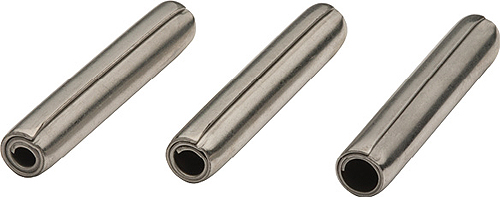
One of the benefits of using a coiled spring pin to affix a hub or gear to a shaft is the coiled pin’s ability to prevent hole damage. Another benefit is that the coiled pin absorbs wider hole tolerances than any other press-fit pin. This translates to lower total manufacturing costs of the assembly.

There are a few design guidelines that must be adhered to in order to achieve the maximum strength of the pinned system and prevent damage to the assembly:
Spirol

Load and host material should be considered when selecting coiled spring pins.

1. Shaft and Hub Considerations

• The hole in a shaft should not exceed 1/3 of the shaft diameter. For mild steel and nonferrous shafts, standard duty pins are recommended. The extra strength of a heavy duty pin is only beneficial if the hole is less than ¼ the diameter of the shaft or if the shaft is hardened.
• It is recommended that the hub be designed with a minimum wall thickness of 1.5 times the diameter of the pin. Otherwise, the strength of the hub will not match the shear strength of the pin. As wall thickness of the hub increases, so does the area of material around the pin.
• The diameter of the holes through both the shaft and hub should be precision matched to eliminate any movement of the pin within the holes. It is recommended that the difference between the hole diameters in the hub and shaft not exceed 0.05 mm (0.002 in.) to prevent movement of the parts relative to each other. Otherwise, the pin will be subject to dynamic loading such that a very small change in velocity could equate to a significant change in force impacting the assembly.
• The hole should be centered in both the shaft and hub to prevent stress concentration and ensure there is enough material around the pin to withstand the applied forces.
• If the holes cannot be precision matched, dividing the tolerance between the shaft and hub is recommended. The larger half of the tolerance should be applied to the component with the longest engagement length, and the smaller half should be applied to the other component.
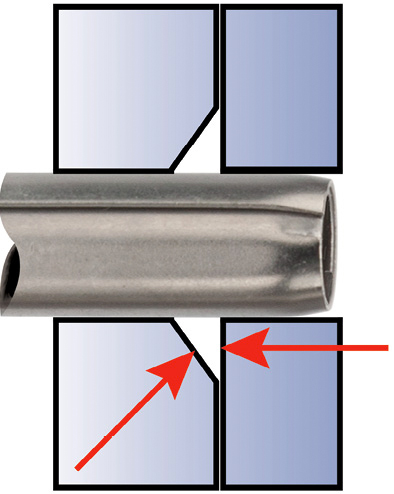
• The outer diameter of the shaft (OD) and the inner diameter of the collar (ID) should be designed such that the distance between the shear planes (OD-ID) does not exceed 0.13 mm (0.005 in.). In both cases, an unsupported length of pin in an area where torque may be applied is created. This could cause a bending moment, which shortens the lifespan of the pin.
• Installing a cylindrical pin into a hole on the surface of a cylindrical object leads to two-point contact between the pin and the hole. This concentrates the compression forces on only two points of the circumference. To increase the contact surface between the periphery of the hole and pin, and to ease installation, a flat should be placed on the exterior surface of the hole.
Spirol2

A countersink increases the distance between the shear planes. This can put the pin in bending and thus reduce the strength of the pin.

2. Coiled Pin Considerations

• It is important to start with the load to which the pin will be subjected and then evaluate the material of the host to determine the duty of the coiled pin. The pin diameter needed to transmit the load in the proper duty can then be determined from the shear strength tables located in the Spirol Coiled Spring Pins design guide/ product catalog taking into consideration these further guidelines:
• Standard duty pins have the optimum combination of strength and flexibility for use in nonferrous and mild steel components wherever space permits. They are also recommended for use in hardened components as they have greater shock absorbing abilities.
• Heavy duty pins should only be used in hardened materials where space or design limitations rule out a larger diameter standard duty coiled pin. An exception to this rule is that austenitic (nickel) stainless steel pins should never be used in hardened components.
• A light duty pin is recommended for soft, brittle or thin materials or where holes are close to an edge. In situations not subject to significant loads, light duty pins are often used because of the lower insertion forces required.

Spirol
www.spirol.com

You might also like


Filed Under: MOTION CONTROL
Tagged With: SPIROL
 

Comments

  1. Casey Huang says

    July 6, 2024 at

    Hello Spirol:
    We are trying to pin a rotor adapter to a Shaft. The rotor adaptor diameter is 54mm with keys that locks into the rotor. The adapter is made of 6061 aluminum with a center drill of 3/4″. The shaft is SS, hardened 3/4″ in diameter. We plan to insert two pins near the front (load) at right angle and one pin near the back. Can you recommend the correct pin size and material for the coiled spring pin? The Torque could be 85 Nm. Should we use a long pin that goes almost all the way, 54mm=2.125″ or shorter pins?

LEARNING CENTER

Design World Learning Center
“dw
EXPAND YOUR KNOWLEDGE AND STAY CONNECTED
Get the latest info on technologies, tools and strategies for Design Engineering Professionals.
Motor University

Design World Digital Edition

cover

Browse the most current issue of Design World and back issues in an easy to use high quality format. Clip, share and download with the leading design engineering magazine today.

EDABoard the Forum for Electronics

Top global problem solving EE forum covering Microcontrollers, DSP, Networking, Analog and Digital Design, RF, Power Electronics, PCB Routing and much more

EDABoard: Forum for electronics

Sponsored Content

  • Robot Integration with Rotary Index Tables and Auxiliary Axes
  • How to Choose the Right Rotary Index Table for Your Application
  • Designing a Robust Rotary Index Table: Engineering Best Practices for Long-Term Performance
  • Custom Integration Options for your New and Existing Rotary Table Applications
  • Tech Tips: Crossed Roller Bearing Update
  • Five Uses for the Parvalux Modular Range
View More >>
Engineering Exchange

The Engineering Exchange is a global educational networking community for engineers.

Connect, share, and learn today »

Design World
  • About us
  • Contact
  • Manage your Design World Subscription
  • Subscribe
  • Design World Digital Network
  • Control Engineering
  • Consulting-Specifying Engineer
  • Plant Engineering
  • Engineering White Papers
  • Leap Awards

Copyright © 2026 WTWH Media LLC. All Rights Reserved. The material on this site may not be reproduced, distributed, transmitted, cached or otherwise used, except with the prior written permission of WTWH Media
Privacy Policy | Advertising | About Us

Search Design World

  • Home
  • Technologies
    • ELECTRONICS • ELECTRICAL
    • Fastening • joining
    • FLUID POWER
    • LINEAR MOTION
    • MOTION CONTROL
    • SENSORS
    • TEST & MEASUREMENT
    • Factory automation
    • Warehouse automation
    • DIGITAL TRANSFORMATION
  • Learn
    • Tech Toolboxes
    • Learning center
    • eBooks • Tech Tips
    • Podcasts
    • Videos
    • Webinars • general engineering
    • Webinars • Automated warehousing
    • Voices
  • LEAP Awards
  • 2025 Leadership
    • 2024 Winners
    • 2023 Winners
    • 2022 Winners
    • 2021 Winners
  • Design Guides
  • Resources
    • 3D Cad Models
      • PARTsolutions
      • TraceParts
    • Digital Issues
      • Design World
      • EE World
    • Educational Assets
    • Engineering diversity
    • Reports
    • Trends
  • Supplier Listings
  • Advertise
  • SUBSCRIBE
    • MAGAZINE
    • NEWSLETTER
We use cookies to personalize content and ads, to provide social media features, and to analyze our traffic. We share information about your use of our site with our social media, advertising, and analytics partners who may combine it with other information you’ve provided to them or that they’ve collected from your use of their services. You consent to our cookies if you continue to use this website.