Design World

  • Home
  • Technologies
    • ELECTRONICS • ELECTRICAL
    • Fastening • joining
    • FLUID POWER
    • LINEAR MOTION
    • MOTION CONTROL
    • SENSORS
    • TEST & MEASUREMENT
    • Factory automation
    • Warehouse automation
    • DIGITAL TRANSFORMATION
  • Learn
    • Tech Toolboxes
    • Learning center
    • eBooks • Tech Tips
    • Podcasts
    • Videos
    • Webinars • general engineering
    • Webinars • Automated warehousing
    • Voices
  • LEAP Awards
  • 2025 Leadership
    • 2024 Winners
    • 2023 Winners
    • 2022 Winners
    • 2021 Winners
  • Design Guides
  • Resources
    • 3D Cad Models
      • PARTsolutions
      • TraceParts
    • Digital Issues
      • Design World
      • EE World
    • Educational Assets
    • Engineering diversity
    • Reports
    • Trends
  • Supplier Listings
  • Advertise
  • SUBSCRIBE
    • MAGAZINE
    • NEWSLETTER

Researchers Show How to Optimize Nanomaterials for Fuel-Cell Cathodes

By Rice University | January 5, 2018

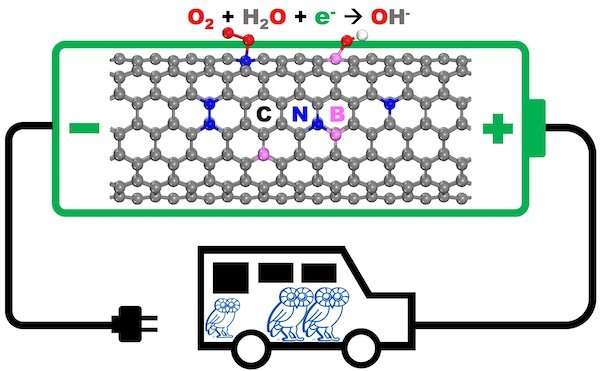
Nitrogen-doped carbon nanotubes or modified graphene nanoribbons may be suitable replacements for platinum for fast oxygen reduction, the key reaction in fuel cells that transform chemical energy into electricity, according to Rice University researchers.

The findings are from computer simulations by Rice scientists who set out to see how carbon nanomaterials can be improved for fuel-cell cathodes. Their study reveals the atom-level mechanisms by which doped nanomaterials catalyze oxygen reduction reactions (ORR).

The research appears in the Royal Society of Chemistry journal Nanoscale.

Theoretical physicist Boris Yakobson and his Rice colleagues are among many looking for a way to speed up ORR for fuel cells, which were discovered in the 19th century but not widely used until the latter part of the 20th. They have since powered transportation modes ranging from cars and buses to spacecraft.

The Rice researchers, including lead author and former postdoctoral associate Xiaolong Zou and graduate student Luqing Wang, used computer simulations to discover why graphene nanoribbons and carbon nanotubes modified with nitrogen and/or boron, long studied as a substitute for expensive platinum, are so sluggish and how they can be improved.

Doping, or chemically modifying, conductive nanotubes or nanoribbons changes their chemical bonding characteristics. They can then be used as cathodes in proton-exchange membrane fuel cells. In a simple fuel cell, anodes draw in hydrogen fuel and separate it into protons and electrons. While the negative electrons flow out as usable current, the positive protons are drawn to the cathode, where they recombine with returning electrons and oxygen to produce water.

The models showed that thinner carbon nanotubes with a relatively high concentration of nitrogen would perform best, as oxygen atoms readily bond to the carbon atom nearest the nitrogen. Nanotubes have an advantage over nanoribbons because of their curvature, which distorts chemical bonds around their circumference and leads to easier binding, the researchers found.

The tricky bit is making a catalyst that is neither too strong nor too weak as it bonds with oxygen. The curve of the nanotube provides a way to tune the nanotubes’ binding energy, according to the researchers, who determined that “ultrathin” nanotubes with a radius between 7 and 10 angstroms would be ideal. (An angstrom is one ten-billionth of a meter; for comparison, a typical atom is about 1 angstrom in diameter.)

They also showed co-doping graphene nanoribbons with nitrogen and boron enhances the oxygen-absorbing abilities of ribbons with zigzag edges. In this case, oxygen finds a double-bonding opportunity. First, they attach directly to positively charged boron-doped sites. Second, they’re drawn by carbon atoms with high spin charge, which interacts with the oxygen atoms’ spin-polarized electron orbitals. While the spin effect enhances adsorption, the binding energy remains weak, also achieving a balance that allows for good catalytic performance.

The researchers showed the same catalytic principles held true, but to lesser effect, for nanoribbons with armchair edges.

“While doped nanotubes show good promise, the best performance can probably be achieved at the nanoribbon zigzag edges where nitrogen substitution can expose the so-called pyridinic nitrogen, which has known catalytic activity,” Yakobson said.

“If arranged in a foam-like configuration, such material can approach the efficiency of platinum,” Wang said. “If price is a consideration, it would certainly be competitive.”


You might also like


Filed Under: Materials • advanced


LEARNING CENTER

Design World Learning Center
“dw
EXPAND YOUR KNOWLEDGE AND STAY CONNECTED
Get the latest info on technologies, tools and strategies for Design Engineering Professionals.
Motor University

Design World Digital Edition

cover

Browse the most current issue of Design World and back issues in an easy to use high quality format. Clip, share and download with the leading design engineering magazine today.

EDABoard the Forum for Electronics

Top global problem solving EE forum covering Microcontrollers, DSP, Networking, Analog and Digital Design, RF, Power Electronics, PCB Routing and much more

EDABoard: Forum for electronics

Sponsored Content

  • Five Uses for the Parvalux Modular Range
  • Robot Integration with Rotary Index Tables and Auxiliary Axes
  • How to Choose the Right Rotary Index Table for Your Application
  • Designing a Robust Rotary Index Table: Engineering Best Practices for Long-Term Performance
  • Custom Integration Options for your New and Existing Rotary Table Applications
  • How Apple Rubber’s Rapid Prototyping Kept Whale Research Afloat
View More >>
Engineering Exchange

The Engineering Exchange is a global educational networking community for engineers.

Connect, share, and learn today »

Design World
  • About us
  • Contact
  • Manage your Design World Subscription
  • Subscribe
  • Design World Digital Network
  • Control Engineering
  • Consulting-Specifying Engineer
  • Plant Engineering
  • Engineering White Papers
  • Leap Awards

Copyright © 2026 WTWH Media LLC. All Rights Reserved. The material on this site may not be reproduced, distributed, transmitted, cached or otherwise used, except with the prior written permission of WTWH Media
Privacy Policy | Advertising | About Us

Search Design World

  • Home
  • Technologies
    • ELECTRONICS • ELECTRICAL
    • Fastening • joining
    • FLUID POWER
    • LINEAR MOTION
    • MOTION CONTROL
    • SENSORS
    • TEST & MEASUREMENT
    • Factory automation
    • Warehouse automation
    • DIGITAL TRANSFORMATION
  • Learn
    • Tech Toolboxes
    • Learning center
    • eBooks • Tech Tips
    • Podcasts
    • Videos
    • Webinars • general engineering
    • Webinars • Automated warehousing
    • Voices
  • LEAP Awards
  • 2025 Leadership
    • 2024 Winners
    • 2023 Winners
    • 2022 Winners
    • 2021 Winners
  • Design Guides
  • Resources
    • 3D Cad Models
      • PARTsolutions
      • TraceParts
    • Digital Issues
      • Design World
      • EE World
    • Educational Assets
    • Engineering diversity
    • Reports
    • Trends
  • Supplier Listings
  • Advertise
  • SUBSCRIBE
    • MAGAZINE
    • NEWSLETTER
We use cookies to personalize content and ads, to provide social media features, and to analyze our traffic. We share information about your use of our site with our social media, advertising, and analytics partners who may combine it with other information you’ve provided to them or that they’ve collected from your use of their services. You consent to our cookies if you continue to use this website.