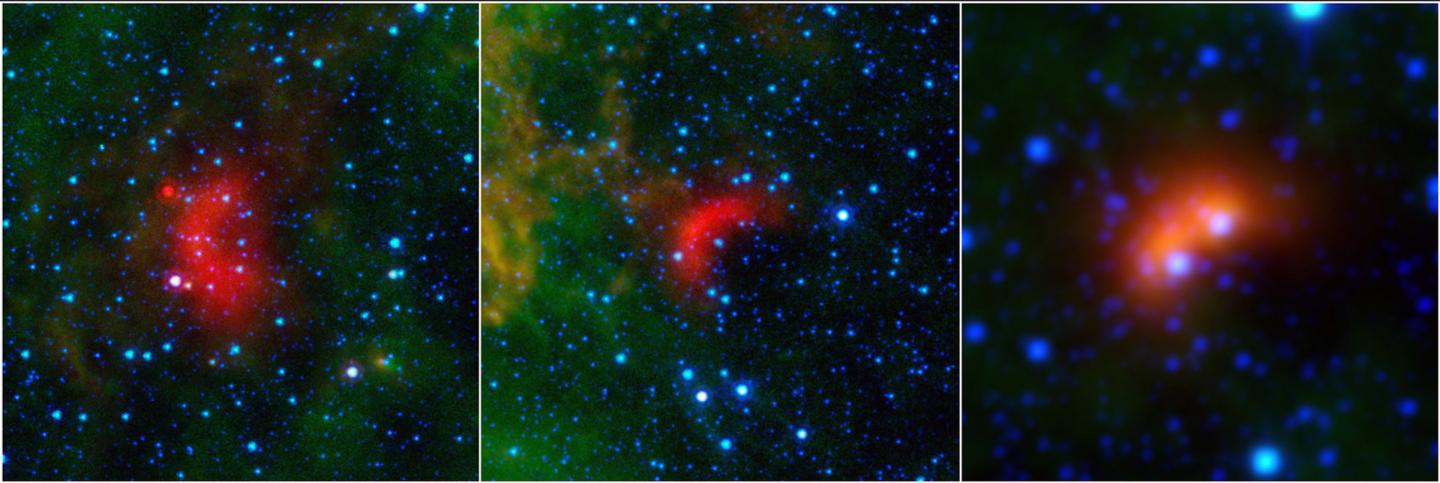
These images from NASA show fast-moving stars (in blue) and bow shocks (in red). Credit NASA
In the last year, astronomers from the University of Wyoming have discovered roughly 100 of the fastest-moving stars in the Milky Way galaxy with the aid of images from NASA’s Spitzer Space Telescope and Wide-field Infrared Survey Explorer (WISE), and use of the Wyoming Infrared Observatory (WIRO) on Jelm Mountain near Laramie, Wyo.
When some swift, massive stars — moving at speeds faster than 50,000 miles an hour — plow through space, they can cause material to stack up in front of them in the same way that water piles up ahead of a ship or a supersonic plane creates a shockwave in front of it. Called bow shocks, these dramatic arc-shaped features in space are helping researchers to uncover massive, so-called runaway stars.
“Some stars get the boot when their companion star explodes in a supernova, and others can get kicked out of crowded star clusters,” says William Chick, a UW doctoral student in physics, who presented his team’s new results Jan. 5 at the 227th American Astronomical Society meeting in Kissimmee, Fla. “The gravitational boost increases a star’s speed relative to other stars.”
“These are a previously uncatalogued collection of fascinating stars,” says Chip Kobulnicky, a UW professor in the Department of Physics and Astronomy, who supervises Chick. “These are hot, massive stars that are moving through interstellar space at supersonic speed.”
Kobulnicky says they use the bow shocks to locate these massive and/or runaway stars.
“The bow shocks are new laboratories for studying massive stars and answering questions about the fate and evolution of these stars,” he says.
The Earth’s sun moves around the Milky Way at a moderate pace, but it is not clear whether it creates a bow shock. By comparison, a massive star with a stunning bow shock, called Zeta Ophiuchi (or Zeta Oph), is traveling around the galaxy faster than the sun, at 54,000 mph (24 kilometers per second) relative to its surroundings. Zeta Oph’s bow shock can be seen at http://www.nasa.gov/mission_pages/WISE/multimedia/gallery/pia13455.html.
“It’s amazing that you can get something that big moving faster than 50,000 miles an hour,” Chick says. “It’s quite an event.”
Both the speed of stars moving through space and their mass contribute to the size and shapes of bow shocks. The more massive a star, the more material it sheds in high-speed winds. Zeta Oph, which is about 20 times as massive as the Earth’s sun, has supersonic winds that slam into the material in front of it.
When a massive star with fierce winds like Zeta Oph zips through space, it forms a pile-up of material that glows. This arc-shaped material heats up and shines with infrared light that is assigned the color red in the many pictures of bow shocks captured by Spitzer and WISE.
The death of supernovas is responsible for most of the heat created in the galaxy, half of all elements heavier than helium and half of all iron that resides in the human race, Chick says. These stars are five to six times hotter than the sun, which is 5,500 degrees Celsius, Kobulnicky says.
Chick and his team used archival infrared data from Spitzer and WISE to identify new bow shocks, including more distant ones that are more difficult to locate. Their initial search turned up more than 200 images of fuzzy red arcs. They then used WIRO to follow up on 80 of these candidates and identify the sources behind the suspected bow shocks. Most turned out to be massive stars.
While some of the stars may indeed be fast-moving runaways that were given a gravitational kick by other stars, in a small fraction of the cases, the arc-shaped features may turn out to be something else: dust from stars, or birth clouds of newborn stars. The team plans more observations to confirm the presence of the bow shocks.
Stephan Munari, a UW student from Cody, was one of five college students in UW’s Research Experience for Undergraduate Program who participated in this work. Other students were from California State Polytechnic University, Pomona; Case Western Reserve University in Toledo, Ohio; Embry Riddle Aeronautical University in Daytona Beach, Fla.; and Front Range Community College in Denver, Colo.
“I learned more about astronomy, how to conduct research and get some hands-on experience up at WIRO,” says Munari, a senior majoring in mechanical engineering. “What I thought was most interesting was the speed at which these stars were moving. It was a very good experience for me.”
Munari says the student work started on campus and consisted of looking through various databases for stars that show different wavelengths of light in infrared. From there, the students found basic bow shock shapes and wrote down their coordinates. The group then traveled to WIRO, pointed the telescope at these stars and obtained more data. Students processed the data and compared the newly discovered stars with those that were already known.
“Once we compared them, we could say, for 90 percent of them, we found another bow shock star,” Munari says. “For the other 10 percent, we couldn’t confirm that for sure.”
Chick says it was encouraging to receive positive comments about his presentation from Whitney Clavin, a science writer in the media office of NASA’s Jet Propulsion Laboratory (JPL).
“Of the eight presentations made that day, she told me I made the best one,” Chick says.
Kobulnicky added Chick was one of only 20 astronomers (out of 2,000) invited to make presentations at the conference.
Some of the first bow shocks from runaway stars were identified in the 1980s by David Van Buren of NASA’s JPL in Pasadena, Calif. He and his colleagues found them using infrared data from the Infrared Astronomical Satellite, a predecessor to WISE that scanned the whole infrared sky in 1983.
Kobulnicky and Chick belong to a larger team of researchers and students — including Matt Povich from California State Polytechnic University, Pomona — studying bow shocks and massive stars. The National Science Foundation funds their research.
Kobulnicky says his group is working on two papers for publication in The Astrophysical Journal, considered the world’s foremost research journal devoted to recent developments, discoveries and theories in astronomy and astrophysics.
Source: http://www.eurekalert.org/pub_releases/2016-01/uow-rsl011216.php
Filed Under: Aerospace + defense