
A typical hydraulic hose consists of an inner tube, one or several reinforcement layers, and an outer cover. Each component is vital for the performance and reliability of the hose. The inner tube must be compatible with the fluid it carries. Typical tube materials are thermoplastic compounds, synthetic rubber, and Teflon. The reinforcement layer (or layers) is wrapped around the tube so that the hose can withstand the operating pressure. Typical reinforcement materials are wire, cotton, and synthetic fibers. The outer cover protects the hose from the environment and external mechanical impact.
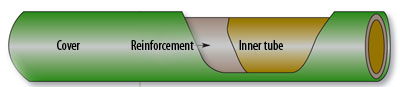
Parker Hannifin’s Parflex 560 is a general hydraulic hose designed for maximum working pressure of 1750 PSI (3/4 inch I.D.) to 3500 PSI (3/16 inch I.D.). The tube material is polyester, reinforcement is wire braid, and the cover is made of urethane.
Hoses are designed to have a finite life. They must be inspected periodically and replaced when deterioration is noticed. Improperly specifying a hose will shorten its life. The following major selection criterion must be considered.Selecting a hose with the pressure rating, equal to, or greater than the maximum working system pressure including surges, will ensure maximum hose service life. Ignoring the surges will shorten the life.
Suction applications, such as vacuum pumps, require special hoses designed for positive and negative pressure. External pressure is another factor. For example, if the external pressure of a hose installed inside a high-pressure chamber exceeds the fluid pressure inside the hose, the higher external pressure must be considered.
When selecting the temperature rating of a hose, consider possible temperature extremes of the fluid and the environment. For example, the transmission fluid temperature of a malfunctioning automotive transmission under heavy load can reach up to 400°F, well above the normal operating range. In another example, a hose might be routed next to a hot object raising its temperature from the outside.
The hose tube and the fittings come in direct contact with the fluid and must be compatible with it. However, if the hose cover and the reinforcement can come in contact with the fluid they must be resistant to the fluid as well.
Examples of environmental factors that can negatively affect the hose are abrasion, temperature, ultraviolet light, ozone, salt water, air pollution, and chemicals. Certain fluids can generate static electricity when flowing thorough the hose. If not properly drained, the static charge can produce sparks that pose a fire hazard or can puncture the hose. Hoses with high enough conductivity to drain the charge are available from hose
manufacturers.
Properly sizing the hose is critical. The inside diameter of a hose must be large enough to minimize the pressure losses. This lowers the heat generated by the losses and reduces the turbulence. Hose manufacturers recommend using a Fluid Velocity nomogram for the proper hose ID selection. This nomogram normally is available in hose catalogs and is based on the following equation:
pi d2 ÷ 4 = (Q x 0.321)/V
Where:
d = hose or tube inner diameter, in.
Q = fluid flow rate, gpm
V = fluid velocity, f/s.
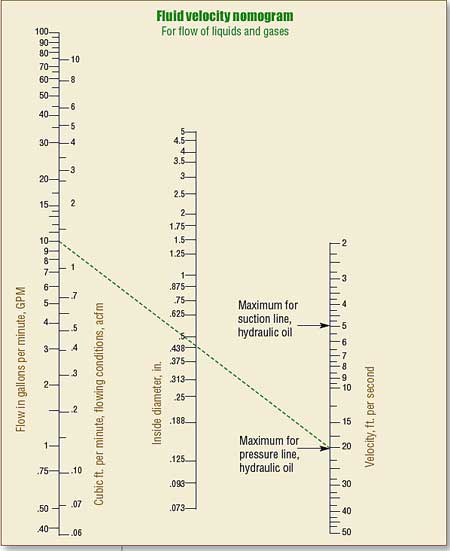
The left Flow axis has two scales,vgpm and ft3/min. The right Velocityvaxis has a ft/s scale and indicatesvthe maximum velocity values for “suction line, hydraulic oil,” and “pressure line, hydraulic oil.” The middle axis is the hose Inside Diameter scale. Mark the required flow rate on the left axis and the recommended velocity on the right
axis. Connect the marks with a straight line and find the minimum hose inside diameter.
Maximum recommended velocity values for suction lines and for pressure lines are usually marked on the Velocity axis of the nomogram. Verify what specifications and standards are required. Normally, hoses conform to the SAE J517 specifications, however, certain
applications might require a different design. Always check if the application requires certain hose cleanliness, such as might be the case in the food industry.
Just as important is the fitting selection. Hose failures at the hose fitting connection are one of the most frequent types. The hose and the fitting must be compatible. In addition, even though fittings from various manufactures have standard sizes, they are usually not interchangeable. Both the hose-fitting nipple and the hose socket must come from one manufacturer. Consult with the hose manufacturer for the recommended assembly equipment. Hoses must be cut and assembled using only the specified tools. When crimping the fitting onto the hose always follow the manufacturer’s assembly procedure, and after completing the assembly verify that the crimps comply with the manufacturer’s crimp specifications.
When installing the hose assembly care must be taken to protect the hose from rubbing against sharp edges, hot objects, and making contact with incompatible substances. In addition, applying high tensile force, twisting, burning, kinking, and cutting are frequent causes of premature hose failures. Finally, every hose was designed for a specific application. Using it in other applications might lead to equipment damage and personal injury.
::DW::
Filed Under: Hydraulic equipment + components, FLUID POWER, Off highway • construction • agriculture


Tell Us What You Think!