Dynamic warehouses seek robots that can adapt to change with minimal human intervention. With localization and mapping software, AMRs can build facility maps, orient themselves, detect differences, and share changes with their fleet for uninterrupted and safer operations.
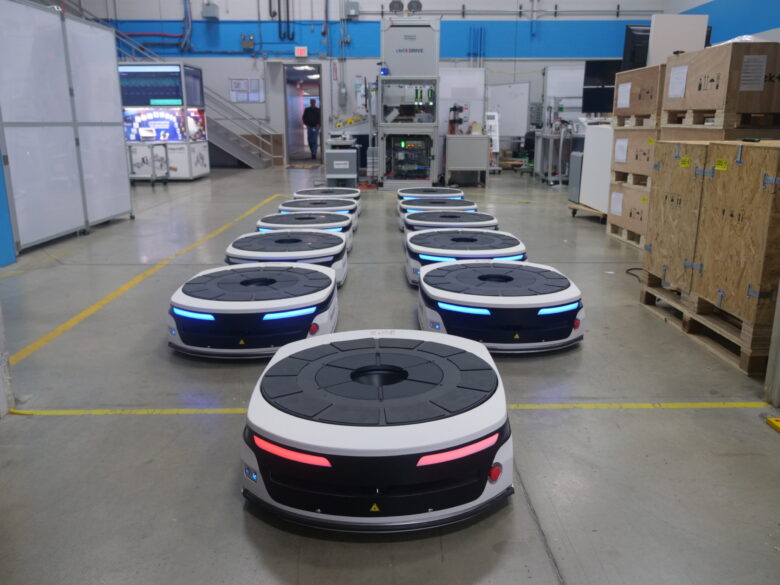
Each AMR detects changes on the warehouse floor so that localization software can update the base map and inform the entire fleet. Image courtesy of Bosch Rexroth.
When people were building warehouses 10 or 15 years ago in the U.S., few considered employing robots over human labor. In time, autonomous guided vehicles (AGVs) proved useful, and workers gradually appreciated their help. Yet AGVs need tape on the floor, magnets, or some sort of infrastructure, which requires well-thought-out strategies and sometimes permanent facility designs.
In comparison, emerging autonomous mobile robots (AMRs) live on the wild side and don’t necessarily need such infrastructure. They can navigate a facility’s current layout without adjustments to aisle widths or flooring. They’re characteristically flexible and can be less costly to implement.
However, the AMR market is still maturing, with new vendors popping up every day. And there’s a sustained resistance to change and an underlying fear that robots will steal jobs and be a headache to deploy and maintain. Many still ponder who will get the call at 3 a.m. when the robots aren’t working — and whose career will be on the line if the automation fails.
It’s fair to say that AMRs are only as effective as the people who commission them. So, the robots need a little human support during and after deployment to ensure they fulfill their intended purpose and function correctly.
“We make deploying robots sound really simple, but it’s a change. It’s an automation project and a people-change project,” said Chris Mercurio, sales product manager for AMR solutions in North America at Bosch Rexroth. “Once people get a chance to work with the robots, they realize they don’t have to walk all the way across the floor to get more supplies. They can just press a button.”
But make no mistake, warehouse robots aren’t servants that make people lazy. Sure, they can take over mundane, repetitive tasks, but they can also spare people chronic back pain, reduce trips and falls, and mitigate common safety risks.
“There are a lot of accidents involving forklifts and other industrial trucks. So, we let the robots take the strenuous and unsafe jobs and reserve people for critical thinking, problem-solving, and handling complex tasks. Everything else, we can automate,” said Mercurio.

In dynamic warehouses, AMRs must understand their location as shelves, pallets, and carts move around. Image courtesy of Bosch Rexroth.
Post-pandemic labor shortages and supply chain issues drive reshoring and automation efforts to recover from setbacks and prepare for new waves of uncertainty. Over the past few years, more companies have welcomed automation to fill vacancies long-term and move remaining people toward value-add operations. Hence, more AMRs are being deployed with no signs of slowing down.
AMRs’ popularity is intertwined with the advancements of their underlying technologies. For example, scanning and sensing technology improves alongside increased AMR demand and subsequently improves affordability. Similarly, the electric vehicle industry drives battery technology forward, and the AMR industry can take advantage of longer life and more uptime.
Additionally, software advancements have made AMRs more intelligent, and open-source solutions lower the barriers to entry. Manufacturers can use open-source technology, libraries, and development tools as a base to build upon without reinventing the wheel.
AMRs usually need three pieces of software: (1) a fleet manager that manages tasks and traffic, (2) a navigation piece that plans the paths and controls the robot’s motion, and (3) a localization piece that tells the robot where it is and where it’s going. The localization software is a key differentiator that makes AMRs more independent.
For instance, Bosch Rexroth’s Rokit Locator software is a simultaneous localization and mapping (SLAM) technology that determines the robot’s position and orientation based on an environment’s natural features, such as the building columns, walls, and machines.
“Rokit Locator creates a map based on the natural environment, and then it’s able to understand where it is on that map and navigate the facility,” said Mercurio. “It’s scanner agnostic and uses existing scanners on the robot to constantly scan the environment, draw a map, and position itself. An algorithm constantly compares the map to what the robot sees so it knows where it is.”

Users can monitor AMR locations and pathways along the SLAM-generated map in real time. Image courtesy of Bosch Rexroth.
This type of software is special because it’s a standalone solution that AMR manufacturers can use to upgrade their systems. They can also use it for other vehicles, such as forklifts, so that all mobile equipment uses the same map as the robots. This improves real-time location tracking to manage warehouse traffic better. Plus, it’s really easy to use.
“It helps our implementation engineers when they can show up, take the robot out of the box, turn it on, and start mapping the facility with a couple of clicks,” said Mercurio. “Just by driving the robot around, it can create that map of the facility. It almost looks like a video game.”
When the robot comes out of the box for the first time, a user will connect the robot to the facility’s wireless network and software. Then, the user manually drives the robot around with a controller, joystick, or interface, such as a tablet. Many safety features are turned off during the manual run-through, which can take as little as one hour or more than three hours, depending on the facility size. Once the initial map is created, the robot can move around autonomously, and personnel must be coached on interacting with the robots to ensure everyone’s safety.
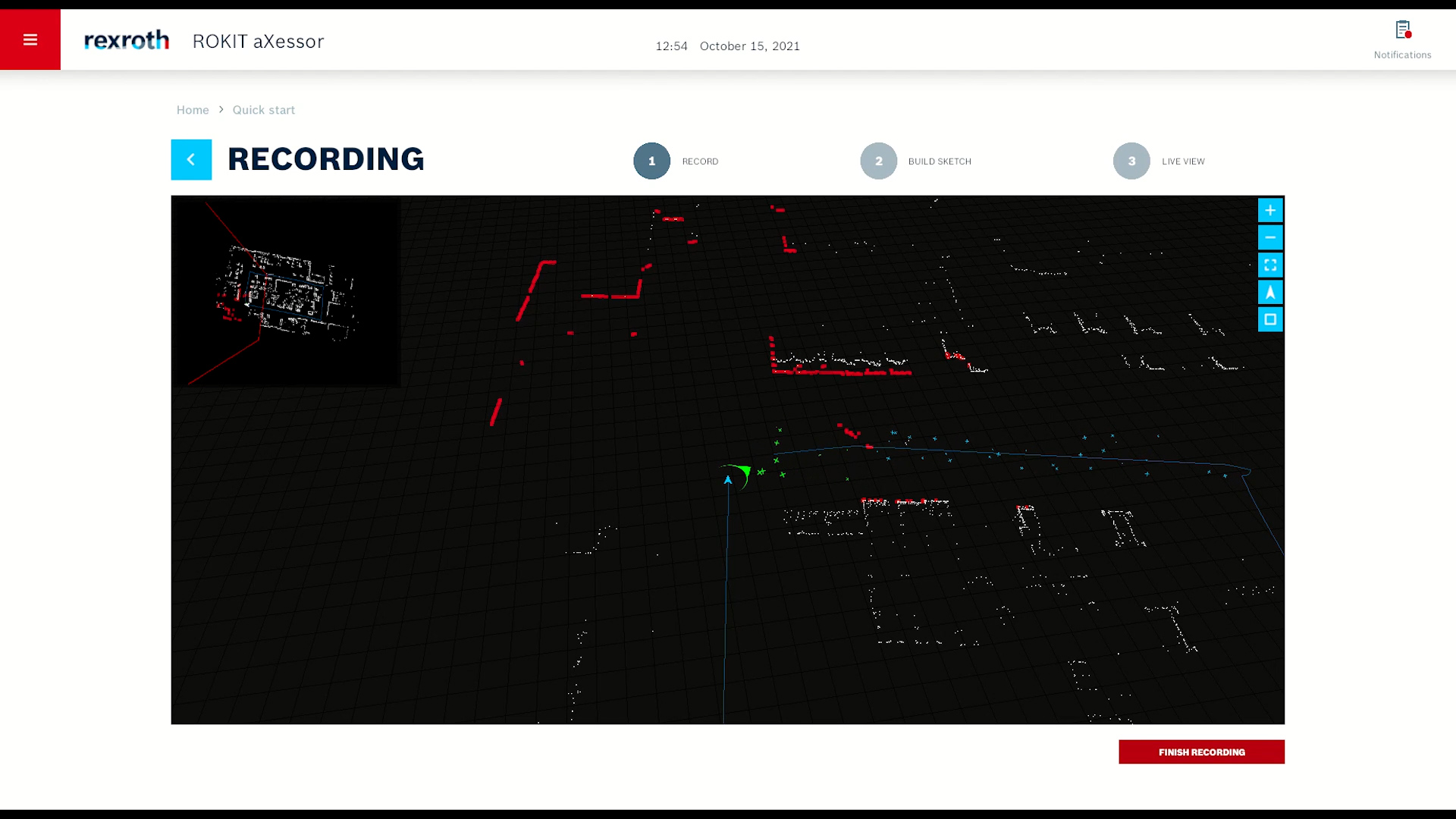
During initial setup, a user manually drives an AMR to create the base map. Then, the AMR can operate autonomously and update the map with detected changes. Image courtesy of Bosch Rexroth.
Many warehouses are dynamic environments. Some have wide-open spaces with few landmarks, while others constantly move pallets and carts, making it difficult for robots to orient themselves. Over weeks or months, enough small changes can throw off a robot such that personnel must redraw the map periodically or deal with the robot getting lost. Most likely, personnel will grow frustrated and stop using the robots.
However, when localization software is deployed to a robot fleet, the fleet records all detected changes. Then, the software modifies the base map and distributes the changes back to the fleet.
“It doesn’t matter how good your fleet management software is or what kind of robot you have. If the robot can’t localize itself, you’re going to have problems,” said Mercurio.
Rokit Locator can use up to two lasers and the wheel odometry for location accuracy. In the near future, Bosch Rexroth will also include a navigation solution to help plan paths. With localization, the robots know where they are; with navigation, they’ll chart an optimal course and respond to obstructions and traffic more intelligently.
“The next big trend in the AMR space will be interoperability — robots from different manufacturers being able to work together in the same environment,” said Mercurio. “And as the adoption rate goes up, warehouses might want to diversify providers to accomplish different tasks. That will push manufacturers to find ways to add value. I’m sure we’ll see all kinds of integrated solutions around robots.”
As AMRs evolve, we may see more 3D vision and more efficient motors and wheels. We may also find more mobile robots outside factories and warehouses, as they’re already in hospitals, grocery stores, and restaurants. And just as other industries advance warehouse automation technology, hardware and software improvements in warehouses influence applications and make robotic solutions more available and affordable.
Bosch Rexroth
boschrexroth.com
You may also like:


Filed Under: Warehouse automation, ENGINEERING SOFTWARE, Robotics • robotic grippers • end effectors