Design World

  • Home
  • Technologies
    • ELECTRONICS • ELECTRICAL
    • Fastening • joining
    • FLUID POWER
    • LINEAR MOTION
    • MOTION CONTROL
    • SENSORS
    • TEST & MEASUREMENT
    • Factory automation
    • Warehouse automation
    • DIGITAL TRANSFORMATION
  • Learn
    • Tech Toolboxes
    • Learning center
    • eBooks • Tech Tips
    • Podcasts
    • Videos
    • Webinars • general engineering
    • Webinars • Automated warehousing
    • Voices
  • LEAP Awards
  • 2025 Leadership
    • 2024 Winners
    • 2023 Winners
    • 2022 Winners
    • 2021 Winners
  • Design Guides
  • Resources
    • 3D Cad Models
      • PARTsolutions
      • TraceParts
    • Digital Issues
      • Design World
      • EE World
    • Educational Assets
    • Engineering diversity
    • Reports
    • Trends
  • Supplier Listings
  • Advertise
  • SUBSCRIBE
    • MAGAZINE
    • NEWSLETTER

Student Develops Spinning Heat Shield For Future Spacecraft

By University of Manchester | August 13, 2018

A University of Manchester PhD student has developed a prototype flexible heat shield for spacecraft that could reduce the cost of space travel and even aid future space missions to Mars.

Heat shields are essentially used as the brakes to stop spacecraft burning up and crashing on entry and re-entry into a planet’s atmosphere. This design is the first in the world to utilise centrifugal forces that stiffen lightweight materials to prevent burnup.

Current spacecraft heat shield methods include huge inflatables and mechanically deployed structures that are often heavy and complicated to use.

Rui Wu, from Manchester’s School of Mechanical, Aerospace and Civil Engineering, says as well as being lightweight in design is prototype is also “self-regulating”. This means there is no need for any additional machinery, reducing the weight of spacecraft even further and allowing for low-cost scientific research and recovery of rocket parts.

He says: “Spacecraft for future missions must be larger and heavier than ever before, meaning that heat shields will become increasingly too large to manage.”
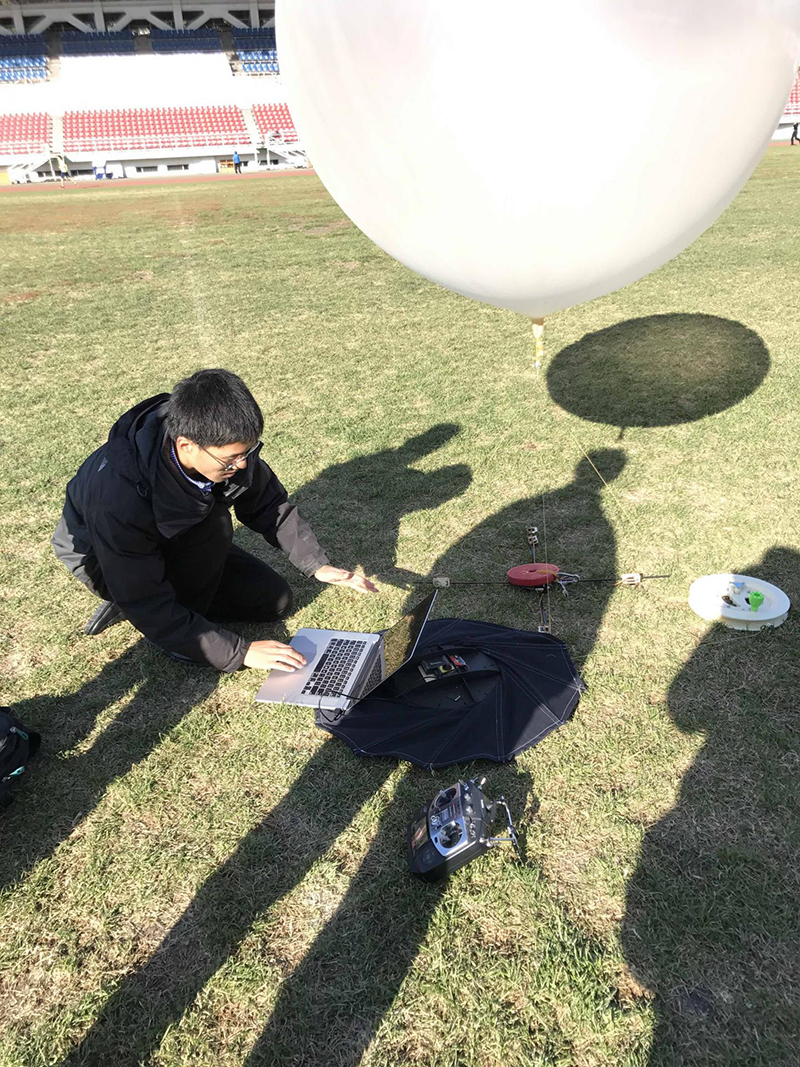
Rui Wu on location testing his heat shield. CREDIT Rui Wu, The University of Manchester

To address this demand Wu and his team have developed a flexible heat shield that is shaped like a skirt and spins like a sycamore seed. Planets with atmospheres, such as Earth and Mars, allow spacecraft to utilise aerodynamic drag to slow down and the prototype’s design uses this to enable atmospheric entry.

“This is similar to high board diving, where the drag from water decelerates your body before you reach the bottom of the swimming pool,” Wu explains.

The fast entry into Earth’s atmosphere generates so much heat – over 10,000 ?C – that the air around the spacecraft can burn into plasma. For safe atmospheric entry, spacecraft need a front end, or shield, that tolerates high heat as well as an aerodynamic shape that generates drag.

However, Unlike Earth, the Martian atmosphere is very thin. “If Earth re-entry is like diving into thick honey, Mars entry would be like diving into water,” Wu says.

To carry heavy equipment and astronauts, a high drag area is needed. When entering Earth’s or Mars’ atmospheres, spacecraft require highly designed shields to avoid burnup, generate drag, and support heavy loads.

Wu’s design potentially solves both issues.

The prototype is made of a flexible material that allows for easy storage on board spacecraft. This material, while foldable, is strong and has a high temperature tolerance.

The shield is also stitched along a special pattern that allows it to spin up during flight, inducing centrifugal force.

Wu sees his design helping with space-based scientific research and rescue missions in the future. He adds: “More and more research is being conducted in space, but this is usually very expensive and the equipment has to share a ride with other vehicles.

“Since this prototype is lightweight and flexible enough for use on smaller satellites, research could be made easier and cheaper. The heat shield would also help save cost in recovery missions, as its high induced drag reduces the amount of fuel burned upon re-entry.”
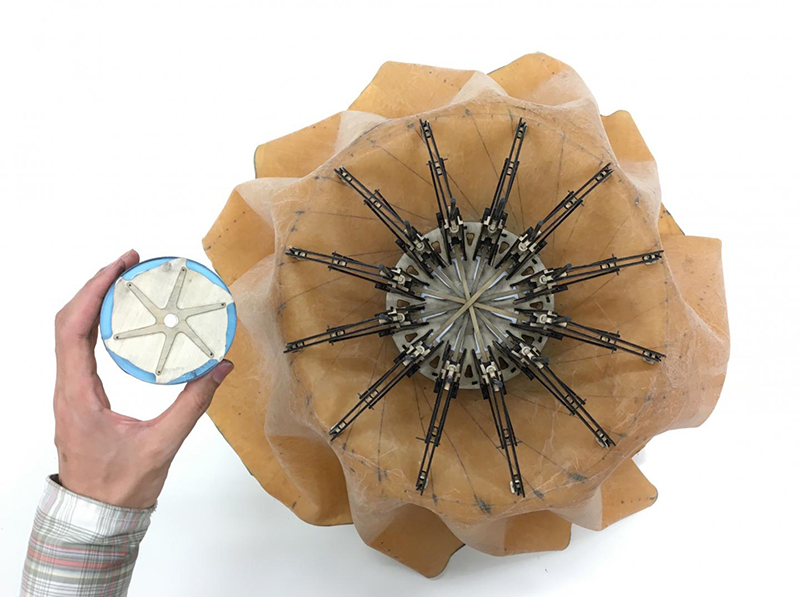
This is the CuSat size system and Cargo Bay image of heat shield CREDIT Rui Wu, The University of Manchester

You might also like


Filed Under: Aerospace + defense, Student programs • Technical education

 

LEARNING CENTER

Design World Learning Center
“dw
EXPAND YOUR KNOWLEDGE AND STAY CONNECTED
Get the latest info on technologies, tools and strategies for Design Engineering Professionals.
Motor University

Design World Digital Edition

cover

Browse the most current issue of Design World and back issues in an easy to use high quality format. Clip, share and download with the leading design engineering magazine today.

EDABoard the Forum for Electronics

Top global problem solving EE forum covering Microcontrollers, DSP, Networking, Analog and Digital Design, RF, Power Electronics, PCB Routing and much more

EDABoard: Forum for electronics

Sponsored Content

  • Digitalization made easy: Bridging IT/OT with scalable network infrastructure
  • Apple Rubber custom o-rings for harsh underwater conditions
  • ASMPT chooses Renishaw for high-quality motion control
  • Innovating Together: How Italian Machine Builders Drive Industry Forward Through Collaboration
  • Efficiency Is the New Luxury — and Italy Is Delivering
  • Beyond the Build: How Italy’s Machine Makers Are Powering Smart Manufacturing
View More >>
Engineering Exchange

The Engineering Exchange is a global educational networking community for engineers.

Connect, share, and learn today »

Design World
  • About us
  • Contact
  • Manage your Design World Subscription
  • Subscribe
  • Design World Digital Network
  • Control Engineering
  • Consulting-Specifying Engineer
  • Plant Engineering
  • Engineering White Papers
  • Leap Awards

Copyright © 2025 WTWH Media LLC. All Rights Reserved. The material on this site may not be reproduced, distributed, transmitted, cached or otherwise used, except with the prior written permission of WTWH Media
Privacy Policy | Advertising | About Us

Search Design World

  • Home
  • Technologies
    • ELECTRONICS • ELECTRICAL
    • Fastening • joining
    • FLUID POWER
    • LINEAR MOTION
    • MOTION CONTROL
    • SENSORS
    • TEST & MEASUREMENT
    • Factory automation
    • Warehouse automation
    • DIGITAL TRANSFORMATION
  • Learn
    • Tech Toolboxes
    • Learning center
    • eBooks • Tech Tips
    • Podcasts
    • Videos
    • Webinars • general engineering
    • Webinars • Automated warehousing
    • Voices
  • LEAP Awards
  • 2025 Leadership
    • 2024 Winners
    • 2023 Winners
    • 2022 Winners
    • 2021 Winners
  • Design Guides
  • Resources
    • 3D Cad Models
      • PARTsolutions
      • TraceParts
    • Digital Issues
      • Design World
      • EE World
    • Educational Assets
    • Engineering diversity
    • Reports
    • Trends
  • Supplier Listings
  • Advertise
  • SUBSCRIBE
    • MAGAZINE
    • NEWSLETTER
We use cookies to personalize content and ads, to provide social media features, and to analyze our traffic. We share information about your use of our site with our social media, advertising, and analytics partners who may combine it with other information you’ve provided to them or that they’ve collected from your use of their services. You consent to our cookies if you continue to use this website.