A fried breakfast food popular in Spain provided the inspiration for the development of doughnut-shaped droplets that may provide scientists with a new approach for studying fundamental issues in physics, mathematics and materials.
The doughnut-shaped droplets, a shape known as toroidal, are formed from two dissimilar liquids using a simple rotating stage and an injection needle. About a millimeter in overall size, the droplets are produced individually, their shapes maintained by a surrounding springy material made of polymers. Droplets in this toroidal shape made of a liquid crystal – the same type of material used in laptop displays – may have properties very different from those of spherical droplets made from the same material.
While researchers at the Georgia Institute of Technology don’t have a specific application for the doughnut-shaped droplets yet, they believe the novel structures offer opportunities to study many interesting problems, from looking at the properties of ordered materials within these confined spaces to studying how geometry affects how cells behave.
“Our experiments provide a fresh approach to the way that people have been looking at these kinds of problems, which is mainly theoretical. We are doing experiments with toroids whose geometry can be precisely controlled in the lab,” said Alberto Fernandez-Nieves, an assistant professor in the Georgia Tech School of Physics. “This work opens up a new way to experimentally look at problems that nobody has been able to study before. The properties of toroidal surfaces are very different, from a general point of view, from those of spherical surfaces.”
Development of these “stable nematic droplets with handles” was described May 20 in the early edition of the journal Proceedings of the National Academy of Sciences (PNAS). The research has been sponsored by the National Science Foundation (NSF), and also involves researchers at the Lorentz Institute for Theoretical Physics at Leiden University in The Netherlands and at York University in the United Kingdom.
Droplets normally form spherical shapes to minimize the surface area required to contain a given volume of liquid. Though they appear to be simple, when an ordered material like a crystal or a liquid crystal lives on the surface of a sphere, it provides interesting challenges to mathematicians and theoretical physicists.
A physicist who focuses on soft condensed matter, Fernandez-Nieves had long been interested in the theoretical aspects of curved surfaces. Working with graduate research assistant Ekapop Pairam and postdoctoral fellow Jayalakshmi Vallamkondu, he wanted to extend the theoretical studies into the experimental world for a system of toroidal shapes.
But could doughnut-shaped droplets be made in the lab?
The partial answer came from churros Fernandez-Nieves ate as a child growing up in Spain. These “Spanish doughnuts” – actually spirals – are made by injecting dough into hot oil while the dough is spun and fried.
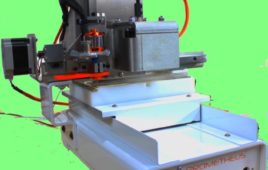
In the lab at a much smaller size scale, the researchers found they could use a similar process with two immiscible liquids such as glycerine or water and oil, a needle and a magnetically-controlled rotating stage. A droplet of glycerine is injected into the rotating stage containing the oil. In certain conditions, a jet forms at the needle, which closes up into a torus because of the imposed rotation.
“You can control the two relevant curvatures of the torus,” explained Fernandez-Nieves. “You can control how large it is because you can move the needle with respect to the rotation axis. You can also infuse more volume to make the torus thicker.”
If the stage is then turned off, however, the drop of glycerine quickly loses its doughnut shape as surface tension forces it to become a traditional spherical droplet. To maintain the toroidal shape, Fernandez-Nieves and his collaborators replace the surrounding oil with a springy polymeric material; the springy character of this material provides a force that can overcome surface tension forces.
“When you are making the toroid, the forces on the needle are large enough that the surrounding material behaves as a fluid,” he explained. “Once you stop, the elasticity of the outside fluid overcomes surface tension and that freezes the structure in place.”
The researchers have been using the doughnut shapes to study how liquid crystal materials, which are well known for their applications in laptop displays, organize inside the torus. These materials have degrees of order beyond those of simple liquids such as water. For these materials, the toroidal shape provides a new set of study opportunities from both theoretical and experimental perspectives.
“This changes how you think about a liquid inside a container,” said Fernandez-Nieves. “The materials will still adopt the shape of the container, but its energy will be different depending on the shape. The materials feel distortions and will try to minimize them. In a given shape, the molecules in these materials will rearrange themselves to minimize these distortions.”
Among the surprises is that the nematic droplets created with toroidal shapes become chiral, that is, they adopt a certain twisting direction and break their mirror symmetry.
“In our case, the materials we are using are not chiral under normal circumstances,” he noted. “This was a surprise to us, and it has to do with how we are confining the molecules.”
Beyond looking at the dynamics of creating the droplets and how ordered materials behave when the torus transforms into a sphere, Fernandez-Nieves and colleagues are also exploring potential biological applications, applying electrical fields to the droplets, and sharing the unique structures with scientists at other institutions.
“This is the first time that stable nematic droplets have been generated with handles, and we have exploited that to look at the nematic organization inside those spaces,” said Fernandez-Nieves. “Our experiments open up a versatile new approach for generating handled droplets made of an ordered material that can self-assemble into interesting and unexpected structures when confined to these non-spherical spaces. Now that theoreticians realize we can generate and study these systems, there may be much more development in this area.”
In addition to those already mentioned, the paper’s authors included V. Koning, B.C. van Zuiden and V. Vitelli from Leiden University, M.A. Bates from the University of York in the United Kingdom, and P.W. Ellis from Georgia Tech.
Filed Under: Rapid prototyping