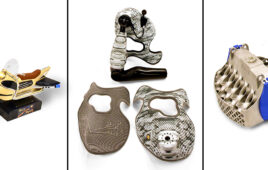
The convergence of software, cloud computing, and additive manufacturing (3D printing) technologies has given manufacturers the ability to cost-effectively supply millions, thousands, or dozens of a given workpiece — and even batch sizes down to one. It’s no wonder that worldwide, batch sizes have in fact shrunk ‚ catering to increased demand for customized products ‚ and additive manufacturing has played a role in this trend. To be clear, this has vaulted additive manufacturing into a realm far beyond its hobbyist and rapid-prototyping origins.
So today, manufacturing relies on additive manufacturing as well as traditional machining and injection molding incorporating software and other digital tools for top flexibility and efficiency. Even legacy machine-tool equipment has become increasingly retrofitted to accept instructions in digital formats to execute the production of workpieces. Injection molding is less digitized than the machine-tool industry, but software-centric approaches have made inroads here as well. Interestingly, digitally driven additive manufacturing is the perfect solution for the rapid production of injection-molding fixtures and jigs. This is just one example of cross-pollination between the various branches of digital manufacturing.
The COVID-19 pandemic has only hastened adoption of digital-manufacturing approaches in the U.S. Consider how many manufacturers relying on Chinese production facilities saw their supply chains negatively affected by shipping and transportation slowdowns in 2020 only to see more challenges in 2021 and 2022 caused by rolling regional manufacturing shutdowns arising from stern governmental attempts at completely containing the COVID virus. For some companies with digital-manufacturing capabilities, rerouting the production of key parts to other regions of the world can be triggered with a click of a button. Those with connected-enterprise capabilities integrating transportation and logistics are most nimble of all.
For the 2023 Design World Trends issue, the editors asked industry experts to comment on these digital-manufacturing developments. Here’s what the sources had to say.
Meet the experts
James Gallant | Director of operations • ISL Products International Ltd.
Robert Luchars | V.P. of business development • ECM PCB Stator Technology
Kelly Walden | V.P. of manufacturing • Bishop-Wisecarver Corp.
Chris Gottlieb | Director — Drives and controls • Kollmorgen
Jeff Maina | Senior applications engineer • PBC Linear
Andy Zaske | V.P. of sales and marketing • Tolomatic
Nathan Andaya | Director — Techline strategic business unit • LINAK U.S.
Gallant: We’ve added minor 3D printing to our suite of design services — more specifically, to help streamline customers’ R&D processes. We manufacture dc motors and gearmotors for the motion control world, and 3D printing helps us provide accessories such as mounting brackets, gears, motor holders, and enclosures. This way, accessories are correctly sized to fit our motor solutions so the customer can get started on their prototyping that much quicker. Once a design concept is finalized, we can then turn over the design to our injection-molding experts for mass production.
Luchars: We use software to scale hardware solutions that can be manufactured anywhere in the world. To accomplish this, ECM pairs PCB Stator printed circuit boards with our PrintStator cloud-based CAD/CAM optimization platform. This fundamentally changes the way motors are devised and manufactured, as the latter lets our partners provide exact performance and dimensional specs on procured PCB Stator designs. These designs are automatically generated into a Gerber file that can be used to immediately print the stator worldwide. The result offers unmatched flexibility, time-to-market, and scalability in a digital manufacturing model.
Walden: We are both a consumer and supplier. We use additive manufacturing as a cost-effective approach to rapid prototyping. We also look for opportunities to leverage this technology where it makes sense to replace traditionally machined parts. This provides opportunities for design customization with low batch sizes. We also supply materials and subassemblies to AM equipment manufacturers, and our technology is well-suited to some of these harsh environments.
Gottlieb: MBrain — our powerful no-code, paperless smart manufacturing platform — is appropriate in the field of digital manufacturing. MBrain’s no-code platform allows for building-block type of workflows and staff work instructions for high-mix manufacturers to reduce build errors, kitting time, and staff onboarding and training time. MBrain can potentially replace a customer’s MES system and tie into most organizations’ ERP systems and IoT/Automation/SCADA systems agnostically.
Luchars: We’re currently beta testing our CAD/CAM optimization platform with plans for a full SaaS release in 2023. Thus far, we’ve taken customer specs for various electric motor applications. From there our in-house engineers and beta partners have used the cloud-based CAD/CAM platform to prototype and produce design solutions. Many of our clients have their own manufacturing facilities and arrangements. For those who don’t, we’ve created partnerships to leverage existing PCB house infrastructure around the world. The resulting motors offer premium weight and performance efficiencies and are produced with less raw materials than conventional machines. Altogether, our innovation and SaaS business model converges software with cloud computing and vertical integration to offer a scalable digital manufacturing solution for next-generation electric motors.
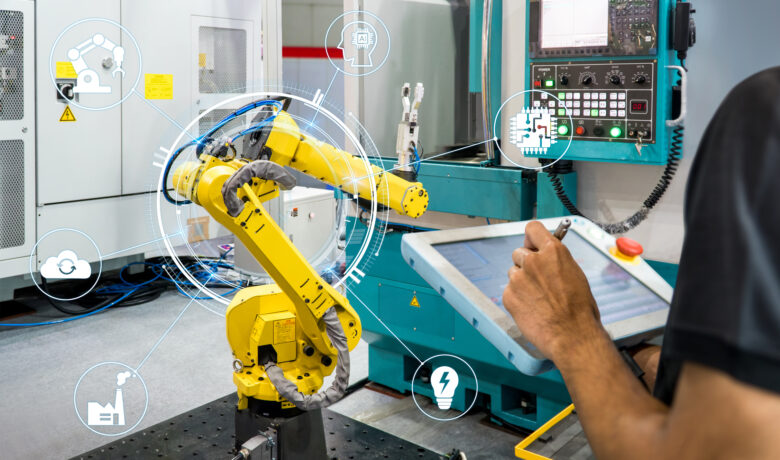
Andaya: We’re currently using additive manufacturing in our design process. We have a series of manufacturing robots and cobots to assist with our automated manufacturing.
Luchars: For motion control and automation, we’ve explored a number of robotic actuators with various input and output encoders for high-resolution positioning. Our design flexibly allows for custom integration of the encoder within the motor housing, which maintains a thin form factor. In addition to the feedback and control mechanism of the machine, we can further customize the motor design to optimize its inertia and dynamic response.
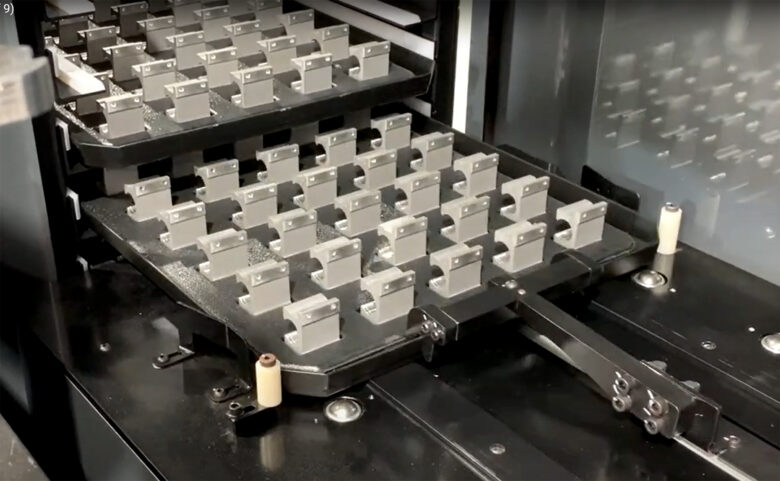
Maina: Our 3D Platform brand builds 3D printers using PBC Linear mechatronics (SIMO Series linear actuators). One of their main functions is the 3D printing of engineered prototype components to effectively get products and system designs to market faster. 3D printers are also instrumental in producing low-volume custom product storage trays for our automation brands, Applied Cobotics and Cobot Feeder.
Luchars: Our technology and design software platform have enabled the creation of electric motors with performance and form-factor characteristics impossible in the past. So, innovators can leverage unlimited design flexibility to create a perfect fit versus a best-fit motor — and engineers can design a motor around their system rather than designing their system around a motor. The applications for these technology benefits extend to HVAC equipment, e-mobility, consumer electronics, household appliances, robotics, medical devices, aerospace, defense, unmanned vehicles‚ and more.
Zaske: Due to the forces and precision requirements of most of Tolomatic’s actuators, we haven’t been able to make use of 3D printing in a significant fashion for making parts. However, we have been buying and installing more capable and flexible machining centers to reduce to time between changeovers. We have also found that 3D-printed parts can be very effective in prototyping and making fixtures and tooling for manufacturing assembly.
Luchars: All the prototypes we design are custom, so we can implement any washdown or sealing design elements on a case-by-case basis, depending on the application requirements. We don’t normally have the entire system available to test the motor, so the system-specific tests are conducted by the customer … but we try to do as much testing as possible before the customer receives the prototypes to ensure the motor design will absolutely meet customer needs.
Read other articles in the Design World Trends series at designworldonline.com/trends.
Filed Under: Make Parts Fast