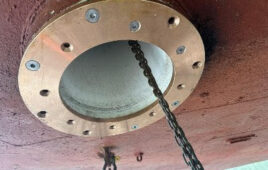
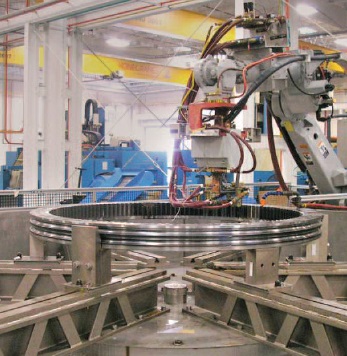
 With all of the easy questions asked, and the basics covered, what is the next step in ensuring the proper selection and installation of a slewing ring bearing? Here is a short run-down of some easily overlooked, yet abundantly important questions to consider during the final phases of your bearing selection process.
Is there any distortion in the mounting surface?
Distortion is one of the most insidious threats to a good mounting, and can happen several ways. Even a tiny piece of
debris or a metal chip lodged between the bearing and the mounting surface during assembly can cause a major
distortion, leading to load concentration in the bearing. A mounting surface that is out-of-flat is another hazard. That
surface needs to be machined to the same accuracy as the bearing mounting face.
Welded riser pads are another common source of mounting surface distortion. A riser pad should be thick enough to resist distortion during welding and flush against the base to avoid any gap below the bearing seat. Distortion here may cause a false reading during bolt tensioning and even generate a spring action when the bearing is in service, leading to bolt fatigue and, ultimately, failure. Deflection is another riser pad consideration: differences between bolt locations can cause circumferential distortions and load concentrations within the bearing.
Will the bearing be properly sealed and lubricated?
It’s essential to keep out debris and corrosion to avoid excessive wear, high torque and stress concentrations, any of which can cause the bearing to fail prematurely. Specifying integral seals on bearings is a great way to accomplish this, as is incorporating shrouding to protect machine-cut gears and bearings.
Lubrication is another key to reducing wear. Bearings are generally packed with a suitable grease when they are assembled, and whenever grease is used, re-lubrication fittings should be specified. Bearings in slow-rotating equipment (such as backhoes, cranes, and excavators) need to injected with a little fresh lubricant every 100 operating hours, while bearings in continuously-rotating equipment (trenchers, borers) should be re-lubricated daily. So should gears. Any equipment with bearings should explain these procedures in its operation and maintenance manual.
How will the bearing be stored?
When slewing ring bearings are being readied for shipment, they are usually given a light coating of preservative oil and packaged in a tire wrap of protective paper and a shipping container. This provides adequate protection during the typical short-term storage in a protected area, but not for long periods or outdoors. If a bearing sits for more than a year before being installed, it should be re-lubricated.
Proper handling is very important, both during receiving and installation. Eyebolts in the mounting holes — or a non-metallic sling — are recommended to avoid damage to the mounting surfaces or gear teeth. The bearing should not be set down on any surface that hasn’t first been checked for cleanliness. This will avoid picking up dirt or “dings” that can lead to stress.
Have proper installation practices been made clear?
Improper installation can negate all the care you take in choosing and acquiring a bearing. Here are three things to tell the installer to reduce the chances of future bearing problems.
❚❚ Position the bearing’s loading plug (the hole in the race through which the balls are loaded) and the hardness gap in the minimum load zone. Locating the plug in the heavy load zone will likely result in premature bearing failure.
❚❚ Check the bearing races after the bolts are tightened to be sure they are round and true. (If one race is piloted, mount that one first; this will “round up” the other ring before bolts are tightened. If neither ring is piloted, leave all mounting bolts loose until both rings are attached, then add a moderate thrust load and tighten all the bolts to the tension recommended by the manufacturer.)
❚❚ Remember to check gear backlash and final bearing torque after completing the installation. If the bearing torque after installation is significantly different than it was before the installation, check for a mounting problem.
Kaydon
www.kaydonbearings.com
The post What slewing ring bearing installation measures are you missing? appeared first on Bearing Tips.
Filed Under: Bearing Tips