Design World

  • Home
  • Technologies
    • ELECTRONICS • ELECTRICAL
    • Fastening • joining
    • FLUID POWER
    • LINEAR MOTION
    • MOTION CONTROL
    • SENSORS
    • TEST & MEASUREMENT
    • Factory automation
    • Warehouse automation
    • DIGITAL TRANSFORMATION
  • Learn
    • Tech Toolboxes
    • Learning center
    • eBooks • Tech Tips
    • Podcasts
    • Videos
    • Webinars • general engineering
    • Webinars • Automated warehousing
    • Voices
  • LEAP Awards
  • 2026 Leadership
    • 2025 Winners
    • 2024 Winners
    • 2023 Winners
    • 2022 Winners
    • 2021 Winners
  • Design Guides
  • Resources
    • 3D Cad Models
      • PARTsolutions
      • TraceParts
    • Digital Issues
      • Design World
      • EE World
    • Educational Assets
    • Engineering diversity
    • Reports
    • Trends
  • Supplier Listings
  • Advertise
  • SUBSCRIBE
    • MAGAZINE
    • NEWSLETTER

Tech Spotlight: preloading ball bearings

By Mike Santora | April 12, 2016

FacebookTwitterGoogle+LinkedInPinterestShare

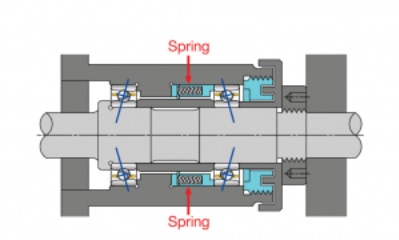
ast-preload-spring-imageIn the case of ball bearings, preload is often a misunderstood concept and overlooked by designers and bearing users alike.

One of the final steps in the bearing manufacturing process is the assembly of the individual bearing components: the outer ring, inner ring, balls and retainer (or ball separator). When the bearings are assembled, it is necessary to have a controlled amount of internal clearance, or looseness between the rings and balls. This is referred to as radial play in most bearing catalogs.

In certain applications, this internal clearance must be removed for a pair of bearings to operate properly. The application of an axial load across a pair of bearings – for the purpose of removing free internal clearances – is called preload.

Benefits of preloading ball bearings include:

Rotational accuracy and precise shaft positioning
Elimination or reduction of ball skidding
Control and reduction of axial and radial deflection under applied load
Noise reduction
Load sharing between bearings

Preload is critical in most high-precision and high-speed applications, particularly where rotational and positional accuracy is required.

If, under operating conditions, a bearing has radial play this means that one bearing race can be moved radially and axially relative to the other. With rotation, this looseness translates into wobble or non-repetitive runout. This motion is unacceptable in applications such as machine tool spindles, electric motors, optical encoders, flow meters, and high-speed hand tools.

The application of axial preload forces the balls into contact with raceways, establishing a contact angle which causes the ball set to rotate in a uniform circumferential plane.

AST
www.astbearings.com

The post Tech Spotlight: preloading ball bearings appeared first on Bearing Tips.

You might also like


Filed Under: Bearings, Bearing Tips, Encoders • optical

Tagged With: ast
 

LEARNING CENTER

Design World Learning Center
“dw
EXPAND YOUR KNOWLEDGE AND STAY CONNECTED
Get the latest info on technologies, tools and strategies for Design Engineering Professionals.
Motor University

Design World Digital Edition

cover

Browse the most current issue of Design World and back issues in an easy to use high quality format. Clip, share and download with the leading design engineering magazine today.

EDABoard the Forum for Electronics

Top global problem solving EE forum covering Microcontrollers, DSP, Networking, Analog and Digital Design, RF, Power Electronics, PCB Routing and much more

EDABoard: Forum for electronics

Sponsored Content

  • For the machines that don’t take days off. How Electrification Is Reshaping On- and Off-Road Machinery.
  • CASE STUDY: Inside ThredUp’s High-Tech Transformation of Its Four-Story Conveyor System
  • Performance Starts with Precision Cuts
  • How Concentric Maxi Torque Bushings Speed the Deployment of High-Precision Machines
  • Simplifying wiring inside industrial control cabinets
  • Tech Toolbox: Designing for cleanrooms
View More >>
Engineering Exchange

The Engineering Exchange is a global educational networking community for engineers.

Connect, share, and learn today »

Design World
  • About us
  • Contact
  • Manage your Design World Subscription
  • Subscribe
  • Design World Digital Network
  • Control Engineering
  • Consulting-Specifying Engineer
  • Plant Engineering
  • Engineering White Papers
  • Leap Awards

Copyright © 2026 WTWH Media LLC. All Rights Reserved. The material on this site may not be reproduced, distributed, transmitted, cached or otherwise used, except with the prior written permission of WTWH Media
Privacy Policy | Advertising | About Us

Search Design World

  • Home
  • Technologies
    • ELECTRONICS • ELECTRICAL
    • Fastening • joining
    • FLUID POWER
    • LINEAR MOTION
    • MOTION CONTROL
    • SENSORS
    • TEST & MEASUREMENT
    • Factory automation
    • Warehouse automation
    • DIGITAL TRANSFORMATION
  • Learn
    • Tech Toolboxes
    • Learning center
    • eBooks • Tech Tips
    • Podcasts
    • Videos
    • Webinars • general engineering
    • Webinars • Automated warehousing
    • Voices
  • LEAP Awards
  • 2026 Leadership
    • 2025 Winners
    • 2024 Winners
    • 2023 Winners
    • 2022 Winners
    • 2021 Winners
  • Design Guides
  • Resources
    • 3D Cad Models
      • PARTsolutions
      • TraceParts
    • Digital Issues
      • Design World
      • EE World
    • Educational Assets
    • Engineering diversity
    • Reports
    • Trends
  • Supplier Listings
  • Advertise
  • SUBSCRIBE
    • MAGAZINE
    • NEWSLETTER