Modern electronics should be able to easily solve a temperature-sensing challenge, but the harsh real-world complexities make it a difficult proposition.
Part 1 of this article looked at the basic issues of railway bearing failure and detecting these before they happen. This part looks into more details and sensing options.
Q: What can the railroad companies do?
A: In addition to logging and monitoring the hours of use along with inspection, replacement, or repairing when an anticipated lifetime is reached, they use condition-based monitoring (CBM), where components are maintained/replaced depending on their condition prior to an impending failure.
Q: What does the CBM strategy require?
A: It uses three related approaches:
- First, there is a measurable parameter that describes the state of an upcoming failure.
- Second, the failure has a steady, consistent trend in characteristics, and does not suddenly change.
- Third, that upcoming failure can be monitored and recognized well before a failure occurs.
Q: How can this be done?
A: There are three options, and they represent the classic dilemma of tradeoffs in technical solutions:
- Permanent On-board Monitoring (POM), where a monitoring unit is installed on every wheelset.
- Temporary On-board Monitoring (TOM), where the monitoring equipment is only installed on cars in use and removed when not in use.
- Permanent Trackside Monitoring (PTM) using the hot-box detectors.
Q: What are some of the tradeoff issues?
A: The first two, POM and TOM, could provide continuous monitoring, but instrumenting all the rolling stock gets expensive both in unit cost and labor. Also, assuring the reliability of each monitoring unit is working is also a challenge, as anything in rail service is a subset to extremes of temperature, vibration and shock, rocks and debris, vandalism, and overall harsh conditions.
Also, connecting the sensors to the monitoring control unit brings new issues: use a wireless link (easy in the lab, but a difficult RF channel in the field), or go wired (perhaps more reliable when all is well, but more difficult to install and maintain, plus there’s the need for rugged connectors).
TOM also requires swapping the monitoring equipment among rail cars and having those cars out of service while the work is performed. PTM, on the other hand, can never provide the same precision and continuity as POM.
Q: Still, POM seems like the “best” solution, so why isn’t it done?
A: Abandoning or supplementing the rail-side in-place measurement and instead placing sensors on the bearings and wheel-sets of each car seems like the solution which offers the highest level of confidence. That could eliminate some problems but create new ones. Each car would need instrumentation, power, and connectivity in a rugged package. That’s tough to achieve given in the realities of railroad-freight cars, even if cost is not a concern (and it certainly is).
Q: Would closer spacing of trackside hot-box detectors make a difference? Alternatively, would lowering the temperature-alarm threshold help?
A: For the first question, the answer is “maybe,” but how many more would make a meaningful difference? For the second, again, it’s a “maybe” as it might also cause more false alarms, which are not only costly and affect schedules, but also lead to the well-known “just ignore it” syndrome.
Q: How accurate is the remote sensing, anyway?
A: It’s hard to give a definitive answer, but some studies in a lab environment with real wheels, using infrared sensing plus co-incident placement of thermocouples, shows that the sensed infrared (IR) reading is around 10-20°F lower than the thermocouple measurements, but there are many factors that affect this differential. Note that the temperature of the area of interest is not uniform, so researchers placed thermocouples at different locations (Figure 1).

They then showed results and differences at these sites, such as the bearing outboard (OB) raceway and the bearing spacer ring (Figure 2).

Q: What other monitoring technologies are being investigated, in addition to temperature?
A: Two possibilities are:
- Vibration: early in the fault process, the axle bearing excites structural vibrations.
- Noise: with increasing mechanical damage of the rollers’ path, the bearing becomes more and more a source of noise; although the level is much lower than environmental noise, it can be detected due to the characteristic frequencies.
These could be used standalone, or in conjunction with temperature measurement.
Q: Can you say more about noise and vibration-based sensing?
A: Acoustic sensors are being tested with sets of microphone arrays spanning about 25 feet of track length. By analyzing the acoustic emissions (AE) generated by the passing car’s bearing components, the system can identify which of the car’s components has an impending fault (Figure 3).
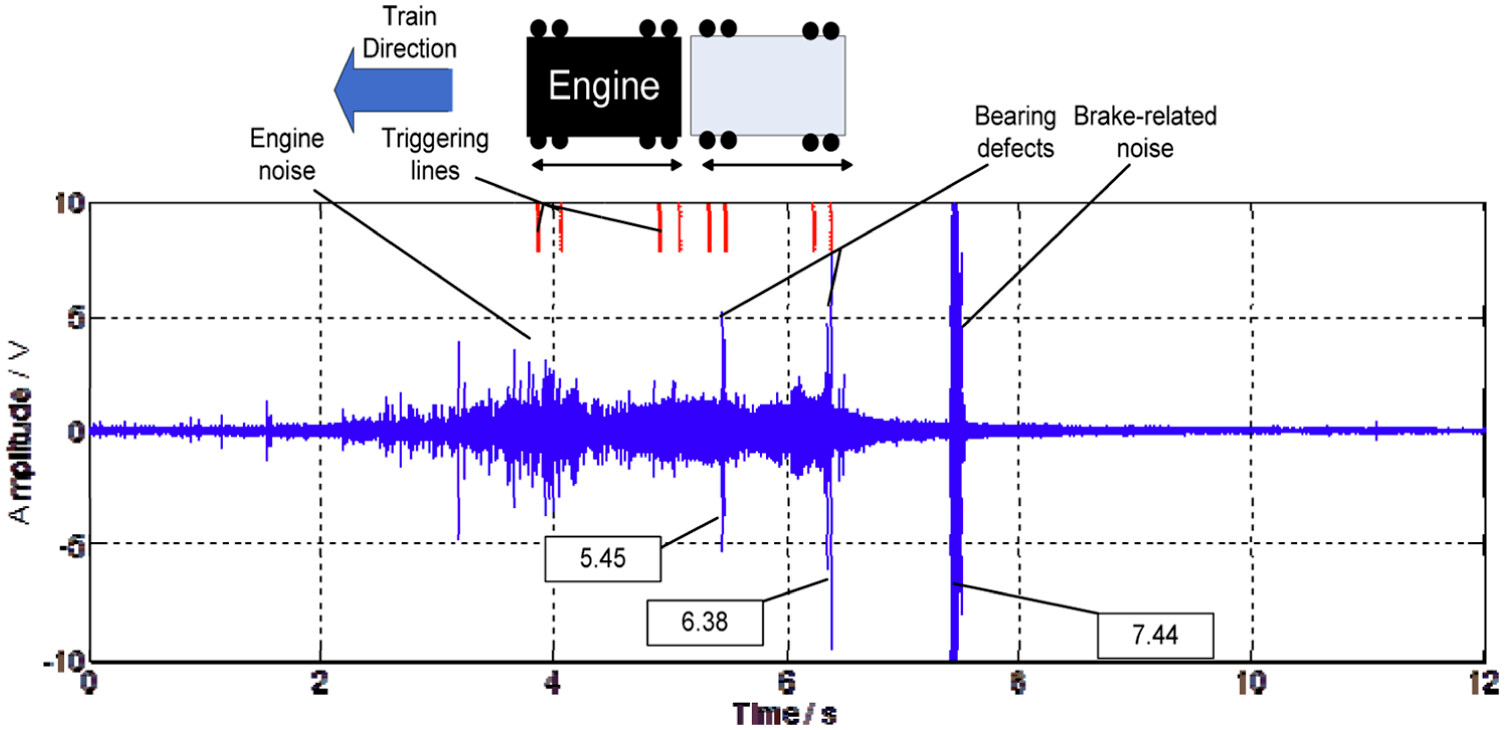
Among the possible defects an acoustic-based system can identify — at least in theory — are bearing spalling or brinelling; loose, cracked, or broken components; peeling or smearing; wheels with flat spots; and lubrication failure. Without a doubt, it’s a long list of acoustic signatures to analyze and characterize in a challenging setting. It’s a lot more difficult than trying to assess bearing problems in a fixed-in-place industrial setting. There has been good progress here, and AI advances may help here, but complicating the problem is that every wheel that passes has a slightly different nominal signature.
Q: Once you have a satisfactory sensing arrangement using one or more sensor schemes, is the overall problem solved?
A: Not at all, as the sensing side is only part of the problem. With an array of sensors strung out over miles of track, there are also connectivity issues and associated reliability considerations. Fault reporting is done via radio link to the train engineer, and by modem, LAN, or GSM to a central station. How do you ensure that the reporting scheme is working properly? Ambient temperature extremes, unavoidable vibration, and overall abuse can easily create faults in the connectivity scheme.
Conclusion
The problem of assessing the wheel-bearing condition and impending problems in a railroad environment — where there are multiple “targets” to be checked in real-time, while the train is moving (often at fairly high speed) in an overall harsh operating environment — does not have an easy solution. Track-side hot-box detectors work fairly well but have system-level shortcomings aggravated by the speed of a train and the relatively long time it takes to stop it.
This entire situation demonstrates what experienced engineers know when sensing temperature (and other physical variables). They often note that “measuring temperature is easy, but sensing it is hard.” What they mean is that once you have the right sensor and good placement for it, actually making the measurement is relatively easy – but getting to that proper location and siting the sensor is often the real challenge.
Related EE World Content
Sorry, but it’s “Goodbye, Caboose” – EoT devices have made you obsolete, Part 1
Sorry, but it’s “Goodbye, Caboose” – EoT devices have made you obsolete, Part 2
Electric locomotives and catenary power systems – Part 1: basic functions
Electric locomotives and catenary power systems – Part 2: power needs
Electric locomotives and catenary power systems – Part 3: power delivery
Electric locomotives and catenary power systems – Part 4: maintenance and corona
External References
Union Pacific, “How Much Freight Ships by Rail In the US?”
Total Connection Logistics Services, “Inland Freight Shipping: Rail vs. Truck”
The Wall Street Journal, “Norfolk Southern’s Ohio Train Derailment Puts Railroad Equipment Sensors in Spotlight”
Design News, “Rail Car Wheel Bearing Monitoring in the Spotlight”
University of Texas Rio Grande Valley, Joint Rail Conference, “An Analysis of the Efficacy of Wayside Hot-Box Detector Data” (very informative with excellent illustrations)
Apna Technologies & Solutions, “Hot Box Detector”
Global Railways Review, “Axle bearings and condition monitoring for railway vehicles”
IBT Industrial Solutions, “Ball Bearings vs. Roller Bearings: What are the Key Differences?”
Springer/Railway Engineering Science, “Defect detection in freight railcar tapered-roller bearings using vibration techniques”
Railway Engineering Science, “Defect detection in freight railcar tapered-roller bearings using vibration techniques”
Sage/Advances in Mechanical Engineering, “Wayside detection of faults in railway axle bearings using time spectral kurtosis analysis on high-frequency acoustic emission signals”
Filed Under: Sensor Tips