
For years, greasy handed mechanics have been dropping magnetic drain plugs and shattering the brittle magnets. Sintered magnetic materials, which are normally used to make these plugs, crack and chip easily. The AlNiCo and ceramic magnets might not even survive the manufacturing crimping processes that secure them in place.
Engineers from General Plug and Manufacturing searched for a material for their magnetic drain plug redesign and chose a new rubber bonded magnet from the Electrodyne Company of Batavia, Ohio. Plastalloy is a high-energy material that maintains its characteristics under the rigors of service in a hot oil environment, plus it can withstand the high impact of a crimping press, and survive a drop from virtually any height.
Drain plugs are pretty straightforward. A straight or tapered threaded plug fitted with some kind of secondary seal assembles into a tapped hole in an engine oil drain pan or a differential housing. Many manufacturers simply affix a magnet to a standard designed plug to catch ferrous particles in the oil stream.
Tapered threads are cut or formed on an angle so that when they are assembled with a mating thread, there is interference between the external and internal threads. To ensure that the threads are sealed, Teflon tape or liquid thread sealant is commonly applied to the thread surfaces; which can be a time consuming process, especially for plugs that are removed and re-installed frequently, as in oil drain applications.
Plugs with straight threads are easy to install and remove, as they require no thread sealing. A seal is typically assembled between the underside of the plug head and the mating surface of the drain hole. Fiber, plastic, copper or other materials have been used as seals. While temporarily effective, they loosen during use, requiring retightening to prevent leaks.
Engineers can use several methods to mount the magnet to the plug. The simplest method is to crimp the metal surrounding the magnet in several places to ensure that it does not come loose from the plug end. With AlNiCo or ceramic materials, however, excess crimping force will damage the magnet.
Another mounting method uses a set screw through a hole in the middle of the magnet. The drawbacks of this method include extra labor to tighten the screw, and potential cracking if too much force is applied. Epoxies will hold magnets in place, too, but the epoxy is messy and requires considerable labor to install, as well as time to cure, which complicates the manufacturing procedure. 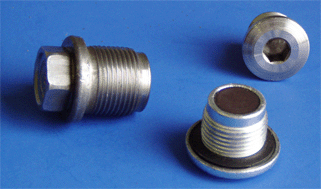
Plastalloy can be magnetized using various methods including conventional, two-poles each side, multiple-poles, or with custom magnetization patterns to suit industrial applications.
It is available in magnet sheets, strips or die-cut shapes, with options that include pressure
sensitive adhesive, polarity identification, custom formulations, and special cutting techniques.
To eliminate these problems, the General Plug procedure forms a pocket in the end of the drain plug, and then inserts the rubber bonded Plastalloy magnet into it. Material from the rim of the pocket is then roll-formed over the Plastalloy, holding it firmly in place. The “bead” that is rolled over the magnet’s edge is both uniform and functional, ensuring that the magnet stays firmly in place with no sharp edges to harm those removing or installing the drain plug.
Unlike the sintered materials, Plastalloy is resilient and durable enough to withstand the roll forming procedure. Since it requires no additional materials, retention by roll forming results in an attractive and cost-effective end product.
The redesigned plug features metal-to-metal contact between the bearing surface of the plug and the bearing surface of the tapped hole. This allows a proper torque-tension relationship to be maintained on the assembled plug. An elastomeric washer-seal encased within a groove formed on the underside of the head of the plug creates a seal. Since straight threads are used, the plugs can readily be installed and removed.
Electrodyne Company Inc.
www.edyne.com
: Design World :
Filed Under: Seals • O rings, Seals



Tell Us What You Think!