Design World

  • Home
  • Technologies
    • ELECTRONICS • ELECTRICAL
    • Fastening • joining
    • FLUID POWER
    • LINEAR MOTION
    • MOTION CONTROL
    • SENSORS
    • TEST & MEASUREMENT
    • Factory automation
    • Warehouse automation
    • DIGITAL TRANSFORMATION
  • Learn
    • Tech Toolboxes
    • Learning center
    • eBooks • Tech Tips
    • Podcasts
    • Videos
    • Webinars • general engineering
    • Webinars • Automated warehousing
    • Voices
  • LEAP Awards
  • 2025 Leadership
    • 2024 Winners
    • 2023 Winners
    • 2022 Winners
    • 2021 Winners
  • Design Guides
  • Resources
    • 3D Cad Models
      • PARTsolutions
      • TraceParts
    • Digital Issues
      • Design World
      • EE World
    • Educational Assets
    • Engineering diversity
    • Reports
    • Trends
  • Supplier Listings
  • Advertise
  • SUBSCRIBE
    • MAGAZINE
    • NEWSLETTER

What are DIN rails for motion applications?

By Miles Budimir | May 31, 2019

Let’s face it — when designing a motion control or automation system, engineers don’t immediately think of enclosures and component mounting. They’re instead concerned with selecting the right type of controllers, motors, actuators, feedback, and networking all of these pieces together. Not top of mind (usually) is how a controller will fit inside of an instrument rack and how it will connect with other components.
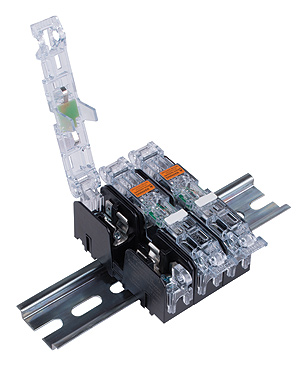
DIN rails

An example of components mounted to DIN rails are these fuse blocks from AutomationDirect.

But simply because mounting accessories may not be top-of-list items doesn’t make them any less important and worthy of consideration than any other piece of a properly functioning automation system.

And so we come to the humble DIN rail. DIN is an acronym for Deutsches Institut für Normung, or the German Institute for Standardization in English. The mounting rail dimensions and specifications were at first standardized by DIN and have since become accepted EN and IEC standards applicable globally. A DIN rail is basically a standard for metallic rails inside of equipment racks onto which are mounted control components such as controllers (PLCs, individual controllers, etc), power supplies, I/O and other types of modules. Most if not all component manufacturers accommodate or supply components that fit on standard DIN rails.

They are typically made of a few different materials, with the most common being galvanized steel. Other materials include copper and aluminum. However, the main way DIN rails are classified is according to rail shape and dimensions.  For instance, there are generally considered to be three basic types: the so-called “top hat”, C section and G section.
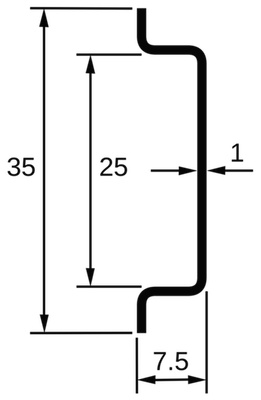
DIN rails

The “top hat” DIN rail (also known as the TS 35 in the U.S.) showing the 35 mm width dimension and the 7.5 mm depth. (Image via Wikipedia)


Top hat – The most common is the “top hat” rail, which looks a bit like a top hat in a cross-sectional view. In the U.S. they’re also known as TS 35 rails. The top-to-bottom rail width is 35 mm and lengths can vary. There are two standard depths; 7.5 and 15 mm, with the more common being the 7.5-mm version. There is also a miniature top-hat version with a rail width of 15 mm and a depth of 5.5 mm.

C section – C section rails are 32 mm wide and their cross section is like a C shape. These are older variants of the standard with the top-hat variety being the far more common type. The four common types are C20, C30, C40, and C50, with the number corresponding to the height of the rail in millimeters.

G section – G section rail resembles a “G” in profile, with a deeper recess on one side. This is usually mounted facing down with the smaller recessed side up. G rails are typically used for heavier components such as power supplies.


You might also like


Filed Under: Motion Control Tips


About The Author

Miles Budimir

Miles has been with Design World since 2009 covering motion control, automation, and test and measurement. He holds a BSEE degree and an MA in Philosophy from Cleveland State University and has experience working in the controls industry as a project engineer. Miles has taught engineering technology courses as well as engineering ethics continuing education courses for professional engineers in the state of Ohio. He is also a drummer, and enjoys travel and photography.

LEARNING CENTER

Design World Learning Center
“dw
EXPAND YOUR KNOWLEDGE AND STAY CONNECTED
Get the latest info on technologies, tools and strategies for Design Engineering Professionals.
Motor University

Design World Digital Edition

cover

Browse the most current issue of Design World and back issues in an easy to use high quality format. Clip, share and download with the leading design engineering magazine today.

EDABoard the Forum for Electronics

Top global problem solving EE forum covering Microcontrollers, DSP, Networking, Analog and Digital Design, RF, Power Electronics, PCB Routing and much more

EDABoard: Forum for electronics

Sponsored Content

  • Digitalization made easy: Bridging IT/OT with scalable network infrastructure
  • Apple Rubber custom o-rings for harsh underwater conditions
  • ASMPT chooses Renishaw for high-quality motion control
  • Innovating Together: How Italian Machine Builders Drive Industry Forward Through Collaboration
  • Efficiency Is the New Luxury — and Italy Is Delivering
  • Beyond the Build: How Italy’s Machine Makers Are Powering Smart Manufacturing
View More >>
Engineering Exchange

The Engineering Exchange is a global educational networking community for engineers.

Connect, share, and learn today »

Design World
  • About us
  • Contact
  • Manage your Design World Subscription
  • Subscribe
  • Design World Digital Network
  • Control Engineering
  • Consulting-Specifying Engineer
  • Plant Engineering
  • Engineering White Papers
  • Leap Awards

Copyright © 2025 WTWH Media LLC. All Rights Reserved. The material on this site may not be reproduced, distributed, transmitted, cached or otherwise used, except with the prior written permission of WTWH Media
Privacy Policy | Advertising | About Us

Search Design World

  • Home
  • Technologies
    • ELECTRONICS • ELECTRICAL
    • Fastening • joining
    • FLUID POWER
    • LINEAR MOTION
    • MOTION CONTROL
    • SENSORS
    • TEST & MEASUREMENT
    • Factory automation
    • Warehouse automation
    • DIGITAL TRANSFORMATION
  • Learn
    • Tech Toolboxes
    • Learning center
    • eBooks • Tech Tips
    • Podcasts
    • Videos
    • Webinars • general engineering
    • Webinars • Automated warehousing
    • Voices
  • LEAP Awards
  • 2025 Leadership
    • 2024 Winners
    • 2023 Winners
    • 2022 Winners
    • 2021 Winners
  • Design Guides
  • Resources
    • 3D Cad Models
      • PARTsolutions
      • TraceParts
    • Digital Issues
      • Design World
      • EE World
    • Educational Assets
    • Engineering diversity
    • Reports
    • Trends
  • Supplier Listings
  • Advertise
  • SUBSCRIBE
    • MAGAZINE
    • NEWSLETTER
We use cookies to personalize content and ads, to provide social media features, and to analyze our traffic. We share information about your use of our site with our social media, advertising, and analytics partners who may combine it with other information you’ve provided to them or that they’ve collected from your use of their services. You consent to our cookies if you continue to use this website.