
By Inês Castro, materials scientist and engineer
Additive manufacturing (AM) technologies offer a range of advantages for the wind industry. The following examples show that implementation is possible, and even recommended, for a more market-competitive energy supplier. Once the technologies are more developed, reliable and standardized, the supplier chains will be reduced and the production could be more localized, reducing the transportation times and costs, allowing the implementation of AM in the wind industry.
In general AM can speed up part and component development time by up to 75%, reduce material resources by up to 65%, and reduce gas emissions by up to 30%. Moreover, a single part can be manufactured in one step, not requiring a secondary joining process.
Additionally, additive manufacturing can also be used in the repair of components.
Additive manufacturing applied to wind turbines
The Global Wind Energy Council has stated that the wind industry is experiencing exponential growth in recent years with the aid of the offshore wind turbines market. Thus, development and innovation through materials and manufacturing technologies are essential for the wind industry to prosper and to continue increasing their annual energy production [7].
A wind turbine’s blades rotate and shift with the action of the wind, making the rotor spin. The gearbox makes the connection between the low-speed shaft to the high-speed shaft, increasing the rotations per minute from 30 to 60 rpm to approximately 1000 to 1800 rpm, which an attached generator use to convert these rotations to produce electric power. The tower supports the turbine’s structure, with the nacelle containing and protecting the components on top of the tower [9].
AM technologies show much potential when it comes to the wind power industry, as it could enable in situ manufacture of turbine components that are designed for the unique needs of the resources of a particular location. This would, for example, decrease the shipping, transportation and handling costs and increase the rate at which new blade prototypes can be tested [6].
Additive manufactured molds
The Advanced Manufacturing Office (AMO) of the US Department of Energy has started to print molds for blades with AM technologies, (figure 2). The expansion of this application in the mold industry would reduce the steps, the cost and the time for mold fabrication, as the traditional route is a process that may take several weeks to months to achieve in its totality [6, 10].
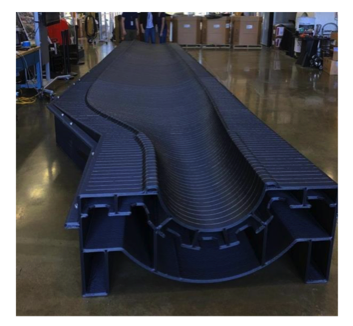
The mold in figure 2 was printed as multiple sections on a Big Area Additive Manufacturing (BAAM) 3D printer at Oak Ridge National Laboratory.

Figure 4: The produced blade section on the printed mold
Additive manufacturing of small, off-grid turbines
A project called ‘A Small Turbine to Make a Big Difference’ started by Kyle Bassett, has the goal to install small-scale plastic-based 3D printed wind turbines in remote areas with minimal access to electricity. The founder of this project started by designing a turbine capable of storing the generated energy in batteries for personal use [11].
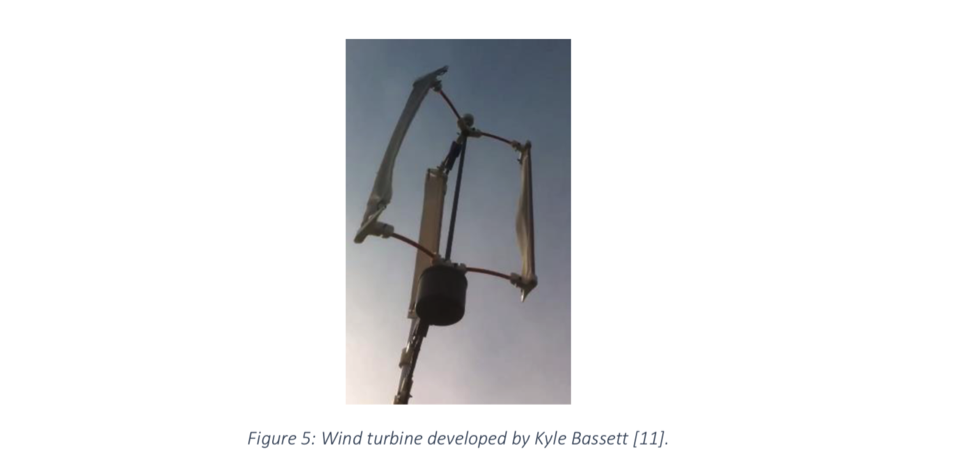
A scale model of the turbine was developed using a Printerbot Simple Metal 3D printer. It included the blades, hubs, rotor connectors, the frame and the blade ends, which would be the most expensive components if made through traditional manufacturing methods [13].
Printed nacelles
Other applications could include the creation of the nacelle. The advantages of incorporating AM into such structures are similar, e.g. economic incentives for mold production, but challenges are also encountered, such as the need to offer weather protection, passive cooling and high geometry complexity.
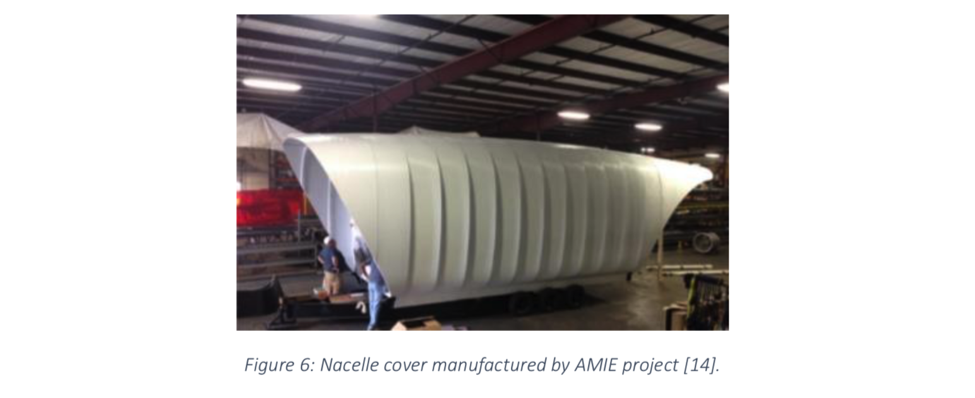
The Additive Manufacturing Integrated Energy (AMIE) project, however, has successfully manufactured the nacelle structure.
Repair and replacement of components
Even though most of the attention is focused on the manufacture of new components, the repair of parts that need improvement or replacement due to wear should also be considered. For this application, hybrid systems incorporating processes such as Directed Energy Deposition with subtractive machining could eventually lead to the proper tolerances and design imitation of the replaced components [14].
Printing large-scale components
Large Scale Metal AM or Wire and Arc Additive Manufacture is an emerging technology which may facilitate the printing of large-scale parts. This even makes additive manufacturing of the nacelle and blade molds possible, as it doesn’t need a constricted operation room, allowing, as the name indicates, large-scale applications.
References:
[3] S. Huang, P. Liu, A. Mokasdar e L. Hou, “Additive manufacturing and its societal impact: a literature review,” The International Journal of Advanced Manufacturing Technologies, pp. 1191-1195, 16 October 2012.
[4] S. Madara e C. Selvan, “Review of Recent Developments in 3-D Printing of Turbine Blades,” European Journal of Advances in Engineering and Technology, vol. 4, no 7, pp. 497-509, 2017.
[5] F. Martina e S. Williams, “Wire+arc additive manufacturing vs. traditional machining from solid: a
cost comparison,” Cranfield University, 2015.
[6] B. Post, B. Richardson, R. Lind, L. Love, P. Lloyd, V. Kunc, B. Rhyne, A. Roschli, J. Hannan, S. Nolet, K. Veloso, P. Kurup, T. Remo e D. Jenne, “Big Area Additive Manufacturing Application in Wind Turbine Molds,” Solid Freeform Fabrication Symposium- An Additive Manufacturing Conference, 2017.
[7] M. Froese, “Windpower-Engineering & Development,” 04 01 2017. [Online]. Available:
https://www.windpowerengineering.com/business-news-projects/blade-materials-manufacturing- changing-keep-larger-turbines/. [Accessed on A 11 11 2018].
[8] Yukon Government, “Energy, Mines and Resources,” [Online]. Available:
http://www.energy.gov.yk.ca/wind.html. [Accessed on 10 11 2018].
[9] Wind Energy Technologies Office, “The inside of a wind turbine,” [Online]. Available:
https://www.energy.gov/eere/wind/inside-wind-turbine-0. [Accessed on 10 11 2018].
[10] Alec, “3D printer and 3D printing news,” 01 08 2016. [Online]. Available:
http://www.3ders.org/articles/20160801-amo-cuts-wind-energy-costs-by-3d-printing-gigantic-wind- blade-molds-in-6-feet-tall-sections.html]. [Acedido em 10 11 2018].
[11] S. Goehrke, “3DPRINT.COM,” 09 02 2015. [Online]. Available: https://3dprint.com/43449/rmrd-tech-
small-wind-turbines/. [Accessed on 06 11 2018].
[12] K. Bassett, R. Carriveau e D. Ying, “3D printed wind turbines part 1: Design considerations and rapid manufacture potential,” Sustainable Energy Technologies and Assessments, vol. 11, pp. 186-193, 2015.
[13] 3D printer an 3D printing news, “Student develops portable 3D printed wind turbines to bring affordable electricity to remote areas,” 09 02 2015. [Online]. Available: https://www.3ders.org/articles/20150209-canadian-student-develops-3d-printed-open-source- wind-turbines-for-remote-regions.html. [Accessed on 10 11 2018].
[14] B. Post, B. Richardson, S. Palmer, L. Love, D. Lee, P. Kurup, J. D.S., T. Remo e M. Mann, “The Current State of Additive Manufacturing in Wind Energy Systems,” Oak Ridge National Laboratory, no ORNL/TM-2017/479, 2017.
[15] F. Martina, “Investigation of methods to manipulate geometry, microstructure and mechanical properties in titanium large scale Wire + Arc additive manufacturing,” PhD Thesis – School of Aerospace, Transport and Manufacturing, Academic year 2013-2014.
[16] Siemens, [Online]. Available: https://www.siemens.com/innovation/en/home/pictures. [Acedido em
10 11 2018].
Filed Under: 3D printing • additive • stereolithography, Gears • gearheads • speed reducers


Tell Us What You Think!