
Design World

  • Home
  • Technologies
    • ELECTRONICS • ELECTRICAL
    • Fastening • joining
    • FLUID POWER
    • LINEAR MOTION
    • MOTION CONTROL
    • SENSORS
    • TEST & MEASUREMENT
    • Factory automation
    • Warehouse automation
    • DIGITAL TRANSFORMATION
  • Learn
    • Tech Toolboxes
    • Learning center
    • eBooks • Tech Tips
    • Podcasts
    • Videos
    • Webinars • general engineering
    • Webinars • Automated warehousing
    • Voices
  • LEAP Awards
  • 2025 Leadership
    • 2024 Winners
    • 2023 Winners
    • 2022 Winners
    • 2021 Winners
  • Design Guides
  • Resources
    • 3D Cad Models
      • PARTsolutions
      • TraceParts
    • Digital Issues
      • Design World
      • EE World
    • Educational Assets
    • Engineering diversity
    • Reports
    • Trends
  • Supplier Listings
  • Advertise
  • SUBSCRIBE
    • MAGAZINE
    • NEWSLETTER

New Headway in Desalination Technology

By University of Illinois at Urbana-Champaign | October 17, 2017

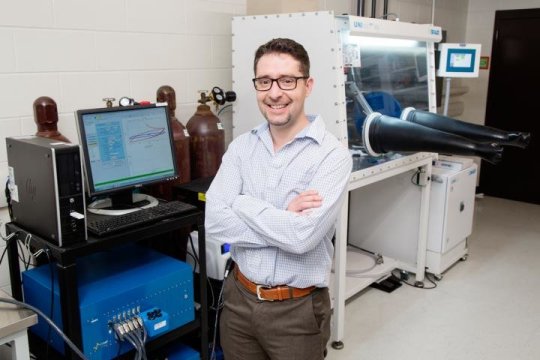
Illinois mechanical science and engineering professor Kyle Smith and his co-authors have shown that a new battery-like water desalination device could help provide fresh water to a variety of regions efficiently and economically. (Credit: L. Brian Stauffer)

Engineers at the University of Illinois have taken a step forward in developing a saltwater desalination process that is potentially cheaper than reverse osmosis and borrows from battery technology. In their study, the researchers are focusing on new materials that could make desalination of brackish waters economically desirable and energy efficient.

The need for practical desalinization technology is rising in the context of global climate change. Coastal regions, where the rise of seawater could encroach upon and contaminate groundwater aquifers, present just one area of concern. As demand for diminishing clean water sources increases, the need for desalination of lower-salinity brackish water from inland and industrial sources will increase, the researchers said.

Illinois mechanical science and engineering professor Kyle Smith and his co-authors have published a study demonstrating the viability of this batterylike technology in the journal Electrochimica Acta.

In a previous study, Smith and his co-authors used theoretical modeling to show that technology used in sodium-ion batteries may efficiently desalinate seawater. Their theory states that by using electrodes that contain sodium and chloride ions, salt is drawn out and held in a chamber separate from the purified water.

“In our new study, we constructed and experimented with a batterylike device that uses electrodes made from a different material. That material can remove from brackish water not only sodium ions but also potassium, calcium, magnesium and others,” Smith said. “This is important because salt and brackish waters do not contain just sodium chloride. It is often in a mix with other salts like potassium, calcium and manganese chloride.”

The new material is a chemical analog to the compound Prussian blue — the intense pigment used in ink for blueprints. It works by taking and holding positively charged ions like sodium within its crystal structure, Smith said.

“The competition between the rate of diffusion of the positively charged ion within the crystal structure and the volume at which the ions can be stored creates a traplike structure,” Smith said. “They go in easily but can’t get out.”

There are other materials that can secure positive ions, but the Prussian blue analog has an additional benefit — it is potentially very cheap to source.

“To make a technology like this be economically feasible, it needs to be cheap and, ideally, have some value-added benefit,” Smith said. “By showing that our device works well with lower-salinity waters, the door for use with inland brackish waters and possibly industrial wastewater has opened.”

Smith and his co-authors show that the amount of salt removal is sufficient to demonstrate their concept using brackish water. However, further research is needed to determine how the removal of salts from higher-salinity seawater and wastewater will impact that energy efficiency.

You might also like


Filed Under: Infrastructure


LEARNING CENTER

Design World Learning Center
“dw
EXPAND YOUR KNOWLEDGE AND STAY CONNECTED
Get the latest info on technologies, tools and strategies for Design Engineering Professionals.
Motor University

Design World Digital Edition

cover

Browse the most current issue of Design World and back issues in an easy to use high quality format. Clip, share and download with the leading design engineering magazine today.

EDABoard the Forum for Electronics

Top global problem solving EE forum covering Microcontrollers, DSP, Networking, Analog and Digital Design, RF, Power Electronics, PCB Routing and much more

EDABoard: Forum for electronics

Sponsored Content

  • Five Uses for the Parvalux Modular Range
  • Robot Integration with Rotary Index Tables and Auxiliary Axes
  • How to Choose the Right Rotary Index Table for Your Application
  • Designing a Robust Rotary Index Table: Engineering Best Practices for Long-Term Performance
  • Custom Integration Options for your New and Existing Rotary Table Applications
  • How Apple Rubber’s Rapid Prototyping Kept Whale Research Afloat
View More >>
Engineering Exchange

The Engineering Exchange is a global educational networking community for engineers.

Connect, share, and learn today »

Design World
  • About us
  • Contact
  • Manage your Design World Subscription
  • Subscribe
  • Design World Digital Network
  • Control Engineering
  • Consulting-Specifying Engineer
  • Plant Engineering
  • Engineering White Papers
  • Leap Awards

Copyright © 2026 WTWH Media LLC. All Rights Reserved. The material on this site may not be reproduced, distributed, transmitted, cached or otherwise used, except with the prior written permission of WTWH Media
Privacy Policy | Advertising | About Us

Search Design World

  • Home
  • Technologies
    • ELECTRONICS • ELECTRICAL
    • Fastening • joining
    • FLUID POWER
    • LINEAR MOTION
    • MOTION CONTROL
    • SENSORS
    • TEST & MEASUREMENT
    • Factory automation
    • Warehouse automation
    • DIGITAL TRANSFORMATION
  • Learn
    • Tech Toolboxes
    • Learning center
    • eBooks • Tech Tips
    • Podcasts
    • Videos
    • Webinars • general engineering
    • Webinars • Automated warehousing
    • Voices
  • LEAP Awards
  • 2025 Leadership
    • 2024 Winners
    • 2023 Winners
    • 2022 Winners
    • 2021 Winners
  • Design Guides
  • Resources
    • 3D Cad Models
      • PARTsolutions
      • TraceParts
    • Digital Issues
      • Design World
      • EE World
    • Educational Assets
    • Engineering diversity
    • Reports
    • Trends
  • Supplier Listings
  • Advertise
  • SUBSCRIBE
    • MAGAZINE
    • NEWSLETTER
We use cookies to personalize content and ads, to provide social media features, and to analyze our traffic. We share information about your use of our site with our social media, advertising, and analytics partners who may combine it with other information you’ve provided to them or that they’ve collected from your use of their services. You consent to our cookies if you continue to use this website.