The DARPA Transformative Design TRADES program was created to develop foundational design tools that will help designers take more advantage of the capabilities of additive technology. Recently, Siemens Technology completed its work on a software project for this program. I spoke with Mark Burhop, principal investigator with the research arm of Siemens, to discuss the developments. Here are the highlights of the interview.
DARPA likes to do big things, and the organization challenged those in the program to improve software by several orders of magnitude.
One of the challenges involved developing design tools that can keep up with developments in additive manufacturing. Features like lattices and organic shapes and similar capabilities are a challenge for design software’s standard way of boundary representations.
“We were exploring a couple of things related to representing geometry,” says Burhop, “for example, should it be algorithms or geometry. The concept that we came up with was basically representing geometry with the program. And the idea behind that was rather than instantiating all the geometry that you have, we wanted to evaluate that geometry kind of lazily and locally. Contrast this with a typical representation which is all faceted and displayed.
“Lazily means you don’t have all the geometry in the computer in memory. You only create the geometry when you need it.
“Locally means that if you have a really complex part, you don’t have to have the whole part there. You only had to instantiate the piece of the part that is important at that time.
“An analogy is DNA. You can think of DNA as a program. If you’re trying to study elephants, for example, they’re huge and they take a lot of space, but the DNA of an elephant is compact. It’s the program that tells you how to create an elephant. It tells the elephant how to grow in different environments and do different things. And it’s a more concise way of passing information around or doing different things.
Expect CAD software, computing hardware, and even the design process to undergo a range of changes to keep up with additive technology. As Burhop noted, design is not just creating some CAD software today. It’s also analyzing, simulating, and optimizing a design. And even beyond that, the optimization has to take into account manufacturability.
Spreading out the design work
As designs get more complex, one approach is to spread the work among multiple CPUs and other resources.
“For example,” says Burhop, “say you have a really gigantic, complicated piece; the mass of the thing is huge, with lots of complexity. Today you would sit down and your computer would calculate all of that. But if you have a lot of geometry, you can’t do that everywhere.
“So, you would look at distributing the data across multiple CPUs, multiple computers, so that each little piece can be calculated. One takes care of a corner, the other one takes care of the middle, the other takes care of the other corner. And then at the end you put it all together. Same thing with simulation and optimization.
“I think maybe the future is not so much CAD on a single platform, but an interface that reaches out to a scalable computer that’s out on the cloud or some high-performance cluster or something like that.”
Better work with multiple materials
There are different definitions of topology optimization, generative design, and lattice optimization, and so on. Burhop sees generative design as things being developed with a computer, and topology optimization is a piece of generative design. Other pieces could also include lattices.
One of the more interesting areas for Burhop is exploring topology optimization and multiple materials, “which is one of the hopefully future promises of additive, where you can start mixing materials, have greater material choices, and so on.
“Color as a property is nice, but as a mechanical engineer, we want to change stiffness, and we want to change durability, and lots of other things there.”
Lattices can sometimes be thought of as kind of a meta-material–an architected material–where you have some material properties that are different than the actual material. If you have a lattice in metal as a bulk property, you’d have different material properties than the actual metal.
Now, as you start to do some topology optimization and you think about different material properties in different points in the design, you can start to think about how those points could be different materials, but it could also be different lattices or lattice types that you do.
If you can’t have multiple materials to really control the material properties, lattices are a nice way to use a single material and still get that variation of material properties in.
When you talk about design space, all the things you could possibly do for a design, it really opens things up a lot, especially as additive grows and design technology grows, where you’re able to specify them to your properties that you need, notes Burhop.
Advances in software
With additive development, it’s three things: machines, materials and software. Development has been ongoing with machines and materials, and now software is in focus.
Topology optimization is a good example, because it doesn’t fit well with sheet metal bending or other traditional manufacturing processes. But if you want to manufacture an additive part, it’s great. Topology optimization and additive go together really well. I think the same thing with lattices and any kind of complicated geometry. I think these needs are really where the software is going to shine.
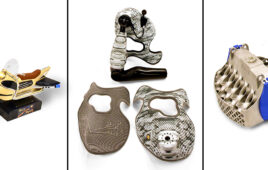
Burhop and his group spent some time looking into lattice software with the TRADES grant. “A lot of the lattice software that you look at right now tends to be with lattice shapes that are very regular. They’ve got these unit cells and it’s just a copy of the unit cells all the way around.
“Whereas what we will do, (we don’t call them unit cells) but if you think of unit cells, we could have them warping and changing and wrapping around things and doing all kinds of amazing things, where the geometry is not the same from place to place. So, there’s some powerful things that are out there that can be done.
“Now it’s still research. But better software is coming. It’s just a question of customer demand, and you know how it goes with CAD companies. I’m on the research side. For me, it can’t come fast enough, but a lot depends on how quickly customers need things like that and how quickly they push it.
“But there’s a lot of need for lattice design features in software, especially in aerospace, and the space industry right now. If you can reduce weight on things, it’s a huge, huge saving. Other things like protective equipment, your helmets in the NFL or if you ride bicycles, or even your shoes, you see a lot of lattices. Conformal lattices made out of new materials, especially polymers, are getting to be really popular. Vibration dampening, I could go on with several other examples.”
In shoes you don’t necessarily have to fill in the space. The bottom of the shoe would be solid and maybe the support above is solid, but the lattice can kind of flow through.
You may have spaces between the inner shell of a rocket and the outer shell where there might be a lot of vibration. You can absorb a lot of the vibration that way using lattices.
Heat sinks and other places where you want to conduct heat, but you also want to take advantage of convection as well can use lattices in the design.
The future
Burhop echoes what many engineers want when it comes to additive technology, more types of materials, more accuracy, and more predictability in the parts.
“There’s a lot of work being done on simulation of different processes and being able to predict what your final shape is going to be. I’m hoping that continues and starts to really improve so that we can take advantage of the flexibility of additive manufacturing.
The group where Burhop works at Siemens Technology is focused on research and support of the company’s other business units, as well as support for DARPA, Department of Energy, America Makes, and others.
“What we try to do is bring the technology from what would be a low readiness level to the point where it can be used in the real world by real manufacturers and real product designers.
Filed Under: Make Parts Fast, PODCASTS