
Composite material, including 3D printer material, has seen a year-over-year market growth between 8 to 12%. In addition, carbon fiber composite applications and carbon fiber reinforced polymers are considered clean energy technologies by the U.S. Department of Energy because they enable “light-weighting,” which reduces energy consumption. It’s estimated that each 10% reduction in vehicle mass drives a 6 to 8% increase in fuel economy.
In response to this growing use of composites across industries, Stratasys (Nasdaq:SSYS) is now shipping an affordably priced additive manufacturing system dedicated for carbon-fiber-filled Nylon 12. The Fortus 380mc Carbon Fiber Edition, previewed at RAPID 2018, is an industrial quality system offered at $70,000 in the US. It began shipping last week.

For both Indy and NASCAR circuits, Team Penske uses Stratasys FDM and carbon-fiber-filled Nylon 12 for strong, lightweight parts.
Copyright: Scott R LePage
Stratasys offers a carbon fiber filled composite for additive, but the material was for high-end production 3D printers in the $200K-$350 range.
“Our customers are pushing us for easier access to carbon fiber,” says Stratasys Senior Vice President of Sales, Pat Carey. “They’ve told us they want an affordable solution but in a reliable, industrial-quality system. So we’re now offering a more accessible system that’s based on our Fortus 380mc platform. Because the 380mc CFE is dedicated to carbon-fiber-filled Nylon 12 and one other material, we’re able to offer it at the lowest price for any of our industrial printers.”
“For many years, the additive manufacturing industry has seen a need for a diversity of machines that produce parts in high-strength composite materials, says Terry Wohlers of Wohlers Associates, an additive manufacturing industry consultancy. “I’m hopeful the newest machine from Stratasys will help to meet this need by offering strong parts in carbon fiber and Nylon 12.”
For both its IndyCar and NASCAR racecars, Team Penske uses Fused Deposition Modeling (FDM) to produce prototypes and end-use parts from carbon-fiber-filled Nylon 12 composite material. The team recently used the composite to produce a mirror housing for its NASCAR race teams. After designing the mirror housing, engineers customized the design for each of their Cup Series drivers before building the final parts from the composite with FDM. The carbon-fiber based material enabled Team Penske to produce lightweight mirror housings with high impact resistance and high stiffness. The composite’s stiffness is especially beneficial when making thin-walled parts, so the parts won’t flex under the aerodynamic loads produced on track.


For both its IndyCar and NASCAR racecars, Team Penske uses Fused Deposition Modeling (FDM) to produce prototypes and end-use parts from carbon-fiber-filled Nylon 12 composite material. The team recently used the composite to produce a mirror housing for its NASCAR race teams.
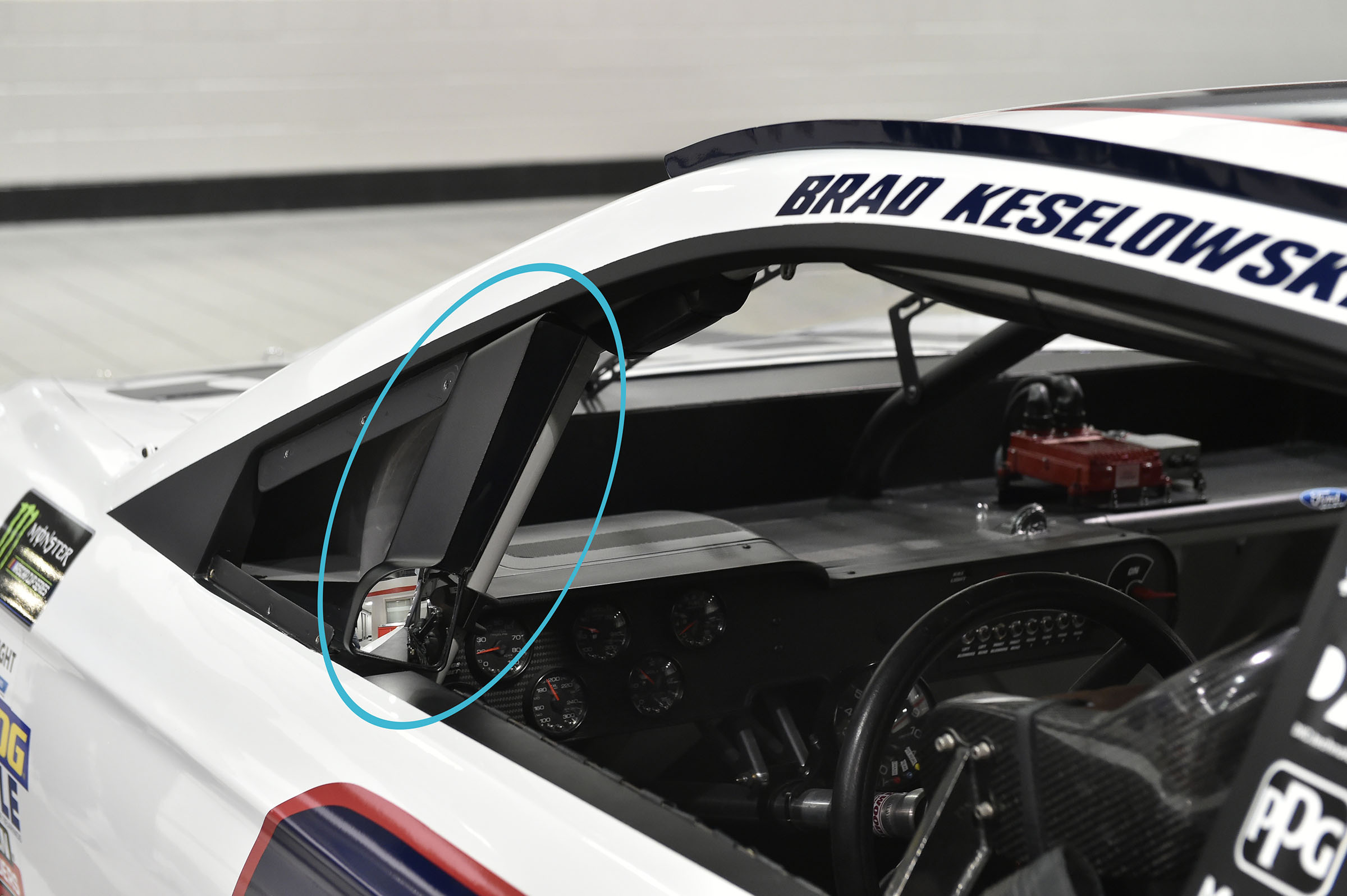
After designing the mirror housing, engineers customized the design for each of their Cup Series drivers before building the final parts from the composite with FDM. The carbon-fiber based material enabled Team Penske to produce lightweight mirror housings with high impact resistance and high stiffness.
Copyright: Scott R LePage
Additive applications for carbon-fiber filled Nylon12 may include:
- Functional prototyping of composite or metal parts
- Short production runs in a high-strength material
- Producing lightweight assembly tools for better ergonomics and reduced worker fatigue
- Replacing metal parts with high strength, light weight composite ones
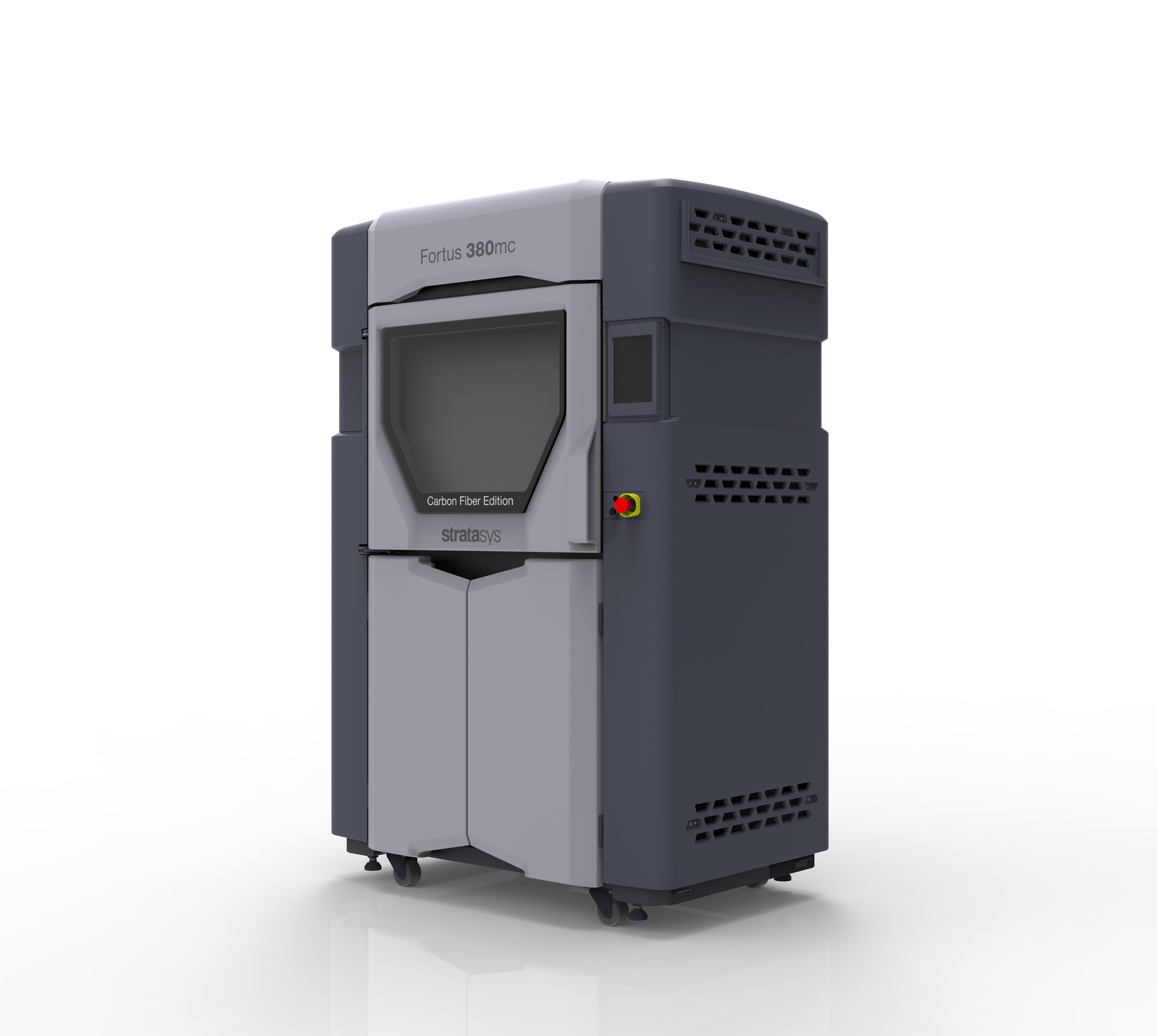
Using carbon-fiber-filled Nylon 12, The Fortus 380CFE will exhibit the highest stiffness-to-weight ratio of any FDM or FFF part.
Stratasys expects the quickest adopters of its Fortus 380 CFE 3D Printer to be those making tooling and fixtures and those in industries that include Automotive; Recreational Sporting Equipment; Marine; Orthosis and Prosthesis; Defense; Aerospace; Medical Equipment; Oil and Gas.
Similar to a typical injection molded carbon fiber reinforced plastic part, Stratasys Nylon 12CF is 35% chopped carbon fiber by weight, and it exhibits the highest stiffness-to-weight ratio of any FDM or FFF 3D printed part.
The Fortus 380mc CFE is based on a proven platform that produces parts with repeatable dimensional accuracy. Parts don’t exhibit appreciable warpage or shrinkage and will hold to a tight tolerance. Stratasys Nylon 12CF is up to four times stronger than a competitively priced alternative in the X and Y-axis, and it will maintain its mechanical properties at a 40% higher temperature. The Fortus 380mc CFE is between two and five times faster than the competitively priced carbon-fiber-based 3D printer.
The Fortus 380 CFE builds parts in 0.010 in. (0.254 mm) layer thickness. The system is also compatible with ASA thermoplastic, for which it can build in either 0.010 or 0.005 in. (0.127 mm) layer thicknesses. The 3D printer’s build chamber measures 14 x 12 x 12 in. (355 x 305 x 305 mm). It offers water-soluble support material removal, which eliminates the need for manual labor to remove the supports. This in turn allows the creation of fine and intricate geometries, which wouldn’t be possible without the soluble support material, because the fine features could be destroyed during cleaning, or intricate geometries might be too laborious or impossible to remove the support material.
The Fortus 380mc Carbon Fiber Edition 3D Printer and a Team Penske NASCAR race car will be on display at the Stratasys IMTS booth # 431600 September 10 — 15 at Chicago’s McCormick Place.
Stratasys
www.stratasys.com
Filed Under: 3D printing • additive • stereolithography


Tell Us What You Think!