
Demand for simple-to-install and pre-integrated linear-slide systems continues unabated … especially in applications only recently automated. Here’s the perspective of Matt Mowry, North American market manager for drylin products at igus:
“We’ve supplied fully assembled and customized linear-slide tables … complete with motors and accessories. We’ve also supplied custom-extruded linear profiles and bearing liners to simplify assembly and optimize designs for OEM customers. We’re seeing a rising trend of applying lower-cost components and assemblies in new automation and robotics markets — and smaller companies broadening these markets. End users also want lightweight motion systems that don’t require maintenance and are quieter that traditional offerings.
On the topic of linear slides, OEMs today need less expensive ways to integrate slides into their designs for automation and robotics. With our linear plain bearings, low cost and weight (and no need for maintenance) are major selling points. In fact, we’ve noticed a huge uptick in the acceptance of engineered plastics and their use as a base material (versus rolling-element bearings) over the past 5 to 10 years.”
Material science is evolving the design of linear slides and guides in other areas. Advancements in raw materials used in linear guides (including steels, aluminum alloys, elastomers, polymers, and ceramics) continue.
In some cases, that’s prompted new offerings with work surfaces that aren’t ground. Instead, zone hardening on work surfaces means manufacturers use inductive processes instead of having to bake whole parts in ovens. Proprietary aluminum extrusions help keep linear-actuator races flatter straighter than standard extrusions. That translates into far easier installation than in the past — enabling new linear guide and slide applications.
Bishop-Wisecarver UtiliTrak linear-motion systems don’t require precise parallelism for accurate operation … and are forgiving of mounting errors and mounting surfaces that are slightly out of parallel. A DualVee guide-wheel assembly (and vee channel) serves as the captive motion side; a MadeWell crowned-roller assembly (and open channel) is on the other.

Shown here is a system with closeups of Bishop-Wisecarver UtiliTrak MadeWell crown-rollers side. These rollers have curved running surfaces for smooth linear guidance … riding in precision-ground channels while accommodating up to 7° of misalignment and eliminating binding issues that can otherwise occur with parallel-mounted guide tracks.
Dave Humblet | Senior application engineer • PBC Linear: Designs that employ linear slides and guides are expanding. For example, new blimp-tender extension systems, scissor lifts for aircraft maintenance, and training trailers and campers put PBC Hevi-Rail to use. Again, good load ratings and robust design are essential. The storage industry also makes use of our rugged linear bearings in mobile-storage lift systems — in what are called horizontal cranes — to bring large storage boxes onto flatbed trucks for relocation. Here, very high loads necessitate rugged linear-motion components (with load ratings) as well as a better stud design on the bearings.

Shown here is a truck-bed extension system with rollers that have the ability to roll into and out of the rail channels. The Hevi-Rail linear bearings in this application also come with a high load rating to give the end user top reliability and ruggedness. Image courtesy PBC Linear
Still another application is that of enclosed high-pressure washers. Here, our linear-rail system of components delivers compactness (with a high load rating for the size); reliability even in the challenging wet environment; and the ability to roll in and out of a support — with significant load on the unsupported (cantilevered) linear rail when the latter is in an extended position.
One last rugged linear-bearing application is that on a blueberry-picking machine. Here, linear bearings provide the OEM with a compact solution for the linear movement of the harvester’s height adjustment and rear unload platform. This has been invaluable in decreasing weight and space requirements.
Dominick Doyle • PBC Linear: By combining traditional ball-bearing footprint with cam-roller technology, Lee Linear has helped solve some challenging design constraints. The marriage of these two technologies allows for running in higher temperature, longer runs, and dirty or dusty environments.

Traditional profile rail technology is extremely rigid with high precision. As part of this technology there are also very time consuming and expensive installation requirements. Certainly, every customer in industrial automation doesn’t need the precision and associated expense of this.
Other recent applications illustrate the trends towards more OEMs incorporating accessibility and serviceability in their designs — often with linear-motion actuators.
Humblet | PBC Linear: In one instance, linear actuators provide cab movement on a trenching machine to give operators good visibility. More specifically, the design uses our CCR16 linear shafting and FLN16 standard linear bearing in a customer housing. Advantages here include availability; good load ratings; and robust design.
Doyle • PBC Linear: Integral-V technology usually installs in about a half hour and doesn’t make installers control parallel rails’ precision. That’s because the rails are essentially the surfaces on one solid extrusion. The carriage interfaces with the extrusion’s two edges; installation is a matter of drilling and tapping machine plates and fastening these rail sections to the plate. Hardened-steel V raceways embedded into the anodized aluminum rails make for a design capable of speeds to 10 m/sec … standard lengths are to 3,650 mm, and longer continuous length or joinable rails upon request.
Check out the related application story: Linear bearings help some CNC machine builders trim cost
Past years of the Design World Trends survey tracked technology improvements for packaging and medical devices, along with emphasis on flexible machine designs. These are machine builds constructed to execute multiple jobs depending on the programming running. That’s still a trend to some extent … though more sources this year cited interoperability of components — including linear slides and guides.
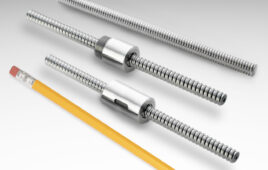
Matt Mowry • igus: The simplest motion designs employ linear-motion actuation. As more things become automated, leadscrews are a key motion-control product … because OEMs are seeking lower-cost options and more choices for diameter and lead. The leadscrew part of igus’ drylin linear-product line is its fastest growing segment, especially its dryspin high-helix geometry. As with other motion components, interoperability of slide systems is a trend here … mostly in the form of mechanical interchangeability to let design engineers simplify linear assemblies.
On a related note, as a German-based company we’ve always provided leadscrews based on DIN and ISO standards.
Of course, OEMs that become familiar with one linear-motion system can employ it in a range of sizes. Some linear-slide suppliers sell rail that can accommodate carriages (runner blocks) of various precision grades. Other linear-slide manufacturers sell systems that let end users replace sections of rail if it sustains damage, for example.
Filed Under: Linear Motion Tips, Trends, Robotics • robotic grippers • end effectors


Tell Us What You Think!