Design World

  • Home
  • Technologies
    • ELECTRONICS • ELECTRICAL
    • Fastening • joining
    • FLUID POWER
    • LINEAR MOTION
    • MOTION CONTROL
    • SENSORS
    • TEST & MEASUREMENT
    • Factory automation
    • Warehouse automation
    • DIGITAL TRANSFORMATION
  • Learn
    • Tech Toolboxes
    • Learning center
    • eBooks • Tech Tips
    • Podcasts
    • Videos
    • Webinars • general engineering
    • Webinars • Automated warehousing
    • Voices
  • LEAP Awards
  • 2025 Leadership
    • 2024 Winners
    • 2023 Winners
    • 2022 Winners
    • 2021 Winners
  • Design Guides
  • Resources
    • 3D Cad Models
      • PARTsolutions
      • TraceParts
    • Digital Issues
      • Design World
      • EE World
    • Educational Assets
    • Engineering diversity
    • Reports
    • Trends
  • Supplier Listings
  • Advertise
  • SUBSCRIBE
    • MAGAZINE
    • NEWSLETTER

Pneumatics in food manufacture

By Lisa Eitel | January 16, 2024

Pneumatic actuation is ubiquitous in food and beverage-processing equipment because it outperforms electric automation for many tasks. Pneumatics have a lower upfront cost and higher resistance to harsh cleaning — both dry and wet. With minimal electrical or electronic subcomponents at pneumatic axes’ end effectors and points of application interactions, these delicate elements aren’t potential points of failure as they are with designs based on electric motors.

Pneumatics: the go-to for food and beverage processing

In fact, another reason pneumatics are more economical for many food and beverage operations is that they avoid the costly housings, seals, and isolating shields that electrical or electronic subcomponents need — especially when subject to washdown. If a pneumatic design prematurely fails in a processing setting due to an exceptionally harsh environment, replacement isn’t expensive.
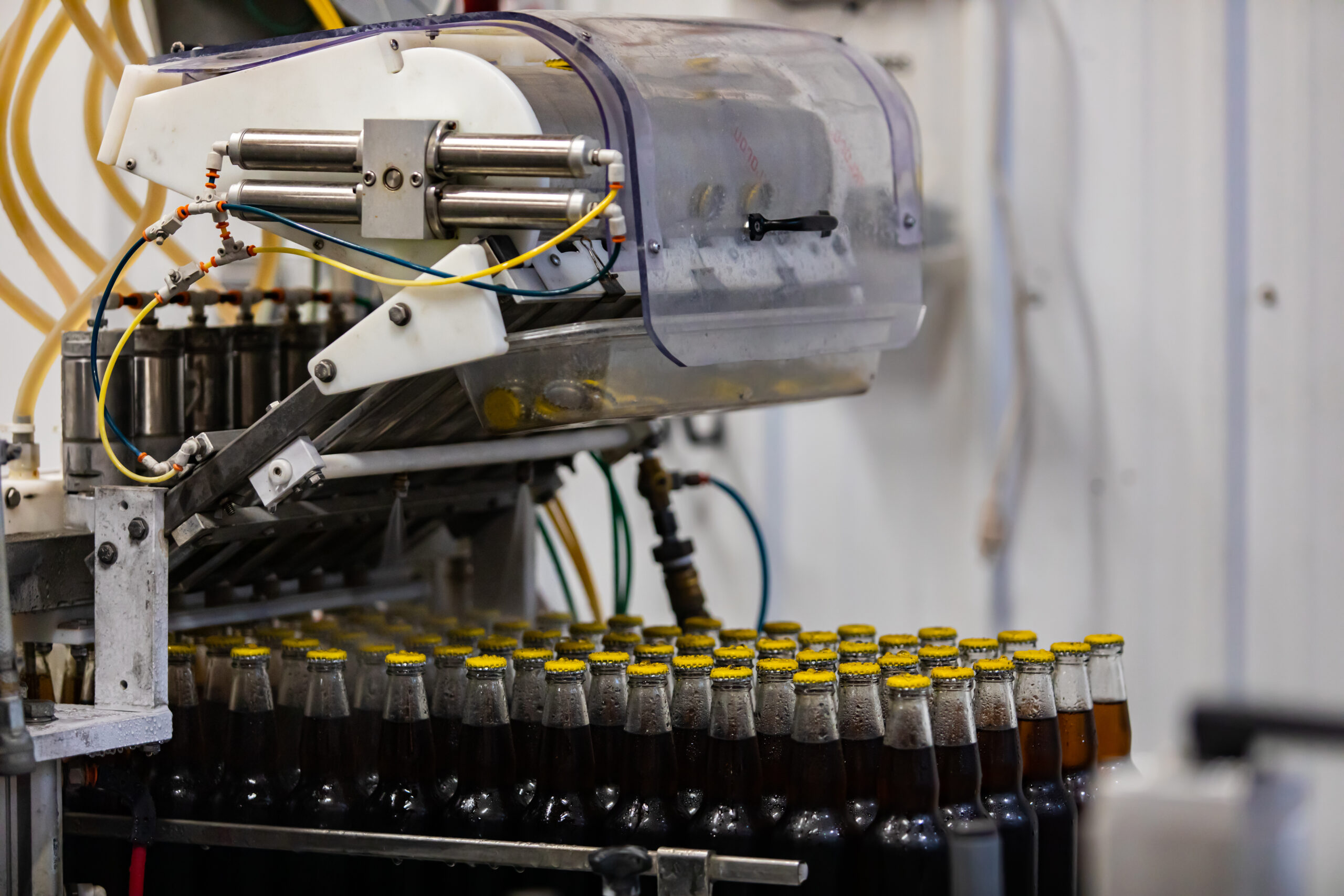
Pneumatic beverage application image: Valmedia Creatives

There are some caveats: Design engineers should eschew all-purpose pneumatic cylinders for those specifically designed for washdown settings. Such washdown-ready pneumatic cylinders have (among other things) large housing radii that don’t hinder high-velocity disinfectant sprays. Typically, these smooth cranny-free surfaces also feature high-gloss finishes that provide no harbor for microbial growth … satisfying Current Good Manufacturing Practices (CGMP) regulations. Here, IP69K machine-mountable valve manifolds can contribute to the smooth easy-clean build of machines subject to frequent cleaning.

Pneumatic air supply and exhaust considerations

Shortening manifold-to-cylinder tubing runs dramatically reduces assembly complexity and cost. Such arrangements also boost design efficiency as well as machine speeds and other dynamics. That’s especially important for helping meet the high-throughput requirements of beverage and food operations needing consistent products with minimal waste. Some manifold supply and exhaust port arrays can also allow for completely independent control of multiple valves — especially useful in food-processing equipment having various pressure zones.

No matter the manifold arrangement, it’s essential that valves never be exhausted into food. That’s because such air has come through a compressor, onwards to a valve and cylinder, and then back out … so likely has collected contaminants. Instead, valves (including check valves) should mount to the undercarriage of equipment or (if mounting from above is best for other reasons) ducting should lead the air down and out.

Designing optimum pneumatic systems for food & beverage packaging

Further addressing this compressed-air issue in 2021, the Global Food Safety Institute-recognized industry-standards organization Safe Quality Food Institute included in its SQF Code 9 edition a section on air quality stating that compressed air used in the manufacturing process must be clean … and present no risk to food safety. The guideline was included because compressed air is often in direct or indirect contact with food products, and contaminants in compressed air can cause changes in color and taste, reduced shelf life, and product recalls. Fortunately, new compressed-air microbial detection devices let personnel take samples faster and easier without the need for extensive training.

Pneumatic beverage dispensing nozzle image © Surasak Petchang

You Might Also Like


Filed Under: Pneumatic equipment + components, Food + beverage


About The Author

Lisa Eitel

Lisa Eitel has worked in the automation industry since 2001. Her areas of focus include motors, drives, motion control, power transmission, linear motion, and sensing and feedback technologies. She has a B.S. in Mechanical Engineering and is an inductee of Tau Beta Pi engineering honor society; a member of the Society of Women Engineers; and a judge for the FIRST Robotics Buckeye Regionals. Besides her motioncontroltips.com contributions, she also leads the production of the quarterly motion issues of Design World.

LEARNING CENTER

Design World Learning Center
“dw
EXPAND YOUR KNOWLEDGE AND STAY CONNECTED
Get the latest info on technologies, tools and strategies for Design Engineering Professionals.
Motor University

Design World Digital Edition

cover

Browse the most current issue of Design World and back issues in an easy to use high quality format. Clip, share and download with the leading design engineering magazine today.

EDABoard the Forum for Electronics

Top global problem solving EE forum covering Microcontrollers, DSP, Networking, Analog and Digital Design, RF, Power Electronics, PCB Routing and much more

EDABoard: Forum for electronics

Sponsored Content

  • Digitalization made easy: Bridging IT/OT with scalable network infrastructure
  • Apple Rubber custom o-rings for harsh underwater conditions
  • ASMPT chooses Renishaw for high-quality motion control
  • Innovating Together: How Italian Machine Builders Drive Industry Forward Through Collaboration
  • Efficiency Is the New Luxury — and Italy Is Delivering
  • Beyond the Build: How Italy’s Machine Makers Are Powering Smart Manufacturing
View More >>
Engineering Exchange

The Engineering Exchange is a global educational networking community for engineers.

Connect, share, and learn today »

Design World
  • About us
  • Contact
  • Manage your Design World Subscription
  • Subscribe
  • Design World Digital Network
  • Control Engineering
  • Consulting-Specifying Engineer
  • Plant Engineering
  • Engineering White Papers
  • Leap Awards

Copyright © 2025 WTWH Media LLC. All Rights Reserved. The material on this site may not be reproduced, distributed, transmitted, cached or otherwise used, except with the prior written permission of WTWH Media
Privacy Policy | Advertising | About Us

Search Design World

  • Home
  • Technologies
    • ELECTRONICS • ELECTRICAL
    • Fastening • joining
    • FLUID POWER
    • LINEAR MOTION
    • MOTION CONTROL
    • SENSORS
    • TEST & MEASUREMENT
    • Factory automation
    • Warehouse automation
    • DIGITAL TRANSFORMATION
  • Learn
    • Tech Toolboxes
    • Learning center
    • eBooks • Tech Tips
    • Podcasts
    • Videos
    • Webinars • general engineering
    • Webinars • Automated warehousing
    • Voices
  • LEAP Awards
  • 2025 Leadership
    • 2024 Winners
    • 2023 Winners
    • 2022 Winners
    • 2021 Winners
  • Design Guides
  • Resources
    • 3D Cad Models
      • PARTsolutions
      • TraceParts
    • Digital Issues
      • Design World
      • EE World
    • Educational Assets
    • Engineering diversity
    • Reports
    • Trends
  • Supplier Listings
  • Advertise
  • SUBSCRIBE
    • MAGAZINE
    • NEWSLETTER
We use cookies to personalize content and ads, to provide social media features, and to analyze our traffic. We share information about your use of our site with our social media, advertising, and analytics partners who may combine it with other information you’ve provided to them or that they’ve collected from your use of their services. You consent to our cookies if you continue to use this website.