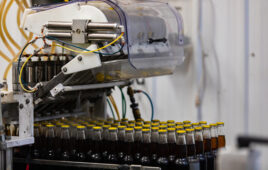
The value of safety — both for protecting people from physical harm as well as end users and OEM machine builders from lawsuits — has spurred increased adoption of integrated safety into slicing, baking, and bottling machines especially. Of course, economic pressures must be weighed against sophisticated safety fixtures.
Save for a temporary rollback of certain regulations during the COVID-19 pandemic, there has been a large-scale shift to globally standardize the safety of more plants. Legislation similar to the Food Safety Modernization Act could force the industry to adopt standards for integrating safety functions into machinery. A more likely scenario in the U.S. at least is one in which OEMs adopt safety technologies due to indirect end-user pressure and efforts to protect themselves from litigation.

Stainless steel emulsifier image: Surasak Petchang
Stainless steel is costlier than aluminum but better resists hot and high-pressure cleaning cycles.
Exhibits at recent years’ Pack Expo events have seen an ever-increasing number of motion-component manufacturers displaying stainless steel washdown products. Multiple industry professionals attribute this move to heightened concern about sanitation issues as well as demand from end users buying new lines specifically to reduce the possibility of cross-product contamination of common allergens. Case in point: Food-grade performance pneumatic systems nearly always feature 316 stainless steel bodies and housings, as this steel is maximally resistant to corrosive materials.
Stainless paired with different assembly types
When it comes to cleaning equipment, speed a key design objective. Food processing companies regularly cite the need for motion subcomponents such as motors, conveyors, and workcell elements that are easy and fast to clean. Easy-to-clean is a major requirement for other equipment manufacturers, as well.
So today, many food-conveyor platforms designed for sanitation can completely disassemble for thorough and efficient. With such conveyor designs, a given module might be made of stainless subsections and let a single plant employee execute the entire disassembly, cleaning, and reassembly process in less than ten minutes sans tools.
Hygienic, stainless gearmotor designs improve fish-processing plant
Bodine debuts new stainless-steel, inverter-duty, hollow-shaft gearmotors
Other machine builds take the exact opposite tack — and are designed with clean in place or CIP processes in mind. CIP is a relatively new approach to the disinfecting procedure. Essentially, CIP equipment can automatically move into a cleaning position so that all areas can receive cleaning without requiring full dismantling of machine subsections. Many of the exposed sections of such CIP machines are stainless.

Stainless-steel grinder image: Surasak Petchang
Additional reading
Managing motion-design EMI for food metal detection
Specialized conveyors and intelligent transport systems are growing technologies
Automation putting faster in the fast-food industry
Integrated motors ensure reliability in high-acceleration food machines
Self-lubricating toothed belt axis for clean use in food manufacturing
Linear slides for IP54 and even IP67 washdown
Patent awarded for new Dualvee Washdown Wheels
Rod-style electric actuator designed to meet hygienic standards
Round-rail linear guide or profile-rail linear guide?
Linear motion designs see wider adoption of linear direct drives
Environmental challenges for linear bearings and how to address them
FDA/USDA/3A-Dairy compliant ETX scraper seals for linear bearings
Don’t overlook these factors when choosing a linear system
For IP56 protection, what electric motor housings work? If a machine design must be rated to IP56 or NEMA 4 or even 4X, designers are limited to a narrow range of motors … but there are still options. There are motors with housings that are autophoretic — in other words, sealed with auto-deposition or so-called A-coat. Other washdown motors have other housing treatments … and non-encapsulated stainless-steel motors also abound. Wherever a machine design needs an IP69K rating to ensure it withstands the harshest and most caustic washdown, stainless-steel encapsulated motors are necessary.
Unfortunately, OEMs sometimes specify gearmotors that are technically legal for such situations but only optimal for dry or non-food scenarios. Such compromised choices can ultimately compromise the operation’s hygiene.
More on other washdown options (especially for motor housings)
Although stainless steel is usually the first material engineers turn to for washdown applications, other options based on advanced polymers are emerging that give similar corrosion resistance and washdown protection. Polymer elements are usually molded instead of machined like stainless steel … helping molding impart benefits of reduced cost and more intricate designs in some parts. All this said, the reliability and corrosion resistance stainless steel provide is in some cases irreplaceable.
Reconsider electric-motor housings. Where exactly are epoxy-coated options insufficient?
Well, washdown motors especially are those constructed to withstand all of the high-pressure equipment cleaning in food processing applications (and in fact, pharmaceutical settings as well). There are generally two types of exteriors on washdown motors … painted and stainless steel. Painted washdown motors use electrically charged epoxy paint that is highly resistant to corrosion and chipping. If an application needs a motor to resist simple rinsing, an array of severe-duty, IEC, and painted as well as paint-free motors may be appropriate.
You may also like:


Filed Under: Food + beverage