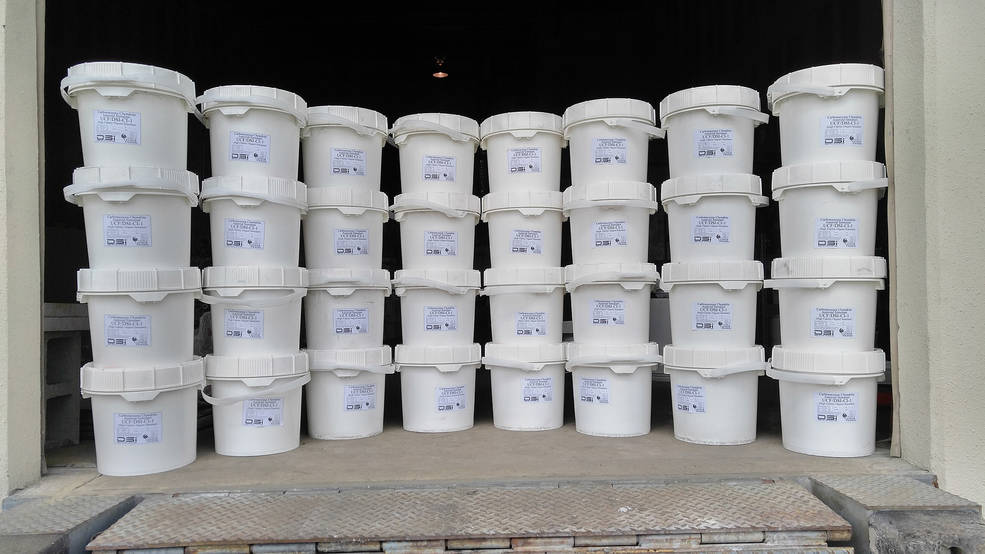
Containers of asteroid simulant are stacked up and ready for delivery to NASA. Image credit: Courtesy of Deep Space Industries
Deep Space Industries recently delivered 3.5 gallons of dirt to NASA. But this wasn’t ordinary dirt; it was developed to simulate the material found on an asteroid or moon.
“The crushed rock found on celestial bodies is called regolith and we can make regolith simulants by using a special recipe of minerals mined on Earth,” said Rob Mueller, a senior technologist with Kennedy Space Center in Florida. “This will help researchers perform experiments and conduct equipment testing for potential mining of useful resources in space. Private industry is helping NASA in this effort.”
Deep Space Industries (DSI) proposed the development of an asteroid simulant in their response to NASA’s Small Business Innovation Research (SBIR) program 2015 solicitation. As part of its plan, the company developed a range of asteroid simulants for government and commercial use, and its recent delivery to Kennedy Space Center marks the first batch ready for use by researchers across the nation.
To make the simulant, Deep Space Industries had to analyze the mineral composition of meteorites — the only material we have on Earth in significant amounts that originated on other planetary bodies (apart from the lunar rocks and regolith brought back during the Apollo program). Once they did this, they found rocks with similar content on Earth and milled them into powders. DSI then mixed the powders in proper proportions to simulate the mineral composition of particular types of asteroids.
Deep Space Industries also worked with faculty and students at the University of Central Florida to test and verify the physical properties of the simulants they created.
“The NASA SBIR program is interested in helping industry grow into new research areas,” said Mike Vinje, who leads SBIR activities at Kennedy Space Center. “We look at this asteroid simulant from Deep Space Industries as a potentially enabling technology.”
The practice of using resources found in a surrounding environment is called in-situ resource utilization, or ISRU. New ISRU technologies may help NASA convert materials found in space into usable supplies like fuel, oxidizer for fuel, water, air, building materials and even spare parts. If more materials gathered onsite can be used, then fewer materials need to be brought from Earth.
DSI will eventually produce several tons of five types of asteroid regolith simulants for NASA, universities and the space mining industry to use for ground testing of technologies. Planetary scientists and engineers at NASA will use the asteroid regolith simulants to design and develop space technologies for future space exploration missions in which local resources can be used instead of transporting resources from Earth. Some of the applications that may benefit from using high-fidelity regolith simulants to test future space technologies include: excavation technologies; sample collection for resource prospecting; granular material handling in microgravity; thermal processing of regolith to extract volatiles like water and carbon dioxide; chemical processing of regolith to extract metals for 3-D printing of parts, oxygen for life support, and other materials; space suit development; and may even help NASA to study potential health effects of asteroid dust particles.
The group of companies capable of producing ISRU technology is small, but the customer base is growing. United Launch Alliance (ULA) recently announced long-term planning that includes the incorporation of ISRU-derived fuels for its Advanced Cryogenic Evolved Stage booster concept.
“If you are able to create an industry that is able to mine propellant from the moon or asteroids or other locations, we’d be willing to buy it,” said ULA Advanced Programs Manager Michael Holguin at the company’s Human Spaceflight Update during the 2016 International Symposium for Personal and Commercial Spaceflight. “It would lower the cost of in-space transportation by an order of magnitude.”
“We have a long way to go in the ISRU field, and a lot of tough challenges that need to be solved along the way,” Vinje said. “However, we are planting seeds in industry – seeds that will help everyone make progress in this field, not just NASA.”
NASA’s SBIR program is managed by NASA’s Ames Research Center in California’s Silicon Valley.
Filed Under: Aerospace + defense