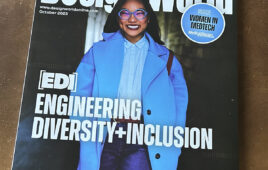
Recent years have seen small increases in STEM diversity with slightly more women, minorities, and persons with disabilities in the field than in the past. That’s according to the National Center for Science and Engineering Statistics (NCSES) of the National Science Foundation.

Women with a bachelor’s or higher degree are overrepresented in social-scientist roles and underrepresented in engineering roles. Image: Dreamstime
Nearly a quarter of the U.S. workforce (34.9M people) is now employed in science, technology, engineering, and mathematics (STEM) fields. However, persons with disabilities, women, and persons from Latino, Black, and American Indian racial and ethnic minority groups remain underrepresented. Increasing the participation of these groups offers three potential advantages:
- Larger labor pools benefit employers looking for top talent.
- Diverse workforces leveraging varied backgrounds, experiences, and points of view can spur unique innovations and product solutions.
- STEM work offers high median earnings that can improve the lives of families that would otherwise remain economically disadvantaged.

Overall, women are paid about $0.80 on the dollar of a man’s wages. That’s according to U.S. Dept. of Labor Women’s Bureau statistics. Female engineers and technical personnel working as engineering managers, mechanical engineers, and electricians enjoyed the narrowest wage disparities. The most work is needed to address gender-related wage gaps for electrical engineering and production management roles. Image: Dreamstime
More specifically, half of the U.S. population ages 18 to 74 years is female but only a third of STEM workers are women. 9% of the population has one or more disabilities — defined as having significant hearing, vision, cognitive, ambulatory, self-care, and independent living difficulties — but are only 3% of those in STEM occupations. (Despite certain perceptions, 18% of STEM workers with disabilities are age 18 to 34; 39% are 35 to 54; and 43% are 55 to 74.) Underrepresented minorities — Hispanics and Latinos, Blacks, American Indians, and Alaska Natives — are 31% of the total population but only 24% of the STEM workforce.

Source: Census Bureau 2021 Social and Economic Supplement of its Population Survey
Most science and engineering (S&E) occupations as defined by the National Science Foundation require a bachelor’s degree — including computer and mathematics scientists’ positions; life, physical, and social scientists’ positions; and engineering positions. (Other S&E-related occupations include technicians, healthcare workers, managers, precollege teachers, and technologists.) Middle-skill occupations typically require STEM expertise (as well as licensing, certification, and on-the-job training) but not a bachelor’s degree for entry … most common in the construction trades as well as installation, maintenance, and production roles.

Demographic statistics on design engineering and automation-related functions are part of a larger data set.

STEM workers with high educational attainment enjoy lower-than-average unemployment; more specifically, STEM workers with a bachelor’s degree saw 2.4% unemployment rates in 2021 (the last year for which finalized statistics are available) while those in the skilled technical workforce faced 4.9% employment rates. Image: Dreamstime
One last group of workers is the skilled technical workforce — those in occupations needing advanced technical knowledge but no bachelor’s degree … including computer-support specialists, licensed nurses, industrial engineers, pharmacy technicians, carpenters, and electricians, for example.

Men and Whites are still the largest share of the STEM workforce, but the last decade has seen increased representation of minorities and women. Image: Dreamstime
Job-function diversity: The skilled technical workforce
The skilled technical workforce — those with advanced industry knowledge but no bachelor’s degree — is about half the overall STEM workforce. 57% of male STEM workers are employed here while 65% of women with STEM jobs have a bachelor’s degree or higher education.
Three-quarters of the STEM skilled technical workforce in the U.S. are men.

Women are a smaller portion of the science and engineering (S&E) workforce than of the overall college-educated workforce. Image: Dreamstime
STEM workers are evenly split between the skilled technical workforce and those with at least a bachelor’s degree. 72% Hispanic and Latino and 67% American Indian or Alaska Native STEM workers are employed in the skilled workforce. In contrast, just 14% of Asian STEM workers are employed in the skilled workforce. 65% of STEM workers with a disability work in the skilled workforce.

Over the last decade, the STEM workforce grew from 29.0M to 34.9M so now STEM workers are 24% of the total U.S. workforce. Fewer women than men work in STEM occupations, but their share of the STEM workforce has increased from 9.4M to 12.3M over the last decade. Men went from 19.7M to 22.6M over the same time.

Latinos, Hispanics, Blacks, and American Indians or Alaska Natives are 24% of all STEM workers filling only 16% of S&E occupations and 20% of S&E-related occupations but 33% of middle-skill occupations. Image: Dreamstime
22.4M White workers are the largest race and ethnic group in the STEM workforce followed by 5.1M Hispanic, 3.6M Asian, 3.0M Black, and 216,000 American Indian or Alaska Native Hispanic workers with Latino STEM workers seeing the highest growth — from 3.1M to 5.1M over the last decade.

Underrepresented minorities defined above now represent a quarter of the STEM workforce — up from 18% a decade ago. Hispanics are 15% of the STEM workforce but are a quarter of those in lower-paying middle-skill occupations. In contrast, Asian STEM workers are 10% of the STEM workforce but 21% of those in higher-paying S&E occupations.

Median wage and salary earnings are higher for those working in STEM than in non-STEM occupations, regardless of sex, race, ethnicity, or disability status. Image: Dreamstime
The bottom line: Earnings in STEM and S&E
STEM workers enjoy higher median wage and salary earnings than others — $65,000 versus $48,000 for men and $60,000 versus $36,000 for women. Asian STEM workers have $92,000 median earnings; White have $66,000; Hispanic and Latino have $45,000; American Indian or Alaska Native workers have $50,000 median earnings in STEM occupations.
STEM workers with a disability have higher median earnings than those in other occupations —$57,000 versus $30,000 — but did not earn as much as counterparts with no disability.
The median earnings for STEM workers with a bachelor’s degree or higher are:
- $100,000 for Asian workers; $107,000 in S&E occupations
- $80,000 for White workers; $90,000 in S&E occupations
- $72,000 for Black workers; $73,000 in S&E occupations
- $70,000 for Hispanic workers; $75,000 in S&E occupations
The median earnings in the skilled technical workforce are:
- $52,000 for White workers
- $45,000 for Black workers
- $44,000 for Asian workers
- $40,000 for Hispanic workers.
STEM workers with disabilities and have median earnings of $89,000 when employed in S&E occupations; $45,000 in middle-skill occupations; and $53,000 in S&E-related occupations — lower than the earnings of those without a disability only for the latter.
Nuanced field understanding sheds light on disparities
STEM occupations include widely disparate jobs in a wide array of fields — including those in the life sciences and social sciences unrelated to the field of design engineering.

The median wage and salary earnings for men with at least a bachelor’s degree was $97,000 in 2020 compared with $74,000 for women in the same education category. In the skilled technical workforce (for which advanced degrees are generally not required) men’s median earnings are $50,000 and women’s median earnings $41,000. Image: Dreamstime
Women are 51% of the college-educated labor force but only 29% of the college-educated workforce in science and engineering occupations. What’s more, women are:
- 61% of behavioral and social scientists
- 46% of agricultural, biological, and other life scientists
- 33% of physical scientists
- 26% of mathematic and computer scientists
- 16% of engineers.
18% of social and behavioral scientists are Black, Hispanic, or American Indian or Alaska Native (and Hispanic workers fill 11% of all social and behavioral scientist roles) but only 12% of physical and related scientists and engineers are from underrepresented groups.
Additional information is available at ncses.nsf.gov and designworldonline.com/diversity.

One third of underrepresented minorities work in the skilled technical workforce but only 16% work in STEM occupations requiring a bachelor’s degree or higher. In contrast, Asian workers made up 17% of those employed in STEM with a bachelor’s degree or higher but only 3% of the skilled technical workforce. 2% and 4% of workers with a disability are employed in the STEM technical workforce or in a role bachelor’s degree respectively. Image: Dreamstime
You may also like:




Filed Under: Engineering Diversity & Inclusion