Automated facilities commanded by industrial control cabinets rely on the components in those cabinets to work reliably even in the face of power variations. These components include local power supplies, PLCs, data loggers, networking and other communication equipment, and IO — which are all vulnerable to the detrimental effects of voltage surge.
Also known as overvoltage, voltage surges can arise from:
• Abrupt plant-floor power events such as large motors turning off or on
• Cyclical overvoltages caused by inductive or capacitive loads turning off or on
• System-induced variations on utility distribution lines exceeding a few percent
• External events such as lightning strikes
Whether cyclical overvoltages, transient spikes lasting a few microseconds to milliseconds, or voltage swells (or sags) all overvoltages can cause substantial damage to (and even total failure of) control-cabinet components … as well as the machines and equipment depending on that control cabinet. The paths for overvoltages into control cabinets are along both incoming and outgoing conductors.

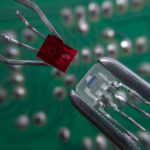
Short circuit on a measuring device after an overvoltage
That’s why industrial surge protectors to protect against overvoltage damage are essential. These surge protectors install in control cabinets and divert harmful surge voltage away from expensive and sensitive equipment … including those connected for digital and analog-signal transmission as well as dc and ac power.
The term surge protective devices or SPDs is an umbrella term referring to the wide array of components that safeguard industrial automation systems against voltage surges. SPDs restrict transient overvoltage and redirect current waves — to reduce the magnitude of the overvoltage until it’s manageable and safe. The two main SPD component subtypes include surge arresters and surge protectors.
Industrial surge arresters install in utility-power substations and more local voltage stepdown locations … as explained, to protect equipment against the effects of switching and lightning-originating overvoltage. In fact, the National Electric Code (NEC) defines a surge arrester as a protective device capable of restricting overvoltage by bypassing or discharging surge current — and eliminating current flow while maintaining the ability of repeating these functions for future overvoltages. Surge arresters connect with the equipment it protects in parallel. That lets surge arrester restrict voltage surge through the equipment … and redirect the electrical current safely to ground.

Voltage surge as defined by IEEE 1100-2005 include both voltage swells and transients. DIN rail mounted overvoltage and undervoltage control image via Shutterstock
Industrial surge protectors also serve to safeguard electrical and electronic components against overvoltage — but do so by restricting the voltage supplied to the components by either shorting or blocking current. That in turn takes voltage down to a safe level. Such industrial surge protectors let design-appropriate electrical current flow from the source to various connected industrial components. Then if voltage from the source spikes or surges (and rises above an accepted threshold) the surge protector redirects the additional electricity into grounding wire. In many surge protectors, it’s a metal-oxide varistor or MOV that redirects the surplus voltage.

Power utilities transmit electricity as ac because transformers can easily step such voltage down and up. The catch is that ac power necessitates the inclusion of power-quality equipment.
Industrial surge-protective devices fall into three basic categories.
• Low-voltage SPDs
• Medium-voltage SPDs
• High-voltage SPDs
High and medium-voltage SPDs generally use restriction to address overvoltage. In contrast, low-voltage SPDs take three different tacks.
Type-one SPDs install in industrial buildings where there’s a need to protect the electrical components’ insulation against external overvoltage. These SPDs can install between the utility transformer’s secondary side and the utility-line side of the primary service equipment. Engineers can also specify that these SPDs install on the load side of the primary service equipment. Such SPDs impart system protection against direct lightning strikes.
Type-two SPDs are SPDs that install on the load side of the primary service-equipment’s overcurrent protective device. These SPDs can also install at the electric-utility service entrance point … but that’s less preferred. Type two SPDs prevent the overvoltage from reaching other electrical equipment in the industrial installation. Type three SPDs complement type-two SPDs and usually install after a main system breaker.
You may also like:



Filed Under: Power supplies, Surge protection